Middle aged dad, awful musician, lifelong cyclist, #ReadingFC. Chief Digital, Data and Technology Officer at @ukhomeoffice/@HODigital. Views are my own.
Right now, 250,000 miles from Earth, an astronaut is filming the Moon’s far side on the same phone in your pocket.
NASA Administrator Jared Isaacman approved latest-model iPhones for Artemis II in February, the first time personal smartphones have been permitted on a deep-space mission. Within hours of reaching orbit, crew videos surfaced showing Christina Koch filming Victor Glover while iPhones tumbled through the cabin in zero gravity. Standard consumer hardware. No radiation hardening. No custom chips. The same device you use to check the weather is operating beyond the Van Allen belts where cosmic rays flip transistor states at random and no cell tower exists within a quarter million miles.
NASA qualified the phones through radiation characterization, EMI testing, and thermal vacuum screening. They run in airplane mode. All communication routes through Orion’s Deep Space Network and laser links. The iPhones are cameras, not communicators. But that distinction contains the entire future of human spaceflight.
Consider the economics of what is happening.
The SLS rocket carrying these phones cost $4.1 billion. That figure comes directly from NASA’s Inspector General, who called it “unsustainable.” The rocket is fully expendable. Every RS-25 engine, every solid booster, every tank is destroyed on a single use. The phone floating inside it costs roughly $1,200 and contains more computing power than every machine used during the Apollo program combined.
A $1,200 consumer device just proved it can function in deep space without modification beyond a qualification test. A $4.1 billion launch vehicle proved it cannot come back.
This is the inflection point nobody is naming.
When Isaacman announced the policy change, he framed it as crew morale. Personal photos. That framing undersells what happened by several orders of magnitude. NASA just demonstrated that consumer-grade silicon, optics, and sensors designed for terrestrial mass markets can survive translunar flight. The qualification barrier between Earth electronics and space electronics collapsed for an entire hardware category in a single policy decision backed by a ten-day live experiment.
The reason this matters is Terafab.
Musk announced on March 21 that 80% of Terafab’s planned chip output targets orbit. The D3 chip being designed for those satellites runs hotter than terrestrial processors to exploit vacuum radiative cooling. The design philosophy starts from the same premise Artemis II just validated: you do not need to redesign consumer electronics from scratch for space. You characterize their behavior under radiation and thermal extremes, design around the failure modes, and accept that cosmic-ray flux is survivable for silicon never intended for it.
The iPhone floating in Orion right now is the proof of concept for every AI satellite Terafab will ever build. Not because the chips are identical. Because the philosophy is identical. Test it, characterize it, fly it. Skip the decade of bespoke radiation-hardened redesign that made space electronics cost a thousand times their terrestrial equivalents.
Apollo gave us Hasselblad photos that defined a generation. Artemis II will give us iPhone videos from the lunar far side shot on hardware you can buy at any Apple Store.
The $1,200 phone that survived deep space just told the $4.1 billion rocket it rode on that the future belongs to consumer-grade hardware launched on reusable vehicles at a fraction of the cost.
The qualification wall just fell. Everything that follows moves faster.
https://t.co/ihRchtyrjc
Microservices is the software industry’s most successful confidence scam. It convinces small teams that they are “thinking big” while systematically destroying their ability to move at all. It flatters ambition by weaponizing insecurity: if you’re not running a constellation of services, are you even a real company? Never mind that this architecture was invented to cope with organizational dysfunction at planetary scale. Now it’s being prescribed to teams that still share a Slack channel and a lunch table.
Small teams run on shared context. That is their superpower. Everyone can reason end-to-end. Everyone can change anything. Microservices vaporize that advantage on contact. They replace shared understanding with distributed ignorance. No one owns the whole anymore. Everyone owns a shard. The system becomes something that merely happens to the team, rather than something the team actively understands. This isn’t sophistication. It’s abdication.
Then comes the operational farce. Each service demands its own pipeline, secrets, alerts, metrics, dashboards, permissions, backups, and rituals of appeasement. You don’t “deploy” anymore—you synchronize a fleet. One bug now requires a multi-service autopsy. A feature release becomes a coordination exercise across artificial borders you invented for no reason. You didn’t simplify your system. You shattered it and called the debris “architecture.”
Microservices also lock incompetence in amber. You are forced to define APIs before you understand your own business. Guesses become contracts. Bad ideas become permanent dependencies. Every early mistake metastasizes through the network. In a monolith, wrong thinking is corrected with a refactor. In microservices, wrong thinking becomes infrastructure. You don’t just regret it—you host it, version it, and monitor it.
The claim that monoliths don’t scale is one of the dumbest lies in modern engineering folklore. What doesn’t scale is chaos. What doesn’t scale is process cosplay. What doesn’t scale is pretending you’re Netflix while shipping a glorified CRUD app. Monoliths scale just fine when teams have discipline, tests, and restraint. But restraint isn’t fashionable, and boring doesn’t make conference talks.
Microservices for small teams is not a technical mistake—it is a philosophical failure. It announces, loudly, that the team does not trust itself to understand its own system. It replaces accountability with protocol and momentum with middleware. You don’t get “future proofing.” You get permanent drag. And by the time you finally earn the scale that might justify this circus, your speed, your clarity, and your product instincts will already be gone.
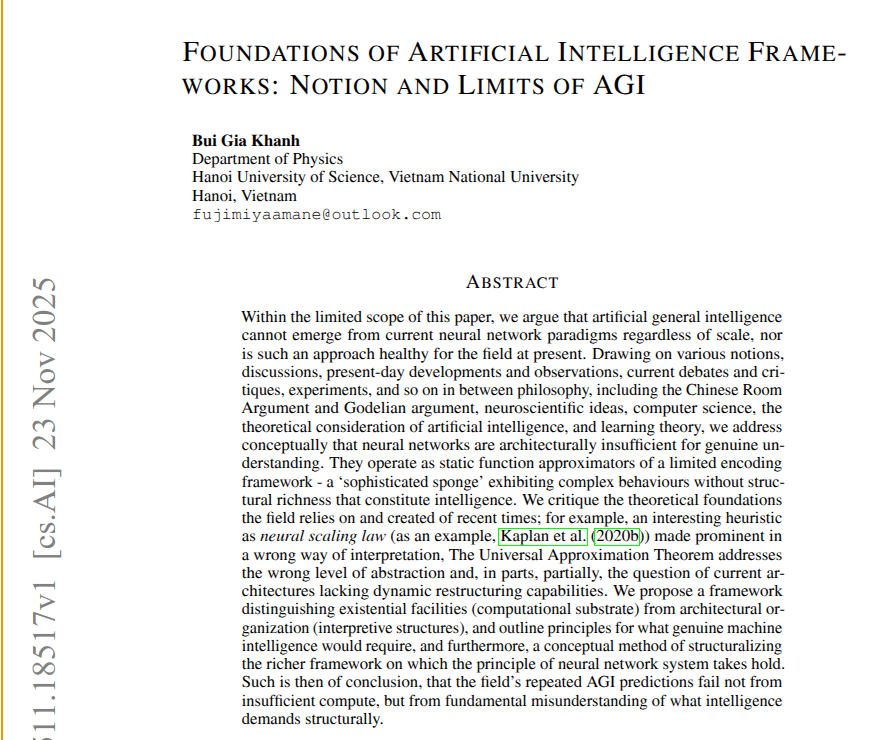
The paper argues that today’s neural networks, even the largest language models, are built in the wrong way to ever become real general intelligence.
It explains from scratch what artificial and intelligence and artificial general intelligence mean, and shows that most current definitions just rate outward behaviour instead of internal structure.
Neural networks are described as static pattern machines, trained once by an outside algorithm to fit input output pairs, then frozen as giant tables of numbers.
Because the learning process lives outside the model, the system cannot decide what to care about, cannot rewrite its own circuitry, and cannot build richer representations over time.
It also argues that popular math stories like scaling laws and universal approximation theorems only say that functions can be fitted, not that deep flexible reasoning will appear.
As an alternative sketch, the author suggests separating raw hardware from higher level organization, designing more structured neuron types and learning rules, so that systems can change both behaviour and wiring from within.
----
Paper – arxiv. org/abs/2511.18517
Paper Title: "Foundations of AI Frameworks: Notion and Limits of AGI"
A 2-billion-year-old rock just revived an old alien theory.
Fresh findings from NASA and Japan’s space agency reveal that asteroid Bennu—a carbon-rich relic from the solar system’s infancy—contains key ingredients of life: 14 of the 20 amino acids used by Earth’s organisms, plus chemical precursors to DNA and RNA.
Confirmed in January 2025 by the OSIRIS-REx mission, these molecules were locked inside pristine rock untouched since before Earth itself existed. They bolster panspermia, the idea that life’s raw materials arrived from space rather than emerging here.
Picture Earth cooling from its fiery birth. Comets and asteroids, loaded with stable organic compounds, slammed into the young planet, delivering the chemical seeds of biology. Panspermia needs no live passengers—just durable molecules that can spark complexity on a hospitable world.
In short: life may not have begun on Earth; it may have been assembled here from cosmic imports.
For years, skeptics questioned whether fragile organics could survive the void, atmospheric incineration, or explosive impact. Yet lab tests and missions like OSIRIS-REx now show many can. If Bennu carries life’s toolkit, the universe may be seeded with it everywhere.
@RCouhig@ToddTrosclair Rob - can you get someone from the club to contact me about Saturday? I've not heard anything since finding out I'd won the raffle. I've emailed and called supporter services but not heard anything. Thanks and looking forward to it all.
@RCouhig@ToddTrosclair Laura has just contacted me to tell me I've won! Looking forward to meeting you and am delighted to be joining you for the first game. What a fabulous suprise!
NEW: China launches its first humanoid robot soccer league in Beijing.
This is way more entertaining than regular soccer.
The AI-controlled robots were supplied by Booster Robotics for the tournament and have the skills of 5 to 6 year old children.
Robots were seen getting carried off the field on stretchers after falling over.
Booster Robotics founder Cheng Hao says the robots' abilities will exponentially increase over time and will eventually challenge adult teams.
"We chose the football scenario for robot competition primarily for two reasons: first, to encourage students to apply their algorithmic skills to real-world robotics," Cheng said.
"Second, to showcase the robots' ability to walk autonomously and stably, withstand collisions, and demonstrate higher levels of intelligence and safety."
Wanted to go see Leftfield with Mrs T at the end of the month but can't go now. Have relisted the tickets if any of you or your acquaintances fancy it: https://t.co/VTajyeJasy
@CazParker1871@james_e1871 It's becoming a common conversation on whether season ticket holders will renew at the end of the season if the money is going to Dai. People just saying let it go into administration and the rebuy under new mgmt.