Our last article on Vulnerability of benthic trait diversity across the Mediterranean Sea following mass mortality events is out in @NatureComms ! 🪸🌱🐚🌡️🌊 A thread 👇🧵
https://t.co/sgSo7NhfYT
Let's put some number on it.
The social cost of carbon from temperature-induced productivity losses is on the order of 73–142$/tCO2 in 2020. This will rise to 92–181$/tCO2 in 2030.
The EU Nature Restoration Law aims to restore at least 20%of the EU’s land and sea areas by 2030, and all degraded ecosystems by 2050. With so much at stake, this is a move in the right direction - although the devil is in the detail in implementation.
https://t.co/BVAeUvNWDi
Advance market commitments and nature equity are mechanisms that are advancing the normalization of the nature assets market. Read the (brief 😎 ) dispatch here.
https://t.co/VWINCnb8UU
For those that didn't had the chance to participate, the incredible artist @adeline_deward did an amazing summary of the different topics discussed ! Thank you Adeline ! 😍
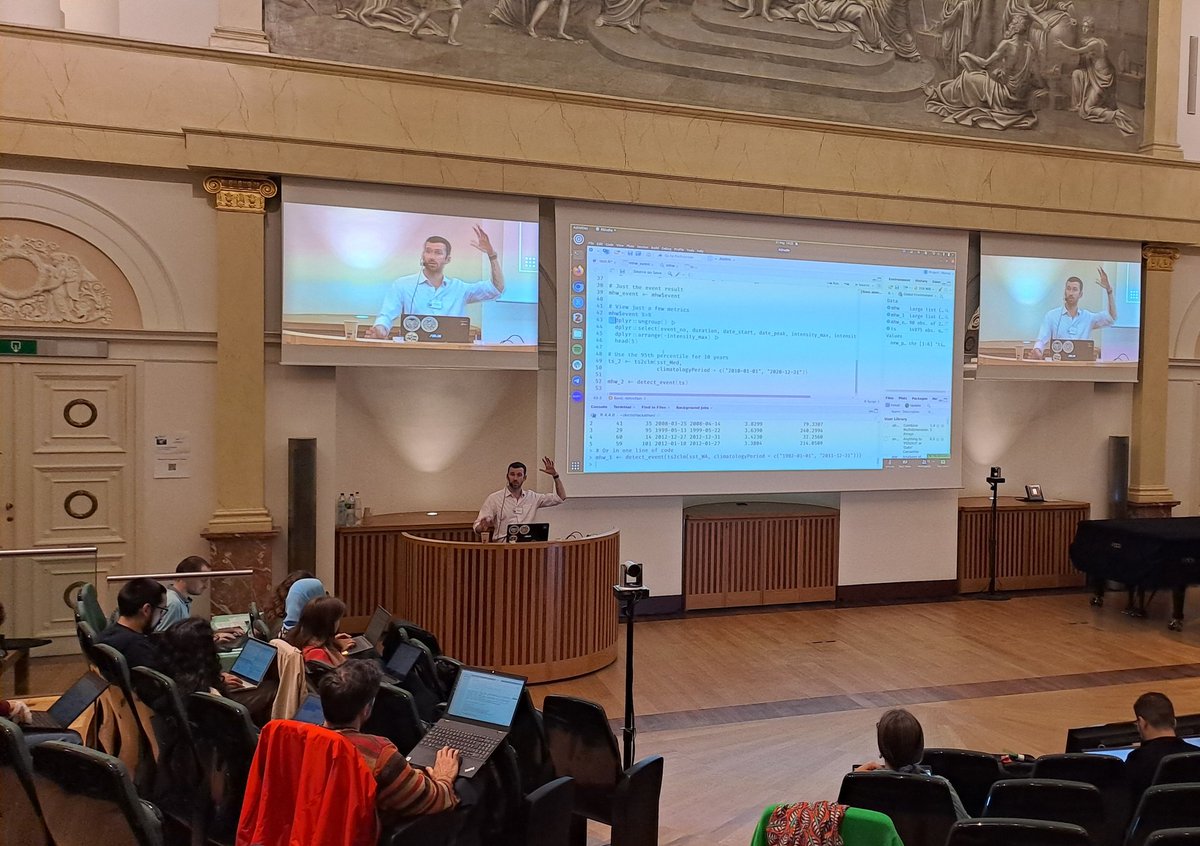
And the last training of the day has started, now we're working on Marine Heatwave detection using #heatwaveR with @robwschlegel . A great way of ending the Liège Colloquium!
We chatted with @robwschlegel on his work studying Arctic's ecology . Robert is a research scientist for the FACE-IT project, which research adaptive co-management of social-ecological fjord systems in the Arctic. Read his answer to our Qs in the thread below:
On Friday 31 May, at #LiegeOcean24, we're organizing hands-on activities for the detection & analysis of ocean extremes: harmful algal blooms, extreme waves, sea ice & marine heatwaves.
All participants to the Colloquium are welcome!
More info: https://t.co/JHw0JpWHQG
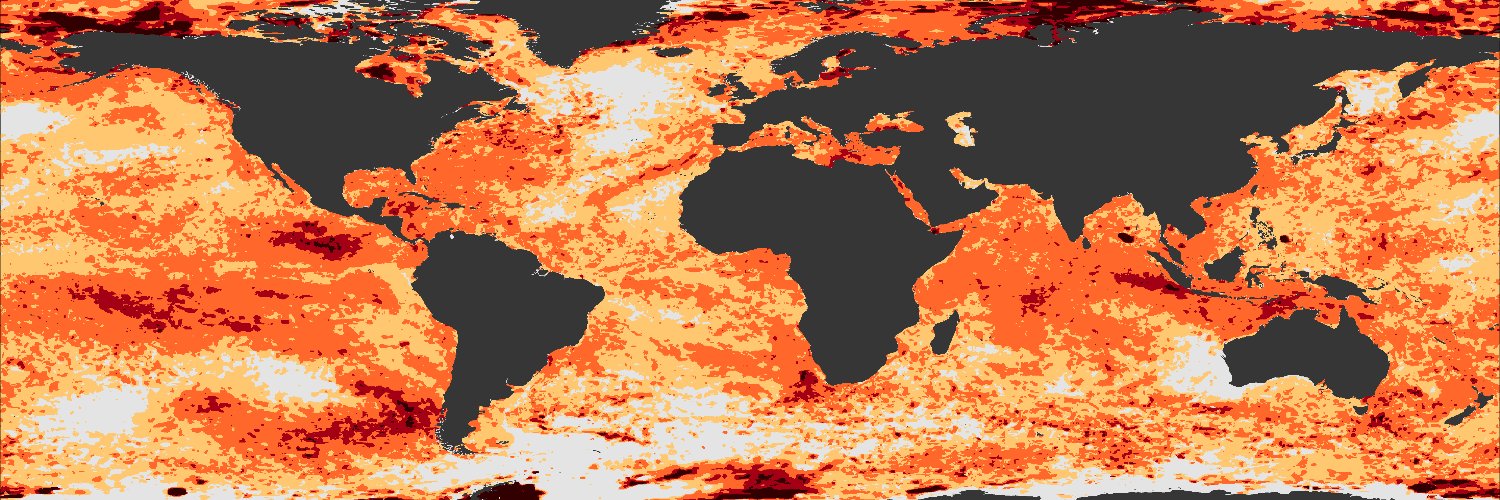
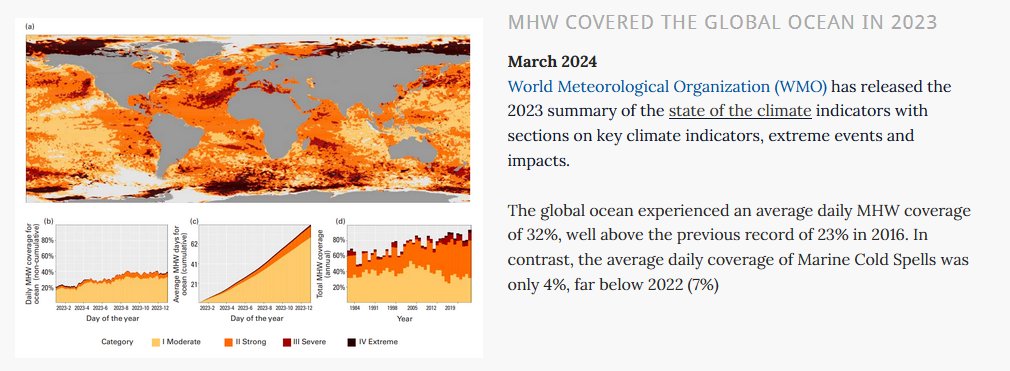
The State of the Global Climate report for 2023 is now out (https://t.co/hN42ZgsN8g) which shows that the global ocean experienced an average daily MHW coverage of 32%, well above the previous record of 23% recorded in 2016.
#marineheatwaves#MHWs
The @ChocTeamLov, @LovLabo, @Sorbonne_Univ_ team of the @FACEITArctic project developed an amazing autonomous flow-through salinity and temperature perturbation mesocosm system for multi-stressor experiments.
See here how it worked:
@EUPolarCluster
https://t.co/6KqA8oG1g2
Check out our new discussion paper “Underwater light environment in Arctic fjords”:
- Discussion paper: https://t.co/7uvuthquTK
- Dataset on Pangaea: https://t.co/oGIe2TzUOM
- R package FjordLight: https://t.co/bLlXj5Vdi4
A team effort from members of @FACEITArctic
@TGuinaldo Thanks :) It was a big team effort from a recent CLIVAR MHW summer school.
2D tracking is high on the TODO list. This is definitely a step forward on the road towards that.
Very happy to announce the release of [heatwave3](https://t.co/KsoAjWvoxO), an extension of the [heatwaveR](https://t.co/HIeHB3X4CT) package that helps us to detect #marineheatwaves directly on NetCDF files.
@Jens_D_Mueller When I return to this project in October I will implement all of the arguments from the heatwaveR package so that we can look for extreme events using many more conditions.
Note however that at the moment all of this only works with daily data, not monthly or annual.
@Jens_D_Mueller Great question :)
The short answer is yes. At the moment the code only implements the base Hobday definition of a five day event above the 90th percentile threshold. So if you have daily data of any numeric measurement it will return those results.
@SonofMars814@flowinguphill@nursekristinrn@Weather_West @EKMeteo @OceansClimateCU@rahmstorf I haven't looked at the data, but in the Med it's possible that the heat from last summer's MHW was stored at depth and has now reemerged. The MHW spreading throughout the Med is already more intense in some places than it was last year, which was the previous record breaker.
@SonofMars814@flowinguphill@nursekristinrn@Weather_West @EKMeteo @OceansClimateCU@rahmstorf A group of us were looking at this yesterday. Removing the long term warming trend removes most the anomalies under ~2°C. There are localised events happening all throughout the North Atlantic, Med, and Japan. El Nino is here for sure, but there must be other forces, too.