@thefuture717@LearningLinkSCO Your commitment to our nation’s values is inspiring, Andrew. Voices like yours keep the American spirit strong. I’d be honored if you’d follow me so we can stay connected ❤️🇺🇸
Our 2T model, which is better than our 1.5T in every way, will finish initial training next week. It might be able to exceed Kimi, but with speed and token efficiency close to our 1.5T (aka Grok 4.5).
I'm a cardiologist. Everyone is sharing this study as a skin story. They're burying the part that matters.
Scientists took the aorta of a 75-year-old donor, applied a single engineered enzyme, and stripped away more than 70% of the molecular damage — bringing it down to the levels you'd see in a 30-year-old artery.
Published five days ago in Nature Communications. Revel Pharmaceuticals, with Calico and the University of Colorado.
Here's what they erased.
Sugar reacts with proteins in your body the same way heat browns bread — slowly, over a lifetime. It leaves behind a residue called CML, the most abundant advanced glycation end product in aging tissue. It welds itself onto collagen and elastin in your skin, your eye lens, and your arterial walls.
Two things follow. Your arteries stiffen. And CML latches onto a receptor called RAGE, which drives chronic inflammation — the exact fire I've been writing about for months as the engine of heart disease.
Since the 1980s this damage was considered permanent. Your body has no enzyme to remove it. Every existing approach only slows new damage from forming. Nothing touched what was already there.
So they built an enzyme that doesn't exist in nature. They screened 45,000 protein structures, then ran five rounds of directed evolution across more than 500 million variants until they had CMLase — a molecular lawnmower that oxidizes the CML off the protein and restores the original, healthy lysine underneath.
Not patched. Reversed.
Over 70% cleared from elderly arterial tissue. Over 55% from elderly skin — below the levels found in 31-year-old skin. 45-78% in lens proteins. The CEO said they expected 20% and were floored.
Arterial stiffness drives systolic hypertension, heart failure, and stroke, and I have no drug that reverses it. I can slow the process. I cannot undo it. This paper says undoing it may be possible.
The caveats are real and I won't skip them. This was done on donated tissue in a dish, not in a living person. No functional data yet — we don't know if that artery got measurably more elastic. Delivering a large enzyme deep into human tissue is a hard, unsolved problem. Clinical trials are years away.
But something considered permanent for forty years just came off human tissue.
We spent a century learning to slow aging. Someone finally figured out how to erase it.
Thank you @theallinpod@friedberg@chamath@pesottas
It is pretentious and poisonous for for-profit companies to call themselves “labs” when they are actually corporations and to create a lords & peasants culture between (looksmaxxing) “researchers” & engineers when they are both, on their better days, actually engineers
my spicy theory is that chinese ai labs keep winning because of culture, not talent or resources.
chinese labs still have a deeply hands-on engineering culture. deepseek and kimi are flat organizations where science and engineering are fused: the same people move between algorithms, data, and infra, doing whatever it takes to make the model work.
but sf tech bros have decided that “researcher” is the high-status title while infra is merely support work. every new sf ai startup calls itself a “lab,” every ambitious engineer quietly upgrades their title to “research engineer,” and the infra work is left to whoever failed to escape it.
but at frontier scale, infra determines experiment velocity, and experiment velocity determines research output. at frontier scale, infra **is** research.
TBC is excited to announce the first residential Music City Loop station agreement, serving those living at the beautiful Prime, Alcove, and Paramount towers in downtown Nashville.
Residents will take an elevator directly to a Loop station within the building, board a Tesla, and be at the airport in ~9 minutes or Lower Broadway in ~2 minutes.
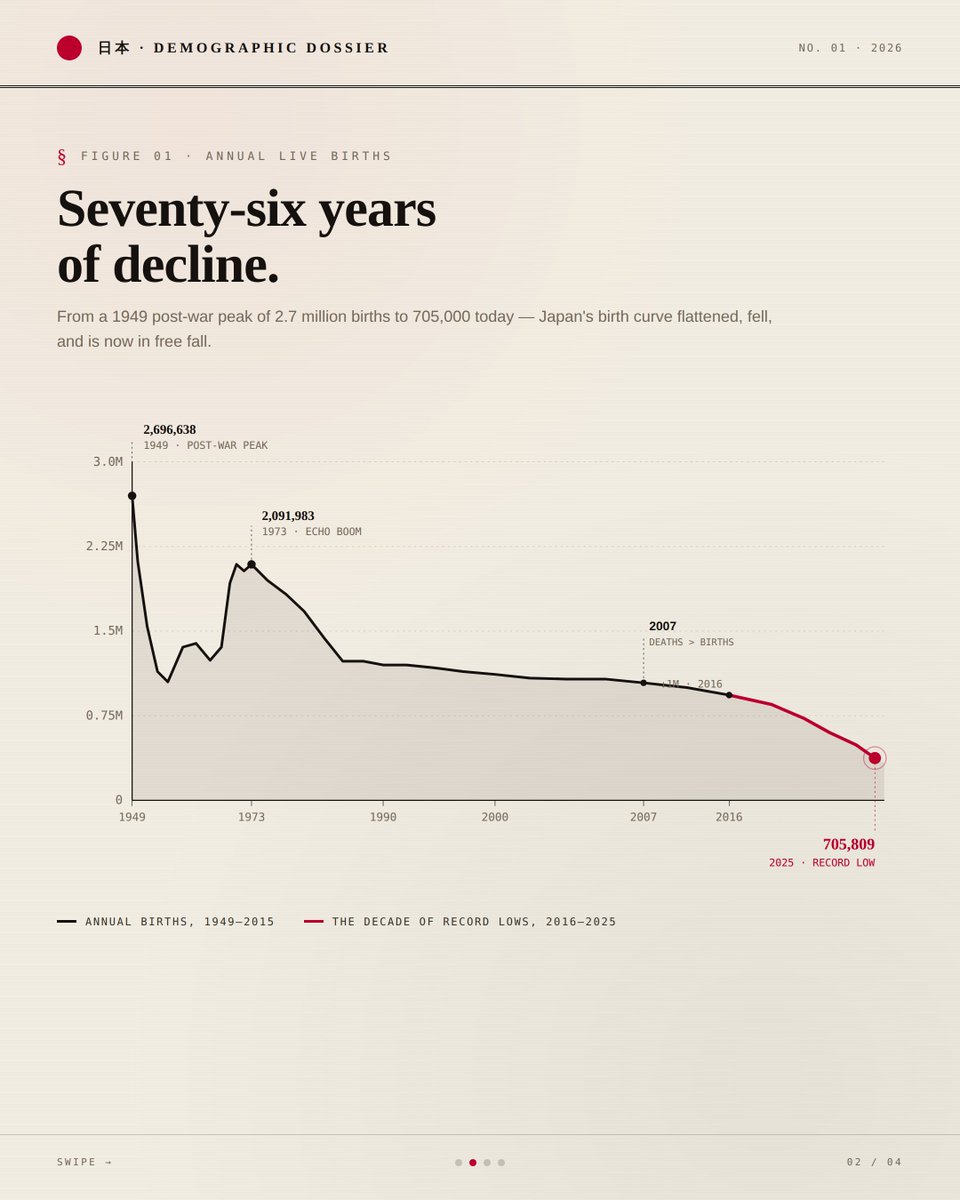
Japan just had the fewest babies born in any year on record. Not since the war. Not since the 1918 flu. Since records began in 1899.
705,809 births, the tenth annual record low in a row, and they're now down 30% in a decade. More than two deaths for every birth. The population shrank by almost 900,000 people in twelve months.
This is what a demographic spiral looks like in real time. Fewer young people now means fewer parents in twenty years, which means fewer births in thirty. Recovery requires reversing a trend that has been running for half a century.
"Of all tyrannies, a tyranny sincerely exercised for the good of its victims may be the most oppressive. It would be better to live under robber barons than under omnipotent moral busybodies. The robber baron's cruelty may sometimes sleep, his cupidity may at some point be satiated; but those who torment us for our own good will torment us without end for they do so with the approval of their own conscience." - C. S. Lewis