Banger!!!
“Specialization and generality are fundamentally at odds. A baby horse is typically walking around within an hour, but it takes human babies around a year to do the same…
…Human intelligence may ultimately come from nature learning the bitter lesson: that while specialized methods can win in the short run, general methods that leverage computation through learning (our big, expensive brains) win in the long run (after our long childhood).”
https://t.co/MqVu87nVAw
@julianlehr @notquantized Your moving target counter argument affects both humans and LLMs at this task. The difference is that LLMs can search / reason over what is newly tasteful much faster than humans. Taste search is getting absorbed by LLMs
@btaylor This is great!!! The vast majority of interactions don’t require UI, but I’ve found some still do. E.g., a team wanting to see the results of their experiments across time. How do you deal with those interactions? Does Ghostwriter make on-demand artifacts whenever they’re needed?
The @BostonCollege Investment Committee (an LP and my beloved alma mater) asked for a few thoughts on what's happening in AI. I recorded a test run yesterday morning and then shared it with my partners, who encouraged me to share it more broadly... so here you go!
This is not a sales pitch, it's just a reflection on what we're seeing. And it wasn't intended to be shared, so please pardon the rough edges.
https://t.co/AuZqHMSSxD
To the extent I have derived any formula for success, it is this – imagine the world is a turn-based game, try to squeeze as many turns into any given period of time that you can, and have the discipline (see below) or infrastructure (e.g., @statsig) to learn as much as you can per turn. In my lived experience, this was the essence of Mark's rise with Facebook.
@watneyrobotics, Ryan and Sean exemplify that (as does @pranavreddy as a side note). We are very excited about them!
You have to teach it young. From Daniel Kahneman in Thinking, Fast and Slow:
"If you are allowed one wish for your child, seriously consider wishing him or her optimism. Optimists are normally cheerful and happy, and therefore popular; they are resilient in adapting to failures and hardships, their chances of clinical depression are reduced, their immune system is stronger, they take better care of their health, they feel healthier than others and are in fact likely to live longer. Optimistic individuals play a disproportionate role in shaping our lives. Their decisions make a difference; they are the inventors, the entrepreneurs, the political and military leaders – not average people. They got to where they are by seeking challenges and taking risks. They are talented, and they have been lucky, almost certainly luckier than they acknowledge...the people who have the greatest influence on the lives of others are likely to be optimistic and overconfident, and to take more risks than they realize."
Humans learn best when at their edge of their capability to learn. Less and they get too bored. More and they get too anxious. Interesting analogy with how RL excels at 50% pass rate. Less makes it too hard and more makes it too easy. @dwarkesh_sp
New blog post. Recently, people have been talking about how it takes way more compute to get a single sample in RL than it does in pretraining.
But this is only half the trouble.
In RL, that expensive sample is also usually giving you way fewer bits.
And this has implications for how well RLVR will scale, plus helps us understand why self-play and curriculum learning are so helpful for RL, why RLed models are bizarrely jagged, and how we can think about what humans do differently.
Link below.
Sharing an interesting recent conversation on AI's impact on the economy.
AI has been compared to various historical precedents: electricity, industrial revolution, etc., I think the strongest analogy is that of AI as a new computing paradigm (Software 2.0) because both are fundamentally about the automation of digital information processing.
If you were to forecast the impact of computing on the job market in ~1980s, the most predictive feature of a task/job you'd look at is to what extent the algorithm of it is fixed, i.e. are you just mechanically transforming information according to rote, easy to specify rules (e.g. typing, bookkeeping, human calculators, etc.)? Back then, this was the class of programs that the computing capability of that era allowed us to write (by hand, manually).
With AI now, we are able to write new programs that we could never hope to write by hand before. We do it by specifying objectives (e.g. classification accuracy, reward functions), and we search the program space via gradient descent to find neural networks that work well against that objective. This is my Software 2.0 blog post from a while ago. In this new programming paradigm then, the new most predictive feature to look at is verifiability. If a task/job is verifiable, then it is optimizable directly or via reinforcement learning, and a neural net can be trained to work extremely well. It's about to what extent an AI can "practice" something. The environment has to be resettable (you can start a new attempt), efficient (a lot attempts can be made), and rewardable (there is some automated process to reward any specific attempt that was made).
The more a task/job is verifiable, the more amenable it is to automation in the new programming paradigm. If it is not verifiable, it has to fall out from neural net magic of generalization fingers crossed, or via weaker means like imitation. This is what's driving the "jagged" frontier of progress in LLMs. Tasks that are verifiable progress rapidly, including possibly beyond the ability of top experts (e.g. math, code, amount of time spent watching videos, anything that looks like puzzles with correct answers), while many others lag by comparison (creative, strategic, tasks that combine real-world knowledge, state, context and common sense).
Software 1.0 easily automates what you can specify.
Software 2.0 easily automates what you can verify.
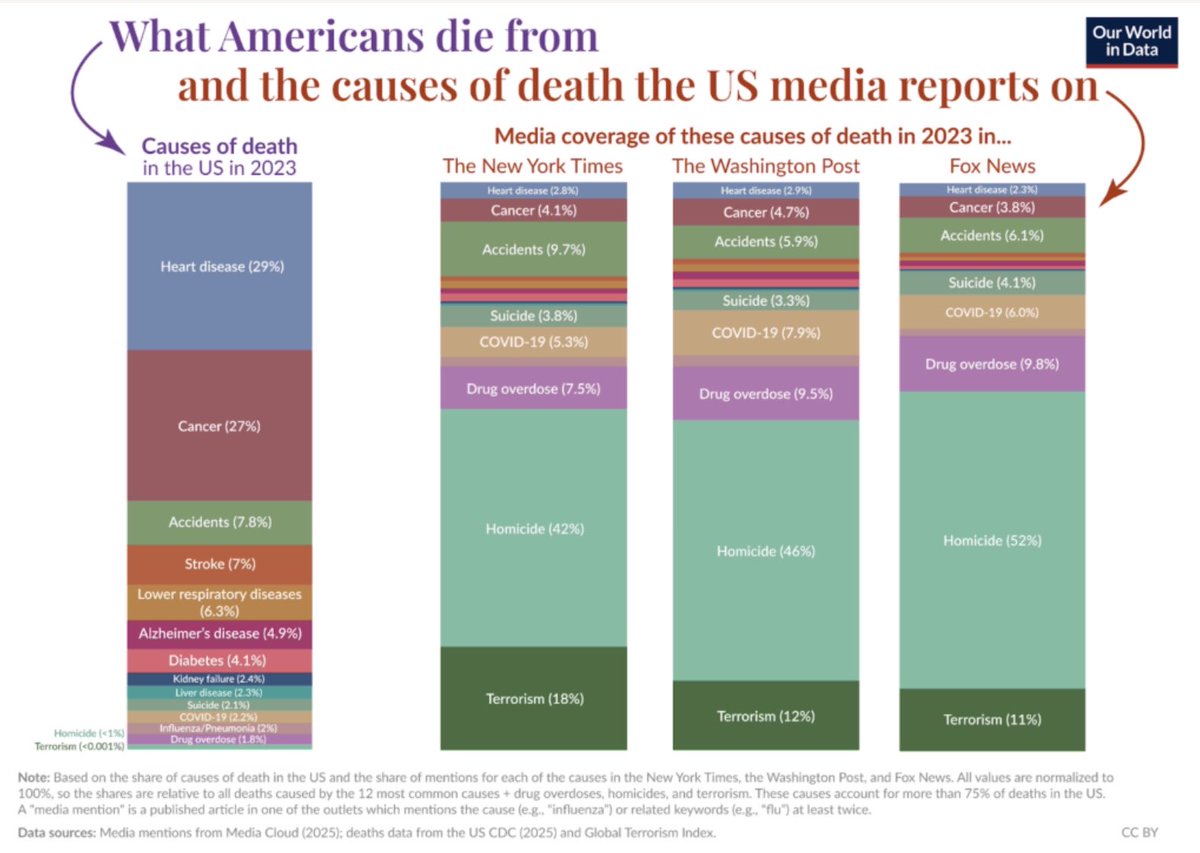
If you want to increase lifespan, correctly identify and prioritize larger causes of death. Fortunately, larger causes have more modifiable factors than lower ones. Move more, eat/sleep better, and do consistent health screening. @PeterAttiaMD
The world needs honest and courageous entrepreneurs and communicators who care for the common good. We sometimes hear the saying: “Business is business!” In reality, it is not so. No one is absorbed by an organization to the point of becoming a mere cog or a simple function. Nor can there be true humanism without a critical sense, without the courage to ask questions: "Where are we going? For whom and for what are we working? How are we making the world a better place?"