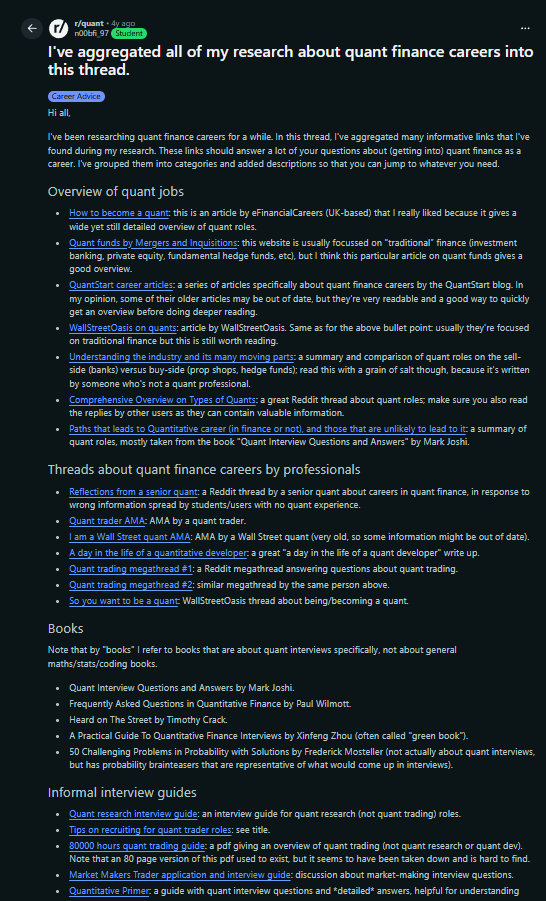
A guy spent months researching how to break into quant finance.
Then he put every single link he found into one thread FOR FREE
This is the industry where new grads clear $500k+
And he just compiled the entire roadmap in one post:
> Overviews that explain what quant roles actually are (QT vs QR vs QD)
> Real interview guides for trading, research, AND dev
The 5 books that matter including the legendary "green book"
> Mental math + probability drills that mirror real assessments
> A hand-curated list of firms and open jobs
The creator of Claude Code teaches more about vibe-coding in 30 minutes than most tutorials do in hours.
Save this — it'll change how you build forever.
Instead of watching an hour of Netflix, watch this 2-hour Stanford lecture that shows exactly how Stanford trains its engineers to build AI systems.
It’s more practical than every Claude tutorial and prompting thread you’ve seen.
El sueño de todo nerd es querer ganar discusiones, negociaciones, dinero, premios y retos con lógica.
Hasta que no abandona ese sueño guajiro y se pone a jugar el juego como debe ser, hasta ese día no tiene oportunidad de pasar al nivel superior.
Por esos muchos nerds se quedan atrapados en la escasez, su nerdez no los limita, sino su ego frágil que les impide ver que saber no es tan importante como la política, diplomacia, emociones y relaciones.
Así es esto. Si eres nerd, haz las paces con esto ya.
—A.
In 2013, Yale professor Ben Polak gave a legendary 1-hour lecture on Game Theory.
It will change how you make decisions in negotiations, business, and life.
His frameworks:
• Dominance arguments
• Backward induction
• The proactive bias
12 lessons to make better decisions:
Jim Rohn on how to get whatever you want (in one word):
"How to get whatever you want. Here's what it says: Ask. That's it. End of notes."
Jim explains:
"If there's one art in life to learn extremely well, it's the art of asking. The formula is staggering; it says 'Ask and you shall receive.' You've got to be better than a good worker. You've got to be a good asker."
He shares three key points on asking:
1. Asking starts a unique process.
"It's mental and emotional. I don't even know how it works; all I know is it works. It's like pushing a button, and all this machinery starts working. Some people are always studying the roots. Others are picking the fruit. Depends on which end you want in on."
2. Receiving is automatic.
"If that's true, receiving is not the problem. What's the problem? Failure to ask. The guy says, 'Oh, now I see it. I got up last year and hit it every day, but there's not a scrap of paper with my goals on it.' Good worker, poor asker."
3. Success is not in short supply.
"It isn't rationed. It's like an ocean. So what's the problem? Some people go to the ocean with a teaspoon. What you want to do in view of the size of the ocean is trade your teaspoon for a bucket."
Jim shares the two ways to ask:
"Ask with intelligence. Be clear, be specific. How wide? How high? How soon? What size? What color? How much? Define what you want and describe what you want. Goals become like a magnet; they pull you in that direction. The better you describe them, the more they pull."
"Ask with faith. Believe you can get what you want like a child. Not an adult. Adults are too skeptical."
He concludes:
"The formula really reads: Make plans like an adult and believe in them like a child. And the most incredible things will happen. Just try it for 90 days. You can always go back to the old ways."
Peter Thiel gave a 40 minute lecture on everything about business competition. This teaches you more than any bachelor’s in business could…
Do yourself a favor and watch this.