Incredibly proud to welcome @BankofAmerica and @Citi as investors in Silicon Data!
Jim DeMare, Co-President of BofA, recognized our role in building AI compute market infrastructure.
Mickey Bhatia, Citi’s Global Head of Spread Products, highlighted the need for independent benchmarks and reliable market data.
Two powerful endorsements of our vision: making AI compute a financeable, investable asset class.
https://t.co/GitpacUdd2
🚨 Read the latest blog from our head of research @stevehou on “crunch spread” and the implications for the economics of neoclouds and AI labs.
https://t.co/2BxtajiLr6
Heading to TomorrowX Summit in Austin, November 17-18. Looking forward to talking compute. If you’re there, let’s connect.
@TomorrowXSummit#tomorrowXsummit
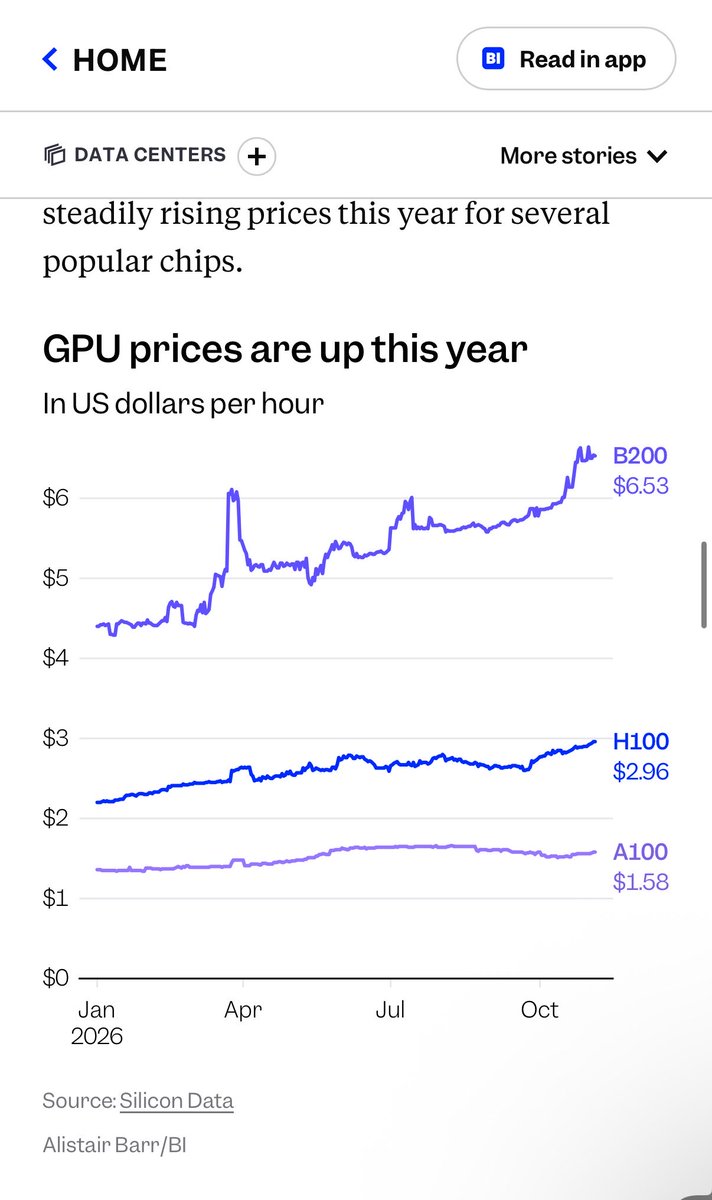
Neocloud stocks got hammered this week. Hyperscalers held up better.
But the price of the actual product — GPU compute — is still rising.
As @BusinessInsider notes (citing @SiliconData), rental prices continue to climb.
The price of compute ≠ the price of the companies selling it.
Thanks to @alistairmbarr for highlighting the data. https://t.co/BDhDtrCxnA
Two milestones for @CantonNetwork in the last 48 hours!
SEC staff issued a no-action letter stating its view that $CC is a digital commodity: https://t.co/ttghtpA706
The first TSV on any chain was launched on Canton with transactions in a tokenized security under the SEC’s Innovation Exemption. https://t.co/eRK0tHDVrq
This demonstrates that on @CantonNetwork it is possible for issuers to permit their stocks to transact on-chain without the risk of their investors being subject to MEV and information leakage.
I first met @cz_binance in person at our @CumberlandSays summit in Singapore in 2018. I had been following his thoughtful commentary as he grew @binance from a startup to the largest crypto exchange. Anytime a risk or hack issue came up, his responses were thoughtful and direct. I have the utmost confidence that Binance will get through this difficult time and go on to great things from here.
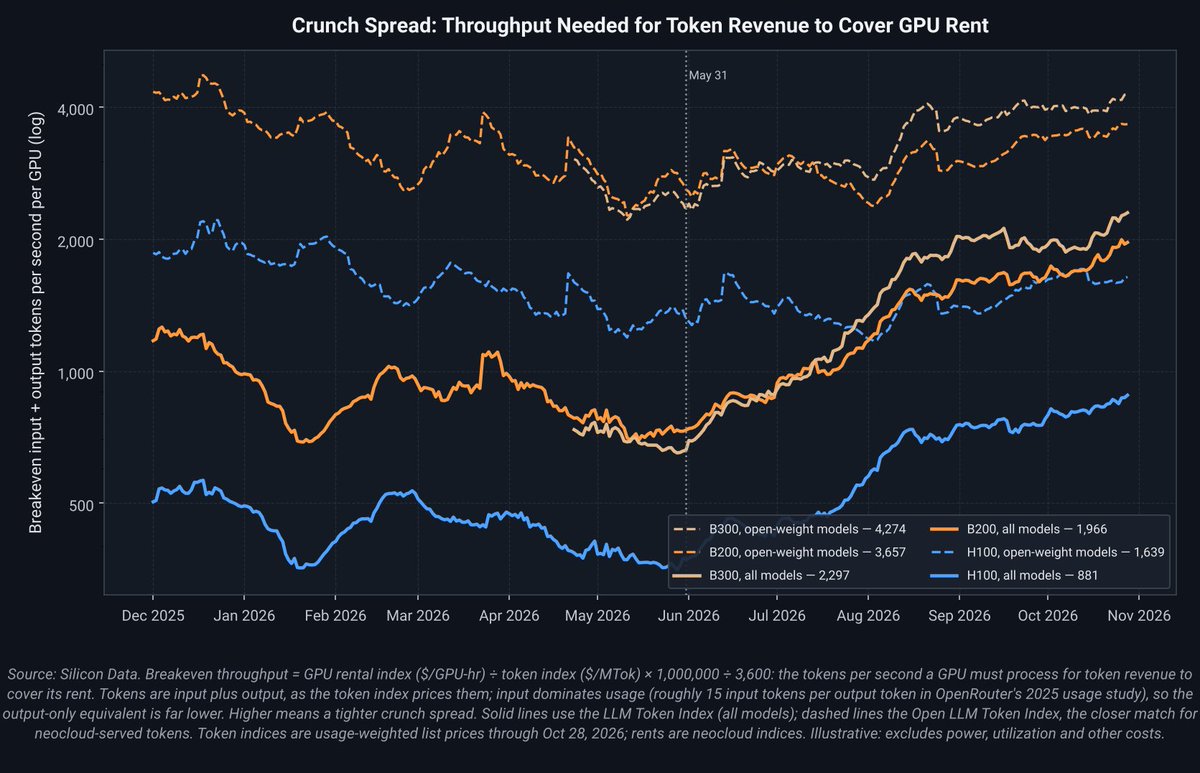
Seen in a different way. We can calculate a version of the “crunch spread” in terms of the minimum token throughput to break even on on-demand compute costs. Once again neither on-demand GPU rental nor our LLM token indices is supposed to represent the average experience.
Since May, the throughput a GPU must deliver to cover its rent from open-weight tokens has risen 25–83%, faster than steady software gains typically add, so margins for inference providers renting GPUs have likely compressed, while GPU owners have captured the gain through higher rents.
Two chart updates in a two part 🧵
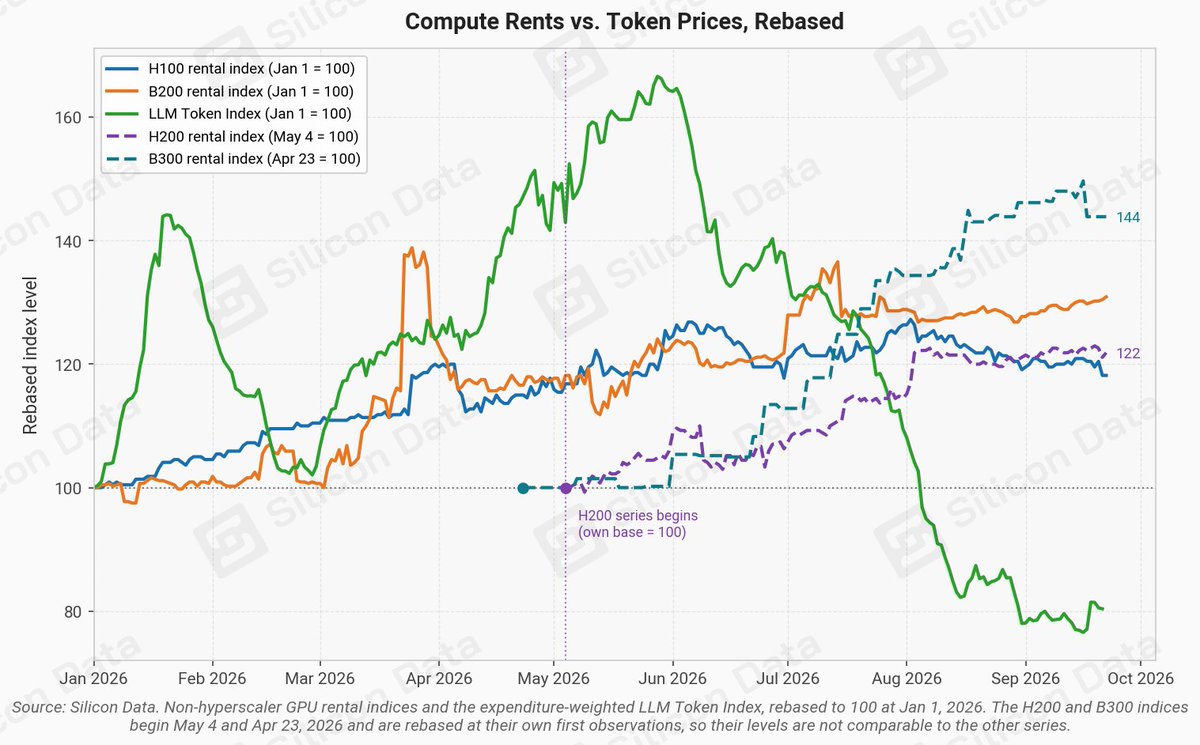
The LLM token index has not put in a bottom as we had previously speculated and has resumed its decline even as on-demand GPU rental indices (a signal of marginal demand and not where most of compute cost sits) continue to surge towards ATHs.
Further to my post about @NYSE working to bring @HyperliquidX onshore, major credit to @ChairmanSelig and the Trump administration for making all of this experimentation possible.
There’s only one way of finding out if something is useful to the marketplace and I’m excited for us to find out. I do have some questions:
1. What is the benefit of trading perps on-chain on a regulated exchange? Isn’t the main benefit of trading on-chain to operate in a trustless (aka non-kyc’d) environment in order to minimize friction, and/or to be able to enter into atomic transactions in order to receive what you are buying in realtime? Since a perp is not an asset, that obviously isn’t helpful.
2. @standuquesne - are you aware that if you trade on Hyperliquid, the world will be able to track your positions and trades in real time? Do you see that as a benefit?
3. Hyperliquid has priority fees - a mechanism that enables market participants to pay to see information first, or even prioritize orders in front of the queue. Is this consistent with CFTC core principles?
4. Will it be possible to combine the liquidity of the offshore order-book with the onshore order-book?
5. If not, wouldn’t it be better to list perps in a traditional (centralized) order-book on a regulated exchange and not have the inefficiencies that on-chain matching introduces?
Today @CantonStrategic announced its partnership with TSV and @fairmint to bring its shares to @CantonNetwork. These shares will carry the same rights as its Nasdaq stock, adding the benefits of 24/7 trading and atomic settlement. It’s been a big week for demonstrating the efficiencies possible on Canton! https://t.co/v6U171CN93
This is a special moment. Today marks the day we can move capital markets to a newer model, one where both US Equities and USTs can settle in real time 24/7. This will bring new types of financial functions that couldn’t exist until today.
Congrats for everyone who took place.
Big congrats to @The_DTCC on the launch of its tokenization service. Firms can now tokenize eligible DTC-held securities without giving up the ownership rights and protections that come with them. This is a super exciting step toward connecting the trade, the financing and the collateral, which unlocks significant capital efficiencies. Very proud to see @CantonNetwork alongside DTCC’s own blockchain as the two networks integrated at launch.
Delaying compute futures has a real cost for US innovation. Some of the largest data center lenders have hit their risk limits. Give them a liquid market to hedge compute price risk and they can free up lending capacity. It's the lack of a hedging instrument that has caused credit spreads to blow out.
We support the @CFTC’s commitment to getting this right. The good news is we already have standards for building these markets properly: independent benchmarks, transparent methodologies and regulatory access to the underlying data. Apply them to compute and let well-designed futures move forward.
Our comment letter: https://t.co/v9gwqX7RIy
Really enjoyed being back on Odd Lots with @TheStalwart and @tracyalloway. Would indeed have been fun to debate perps with Terry Duffy. We clearly have different views…
Following my prediction on last year's recording that in 10 years compute will be bigger than oil, this year I revealed the name we use at DRW for the profit margin between tokens and GPUs: the crunch spread.
Oil into fuel: crack spread. Soybeans into meal and oil: crush spread. Nat gas into power: spark spread. As with those markets, futures on both the GPU hours and tokens eventually will let you trade—and hedge—the crunch.
Listen to Odd Lots on Spotify: https://t.co/3Ajt0UsAtE
Listen to Odd Lots on YouTube: https://t.co/G3R6UQM6HD
Listen to Odd Lots on Apple Podcasts: https://t.co/Z97ied8rzq
It has become fashionable to quote our token index as support for a bearish view on the AI trade. We have pushed back gently a few times, because nothing here is definitive and people should come to their own conclusions. It now seems worth saying a little more.
In June we clarified what our LLM Token Index measures: what API users in our sample actually paid per million tokens. A usage-weighted price. Not token volume, not total spend. We noted it can be read, loosely, as revealed willingness to pay for frontier intelligence.
We should have emphasized the conditions. The binding one is that the intelligence content of a token stays stable. Over a few weeks that is defensible. Across a couple of release cycles it clearly is not. While a token is simply the wrong unit for intelligence, measuring capability itself without bias is also extremely hard. [Btw we will struggle with this measurement problem all over the place as AI proliferates delivering non-market economic value.]
The upshot is that the message from June landed. Maybe a little too well, because it created a new misread: that a falling index is necessarily bearish for the AI trade, since if token prices fall, model-layer margins must follow.
Two things are being conflated.
The deflation in our sample is real, and it is recent. It dates from the end of May. The index peaked at $2.07 on May 28 and sits at $1.00 as of Sept 21, down 52%. But the same index rose 67% from January into that peak, and few read the rise as bullish for lab margins. It is not bearish now. A usage-weighted price moves with the mix, in both directions.
What the mix actually says: more work, at least within our sample, is being routed to cheap, fast models, and labs keep shipping more mid-tier variants. Most everyday tasks never needed a frontier model. That is partial equilibrium for the users we track, and our methodology note is explicit that this index alone cannot separate substitution from efficient agentic routing.
Compute demand is a different question entirely, answered by different data series. Our H200 non-hyperscaler rental index has rerated through the summer: $2.87 average in June, $3.29 now, with a record $3.32 on Sept 19. B200 is $5.76, up 7% over the same stretch and 31% year to date. B300, our newest and thinnest series, is up 44% since inception in late April. H100 is off 7% from its August high, consistent with workloads migrating up the stack. Rents on the parts that are actually scarce are not signaling a demand stall.
A world of mass agentic use is one where cheap tokens are nearly all of the count. Total token usage should keep growing far faster than the price is falling, with most of that growth coming from cheap, fast, and increasingly open models. The usage-weighted price can keep falling anyway. Our view, not a finding from this index: the highest value-add work still routes through frontier models, and that is where most of the economics will accrue. In any event, the implication for compute is more, not less.
An astronomical number of tokens, most of them from cheap flash models, is what economy-wide AI proliferation should look like. It is not a demand stall.
ICYMI: Last week, @CantonStrategic Holdings hosted our Q1 2026 Canton Network Ecosystem Update webinar, and the #tokenomics discussion with @wesarn_real, @Chris_Zuehlke, and @MarkWendlandCSH is one worth watching.
Eric shared a perspective that gets to the heart of why Canton is different: rewards on the network aren't distributed passively, but earned through meaningful participation, from building apps to running infrastructure to introducing users.
Everyone understands @CantonNetwork = privacy. But the tokenomics policy makes it truly unique.
Full webinar replay available: https://t.co/i4g5eOKmSm
#CantonNetwork #Tokenomics
Super happy for my friend @rodrjav and my former employer @DRWTrading for such a great connection. Looking forward to see what's next:
https://t.co/mMqCzRJZFk