In just our first month......... buyback completed.
Green Compute SN110 has now completed an $8,200 USD buyback (37 TAO).
We believe this could be the biggest Month 1 buyback ever and it’s only the beginning.
Transparency matters, so the buyback wallet is public:
5D2UXtzXhP2YCgreodgrGMs2niVZWv2Xt7cxJwYWioU6hdTH
More to come.
@DanielS93282907 Hope it goes great tonight guys! I’m currently travelling back from my honeymoon so won’t make it this month but see you at the next one 🙂
Currently we have 20+ people rsvp’ed for the $TAO event THIS THURSDAY! 🇬🇧
Numbers are growing for each event, and at these prices it is a privilege to meet people dedicated to the ecosystem!
I think we may need a bigger space for the bull run when it comes 😂😅.
If anyone from @MacrocosmosAI, @bitstarterAI, @babelbit, @AstridIntel, @sundaebar_ai would like to come chat to some investors and miners feel free to come this Thursday. Details are below:
#bittensor #brittensor 🇬🇧
Decentralised connections, real conversations.
Most $TAO holders are earning 4% when they could be earning 10%.
The difference is not luck.
It is knowing which three numbers to check on Taostats before you stake a single token.
Here is the exact framework I use.
First, understand why most yield numbers are fake
Every validator page shows an APY figure.
Almost none of them reflect what nominators actually receive.
The only number that matters is the 1M APY on the yield tab.
That is real money paid to real stakers over the last 30 days, annualised.
Everything else is theoretical.
The four validators worth your attention right now
- tao. bot: 0% fee, 506,000 TAO staked, 43,000 nominators, real yield 10.5% to 11%.
- Taostats: 9% fee, 306,000 TAO staked, 76,000 nominators, highest transparency in the ecosystem.
- Yuma: 9% fee, 252,000 TAO staked, rock solid corporate infrastructure.
- TAO. com: 9% fee, 221,000 TAO staked, strongest alpha subnet bias.
How I split my stake
- 38% tao. bot
- 28% Taostats
- 20% Yuma
- 14% rotating high VTrust validators
Blended real yield: 9.8% to 10.4% monthly, annualised.
Never more than 40% with any single validator.
Check these signals every 7 to 14 days
- VTrust below 0.92 for more than 3 consecutive days: switch immediately.
- Take rate suddenly above 10%: switch immediately.
- 1M APY dropped more than 20% with a downward trend: switch.
- Red weight-copying flag appearing: switch the same day.
- Everything green: hold and compound.
The quick formula to calculate your own real yield:
Go to the Yield tab on any validator page on Taostats.
Focus on the 1M APY column. That is actual money paid to nominators over the last 30 days, annualised. Not a projection. Not a marketing number.
Or run it yourself using the nom per 1k per 24h column:
- Divide that number by 1000.
- Multiply by 365.
- That is your true APY.
tao. bot showing 29 to 30 on that column means you are earning 10.5% to 11% in real terms.
Both methods land at the same number. The Yield tab just does the math for you.
Most people staking $TAO right now are leaving half their yield on the table because they never checked this page.
All the links you need are in the reply below.
Save this. You will want it when you rebalance.
On Friday Nerds hosted $TAO Subnet 118 @heydittoai for an AMA
Subnet 118 does not produce an agent. It produces the model harness.
That was the most important clarification from the AMA with @peytonspencer , CEO and lead dev, and @sebyrubino , growth and product advisory. @heydittoai has been in development for five years. Omar Barazanji is CTO and head of ML.
@heydittoai is an open-source Agentic OS for consumers and enterprise. The user-facing product is a workspace where organizations manage people, agents, projects, issues, chats, files, and tasks in one environment. The orchestrator routes work between humans and agents, manages projects, and provisions agents, projects, and orgs automatically.
Under the hood, the subnet produces optimized GitHub codebases: the harness. That harness improves memory, speed, error recovery, inference behavior, and prompt enhancement. @peytonspencer called it “the car the LLM drives.” The goal is to make open-source models like DeepSeek and Kimi behave more like Claude, at a fraction of the cost, inside an open workspace.
The competition is Claude Cowork, Perplexity Computer, Slack, Google Drive. Open source: complementary to OpenClaw, IronClaw, and Hermes, but a direct replacement for Paperclip. Seby’s pitch is simple: one-click migration into a better, cheaper, safer, more private OS.
Benchmark is LongMemEval. Ditto’s first baseline is 77.8 composite with Gemini 3.1 Pro. 71.2% QA accuracy across 500 questions. 87.6% session recall.
The interesting number is seed-only retrieval. When Ditto surfaces the right memories upfront, accuracy hits 90% at 1.8s median latency. When the model has to wander through multi-hop tool calls, accuracy drops to 61% and latency stretches into minutes. Target is obvious: shift more questions onto the fast seed path. Better retrieval weights, larger seed memory chains, time-aware query expansion. Temporal reasoning sits at 57.1% and multi-session at 56.4%. That is where miners can move the score.
But Ditto does not see LongMemEval as the final destination. The plan is to push the memory system close to saturation on the existing benchmark, then have the subnet generate harder memory benchmarks from there. They are researching MemPalace and integrating parts of that approach into the existing code. LongMemEval is the warm-up, not the destination. Once it saturates, the subnet itself becomes the place where the next generation of memory benchmarks gets built. That is a much bigger surface area for miners than chasing one score.
The strongest point from the AMA is that Bittensor gives Ditto a 24/7 product improvement engine. They have already shipped hundreds of releases on closed-source infrastructure. Now they are opening parts of the harness so miners continuously improve it. Peyton said Bittensor could “quickly saturate LongMemEval.” That is the trigger. Once saturated, the subnet can move from optimizing against existing tests to helping create the next generation of memory benchmarks. The product gets better at remembering what users said, what changed, what matters, and what context to pull before the main agent responds.
Roadmap
Structure Sprint: orgs, projects, issues, agents, chat threads, people, friends.
Agents Sprint: concurrent threads, async queue, scheduled tasks, heartbeat, group chats.
Miner Competition: launch and integrate outputs into Ditto Cloud for continuous memory-core improvement.
Enterprise Readiness: SOC2, HIPAA, sales engineers, forward-deployed engineers.
The business model is starting to show. Consumer growth via ads, demos, X and YouTube content. SMB and enterprise revenue from licensing, managed deployments, and on-prem installs. It matters because it is the privacy and control angle against centralized platforms.
My take: this is one of those subnets where the narrative sounds big but the mechanics are concrete. Live product. Real benchmark. Public baseline. Miners submit code. The first target is memory and speed.
A Bittensor founder gave a lecture that most crypto people will never find.
He did not talk about price. He did not talk about the token.
He spent the entire time explaining why combining AI with incentive design is the most important idea of this decade.
Jacob Steeves taught at the intersection of machine learning and distributed systems.
And he used his lecture to teach the one thing most crypto investors never understand.
How intelligence actually scales.
15 ideas that will change how you think about $TAO forever:
1) Bitcoin never set out to store value. It set out to coordinate strangers at planetary scale using nothing but incentive design. That is the blueprint $TAO borrowed.
2) Deep learning did not win because the algorithms were smarter. It won because adaptive feedback loops replaced human guesswork. $TAO applies that same principle to entire economies of compute.
3) Every AI system you have ever used follows the same four steps: State. Objective. Feedback. Adaptation. $TAO is a network built entirely around that loop.
4) Bitcoin is not just money. It is the largest incentive computer ever built. It runs 24 hours a day, borderless, permissionless, with no CEO and no off switch. $TAO is the next version of that machine.
5) Miners on $TAO do not secure transactions. They produce intelligence: models, inference, predictions, code. The network grades the output and pays the best. The weak get cut automatically.
6) A 70 billion parameter model can now be trained across thousands of anonymous computers worldwide, coordinated by nothing but token incentives. No lab required. No permission required.
7) GPU compute is becoming a digital commodity. $TAO already has a subnet treating it exactly like that — a spot market for raw processing power anyone can access or supply.
8) The quality of an idea means nothing if it cannot transfer into another mind. $TAO solves that problem for machine intelligence. It makes useful AI transferable, tradeable, and open.
9) Closed labs own what they build. $TAO inverts that. Every subnet, every model, every contribution belongs to the network. Ownership flows to the contributors, not the corporation.
10) Subnets are not just features. They are open markets: trading, robotics, vision, weather prediction, sports analytics. Each one is a self-contained economy incentivising useful work in its domain.
11) Dynamic TAO is the mechanism that decides which subnets deserve resources. It is a market-driven quality filter running continuously, replacing human editorial decisions with game theory.
12) The difference between $TAO and every other AI token is this: most AI tokens fund AI companies. $TAO is the AI infrastructure. The rails, not the train.
13) Open-source AI is losing the resource war against closed labs because contributors have no economic reason to compete $TAO fixes the incentive structure. That changes the outcome.
14) Jacob said he was not there to sell crypto. He was there to explain why intelligence and incentive design are the same conversation. Six years later that conversation is worth paying attention to.
15) The question is not whether decentralised AI will exist. It already does. The question is whether you understood it early enough to matter.
Jacob chose to spend his lecture on the idea behind the idea.
Not the token. Not the roadmap. Not the price.
The architecture of how machine intelligence gets built, coordinated, and owned when no single company controls it.
You can wait for the mainstream to explain this to you.
Or you can understand it now, before the price does it for you.
Bookmark this. Watch the lecture tonight.
Follow @2xnmore for more breakdowns of the ideas that move markets before the crowd arrives.
Someone used RESI to negotiate their mortgage down last week.
-> They just typed in an address.
-> Got an instant property appraisal.
-> Walked into the bank with the number.
That's what ~98% accuracy across 1M+ properties actually looks like in practice.
Try it yourself👇
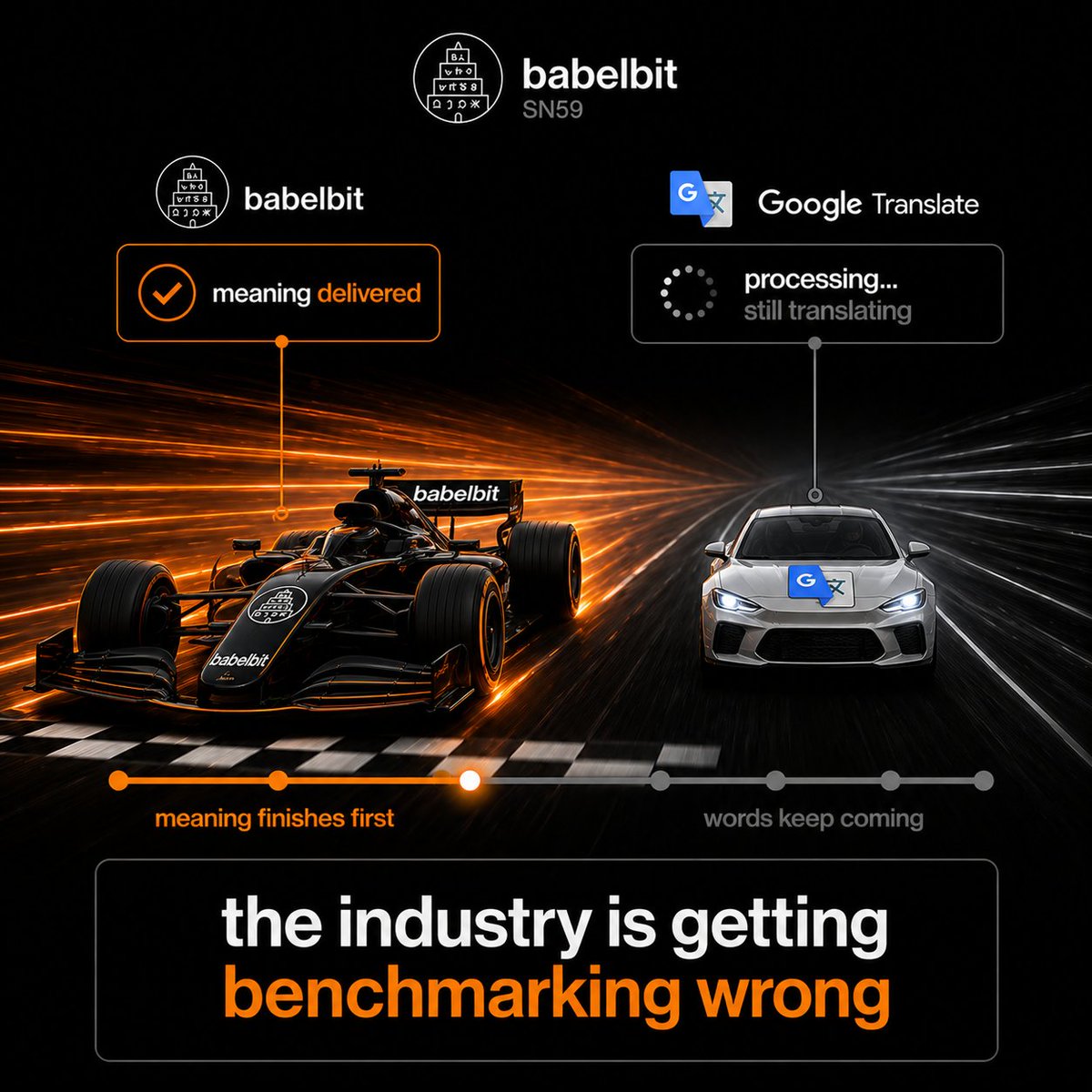
There’s no benchmark for what we’re building.
So we’re creating one.
We are working on precise benchmarking so that we can show the gains we are making over Google Translate and other translation systems.
Most translation systems optimise for literal accuracy.
They measure latency as delay between “equivalent words.”
That misses the point.
We measure something else → time from expression to understanding
Not when the words arrive.
When the meaning lands.
For example:
🥐In French: 'Je pense que vous avez tout à fait raison.'
🌍Google says: 'I think you’re absolutely right.'
🚀Babelbit says: 'Agreed.'
Babelbit wins out because average word delay is a broken benchmark.
Because interpretation ≠ translation.
We’re building a benchmark that reflects how humans actually communicate. Stay tuned 👀
Vidaio x Pip Studios — Joint Venture
We are beyond excited to announce this joint venture! This is bigger than a partnership. It’s a gateway to the global media ecosystem.
Through this joint venture, VidaioOS is now positioned directly within Pip Studios’ network spanning major studios, platforms, and content owners, including Netflix, Amazon, Sony, Universal, Paramount, and more.
This means:
→ Direct access to enterprise workflows
→ Real-world video workloads entering the network
→ Faster adoption at scale
Pip Studios is part of the TPN (Trusted Partner Network), the industry standard for secure content handling. That places VidaioOS inside trusted pipelines used by the world’s biggest players.
This isn’t about selling individual tools, its about embedding an AI-native video infrastructure layer across an existing global client base. Think of this as a gateway to 50+ major partnerships.
We’re not just building the future of video infrastructure; we’re now connected to where it already operates.
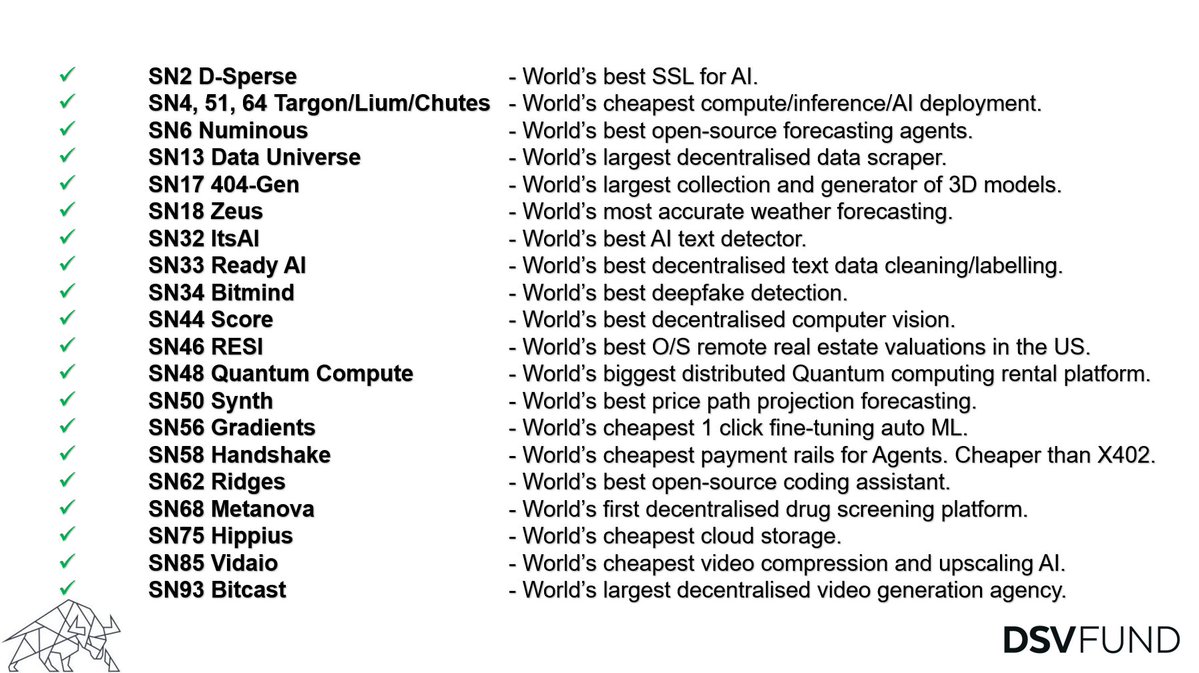
"But Bittensor doesn't really do anything..."
Most companies or crypto projects struggle to be the world's best at 1 thing.
In just over a year, Bittensor has become the world's best at over a dozen things. And I've most likely missed a few subnets here.
Bittensor is the Nasdaq of distributed decentralising AI... For me, it's literally a candy shop of some of the brightest minds out there building cool stuff.
And all it takes is just 1 out of 128 subnets to achieve Product Market Fit and make hefty revenues and it will drag the price of TAO up. Because it will attract buyers into that subnet, but the only way to buy that subnet token is to first buy TAO and then swap it for that subnet token.
Ethereum missed a trick here. ETH was never needed (other than gas fees) or linked to an ERC-20 project that mooned. With Bittensor, when you buy a subnet token, you're not selling TAO, you're temporarily swapping it...
Bitcoin has been declared dead 471 times.
And yet…
Bitcoin is still here.
Today, some are already calling the death of
Bittensor $TAO
It’s always the same cycle:
→ fear
→ noise
→ capitulation
→ forgetfulness
→ rebirth
The weak exit.
The convicted observe.
The builders keep building.
This isn’t the end.
It’s a phase.
Source: https://t.co/1bSmp78iZF
I am not going to sugarcoat this. Last night hurt $TAO & Subnet holders
The founder of Covenant AI decided to cash out of SN3, SN39, and SN81, dumped roughly 37,000 $TAO worth of subnet Alpha on the way out, and cratered prices across the board. $TAO dropped as much as 27%. Nearly $900 million in market cap wiped. $9 million in longs liquidated. Alpha holders on those subnets got absolutely crushed.
I was one of them. I lost a significant amount from this. That is the reality and I am not going to pretend otherwise.
But I am still here. And I am still buying. Let me tell you why.
First, let me be clear about what actually happened. A subnet owner got into a disagreement with Const, got upset, and used it as an excuse to dump his bags on the people who trusted him. That is it. That is the whole story. He dressed it up as a principled stand against centralized governance but the man sold 37,000 $TAO worth of Alpha on his own community while posting a manifesto. That is a rug plain and simple.
Const responded within the hour. Publicly. On chain. With a solution.
Some people are acting like Bittensor died last night. It did not. Let me show you what actually happened in the hours after the dump.
Const proposed lock-based subnet ownership where ownership of a subnet is determined by a team's long-term economic commitment to the project. Not by who registered first. Not by who controls the keys. By who has skin in the game over time. Investors would see in advance if an owner unlocked their tokens. The market could reprice the subnet before the owner dumps. And conviction could be directed to another team or even an agent to manage the system.
If implemented, this would be the most significant governance upgrade since dTAO launched. And it came within hours. Not weeks. Not after a committee meeting. Within hours.
That is what this network does. It finds its weak spots and it fixes them. Fast.
@MacrocosmosAI posted: "Bittensor always emerges stronger from pain. Hacks, exploits, disagreements all fade into the history of this protocol. The flame of distributed training continues to burn brightly. One individual does not make a nation."
@jon_durbin from Chutes: "Chutes is and always will be a Bittensor project. Chutes is Bittensor and Bittensor is Chutes."
@MaxScore from Score: "Score is and always will be a Bittensor project. Score is Bittensor and Bittensor is Score."
Loayei: "Don't care about the drama. Will continue building $TAO."
@TroyQuasar from Quasar called it what it was. He said it was bullshit, that no one is bigger than the network, and that Quasar will take it from here.
The builders did not leave. The builders doubled down within hours. Publicly. On record.
@markjeffrey put it simply: "Bittensor is quite a LOT more than Subnet 3, and $TAO will carry on fine without it. There are 125 other subnets plus three new slots that just freed up."
Three new subnet slots just opened. While people were panic selling, builders were already eyeing the open seats.
@SiamKidd gave the most grounded take. He acknowledged the drama, acknowledged that Sam's governance concerns were not entirely wrong, but made the point that Const's motives have always been genuine. This is growth. This is what permissionless systems look like when they encounter stress. They break in specific places, they get patched, and they come back harder.
This is not the first time something like this has happened on Bittensor. It is not even the second time. Nous Research left the ecosystem before. And what happened? The network adapted, subnets evolved, and the protocol kept building. Every previous inflection point led to upgrades that made the system stronger.
Covenant-72B was real. The training was real.
Fundamentals haven’t changed:
21M hard cap, halving complete, 68% staked, nine institutional products accumulating, Grayscale ETF pending.
$TAO just went on sale at a 27% discount.
Builders keep building.
I’m buying this dip.
$TAO
Rough few hours for many.
Moments like this are a reminder that Bittensor is much bigger than any one event.
We’re here for it all, and in it for the long run ❤️🍨
$TAO
Hey #bittensor community, the next London UK event is booked! 🍸🍻
We are organising a $TAO social on Thu 23rd of April with an exclusive section for $TAO enthusiasts.
Whether you're deep in the subnets or just getting started, come learn, share knowledge and discuss $TAO and its subnets with like-minded people.
Last time the variety of knowledge was refreshing.
Details:
- Thu 23 April, 6:30pm onwards
- The Fellow, Kings Cross (24 York Wy, London N1 9AA)
- 2-min walk from Kings Cross Station → head straight upstairs to our cornered off space
RSVP ON THE LINK HERE IF YOU CAN JOIN 👇 SPOTS LIMITED.
https://t.co/ATJVq6AGl5
Decentralized connections, real conversations. #Brittensor 😄