Beliefs aren't facts. They're tools.
Most of us treat our beliefs about ourselves like weather reports — accurate descriptions of conditions we can't change. "I'm not a morning person." "I have no willpower." "I'm bad at math."
But a belief isn't a finding. It's a frame. And frames can be swapped.
The research on this is clearer than people realize. Carol Dweck's lab at Stanford found that subjects who believed willpower was a limited resource showed signs of ego depletion. Subjects who didn't believe that, didn't. Same task. Same brain. Different belief, different outcome.
That's not motivational poster talk. That's the data.
So the question isn't whether your beliefs are true. The question is whether they're useful. Does this belief expand what's possible for you, or shrink it? Does it move you toward what you actually want, or give you a reason to stay where you are?
If a belief isn't serving you, you're allowed to set it down. Not because you've disproven it — but because you've outgrown it.
Beliefs are tools. Pick the ones that build something.
Un día como hoy de 1988, Alain Prost ganó el #MexicoGP el Autódromo Hermanos Rodríguez sobre Ayrton Senna en una batalla de McLaren que tenía al resto mirando 🏆🇫🇷
Cuatro carreras y los periodistas ya decían que la temporada estaba terminada. Casi tenían razón.
Photographer Phil Thurston shot a wave.
Slowed it down until those few seconds became 40.
Turns out the ocean is doing something extraordinary every single moment.
We're just moving too fast to notice.
Highly recommended!
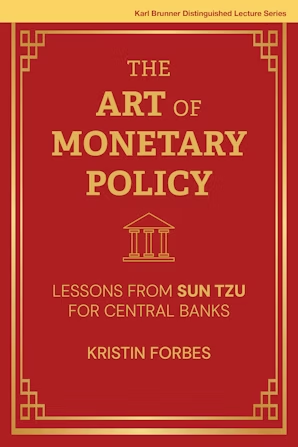
"The Art of Monetary Policy" by Kristin J. Forbes (Karl Brunner Distinguished Lecture Series).
https://t.co/lWLWjaet2v
"When central banks were forced to innovate and develop a multifaceted set of new weapons in response to the 2008 global financial crisis and 2020 COVID-19 pandemic, the result was a substantial expansion in their authority and reach. In The Art of Monetary Policy, Kristin Forbes draws lessons for monetary policy of the last two decades from the principles of Sun Tzu, the author of The Art of War, a Chinese philosopher and military strategist from the fifth century BC. Tzu proposed several key principles for success—tenets that apply to monetary policy and the battlefield today: (1) plan in advance for the next battle; (2) accept and adapt to the inevitability of powerful, external shocks outside your control; (3) establish a strong tactical position; (4) develop a variety of weapons that can be combined for different maneuvers and situations; (5) maintain flexibility so that you can quickly modify your strategy; and (6) consider the longer-term costs when evaluating the trade-offs of different approaches. These principles provide insights into what central banks did (and did not) do well over the last two decades, as well as how they should deploy interest rates, balance sheets, emergency support programs, forward guidance, and macroprudential tools in the future."
https://t.co/lWLWjaet2v
Beyond Differences - His Holiness the Dalai Lama explains why he sees every person simply as another human being—beyond nationality, religion, or status. Reflecting on how divisions create conflict, His Holiness reminds us that our shared humanity is the foundation for peace, compassion, and a happier world. Video originally recorded on November 11, 2014.
For everything we’ve seen about agents so far, it’s clear that they will make it far easier for people to get into previously extremely complicated fields. That will most certainly mean far more people will build software, explore creative work, research spaces they couldn’t do before, and so on.
Yet, equally, we’ve seen that people with experience in every one of those fields have a huge edge with the right judgment and historical context to leverage these tools in ways that exceed the output of the novices (if they choose to). They know when the agents are making catastrophic mistakes, can give the agents the right context to do the job better than they otherwise would have, and so on.
The combination of these two facts essentially means that we will continue to get the same lift as we’ve seen in any other technological revolution. More democratization, but similarly greater output from the experts. This then makes the experts continue to be in higher demand because over time our expectation for what we can get out of any field will just go up.
This is going to be true in essentially every important field. You’ll trust a lawyer using an agent for legal advice over someone who’s never had to experience how well a contract holds up. You’ll trust an engineer developing and running software over someone who’s never seen a production system. You’ll rely on the important instincts of a designer using agents over the average prompter.
The quality and volume of output we expect from these functions will certainly go up meaningfully, but the person with experience will always have a leg up, which is why the jobs don’t go away.
The countdown to our first race in the 2027 FIA World Endurance Championship has truly begun – excited to reveal the MCL-HY FIA Hypercar, our 24 Hours of Le Mans challenger. Cannot wait to see it on track!
Simply known as 'The Pass'...
During the 1996 Monterey Grand Prix at the WeatherTech Raceway Laguna Seca, Alex Zanardi passes Bryan Herta at the The Corkscrew during the final lap of the race.
@Handre "Private companies must satisfy customers to survive, while government monopolies need only satisfy politicians."
This should be framed and hung on the wall in every classroom and government office!
Existing firms, especially those not yet digital-first in any deep sense, will not simply install autonomy as though it were an upgrade to a software package. They will have to live through a prolonged re-distribution of work between humans and digital labor.
Roles will shift, then shift again. Resources will be re-allocated. Budgets will be re-written. Skills will need to be renewed. Some tasks will be automated, some augmented, some re-defined and some removed altogether. Hierarchies that once looked clear will become uncertain. The location of judgment will move.
The meaning of leadership itself will begin to change as leaders are required to operate in environments where intelligence is more distributed, where real-time understanding becomes more important, and where the ability to orchestrate the conditions of success matters at least as much as direct control. @salesforce@diginomica
https://t.co/lWIRPX5gkX