Best way to discuss a code change: create a PR that goes in the direction you need it to go. It doesn't really matter if it's wrong, it just needs to go in the right direction and mention the people involved.
They will be right in context for the discussion and bring ideas.
Bom, enquanto não morre isso aqui, vou mandar o que eu tava planejando pro começo da semana que vem
Estamos abrindo uma vaga de BACKEND PLENO ELIXIR na Cumbuca
Deem um RT aqui para que chegue nas pessoas antes do apocalipse
Requisitos:
- 1 ano de experiência com programação
- Experiência prévia com frameworks web
- Interesse em programação funcional
- Interesse em sistemas financeiros
Diferenciais:
- Experiência prévia com programação funcional
- Experiência prévia com sistemas financeiros
Interessados enviar email com currículo e um parágrafo explicando por que você é um(a) bom(boa) candidato(a) para [email protected] com o assunto "Vaga Backend Pleno"
Here's a super dangerous (never evaluate code from LLMs folks) tool for using LiveView + LLMs to generate LiveViews, incrementally making changes and allowing you to see the generated code. Discarded lightning talk. Have fun! #myelixirstatus https://t.co/hfQX73r86i
We're hiring at https://t.co/3aibERKiDm for a Senior Elixir Engineer. Come work with me and @philipbrown on a Greenfield Phoenix/LiveView project. https://t.co/auvJlqKZ14 #myelixirstatus
If anyone in my network is looking for work as an Elixir engineer, we have an opening at Draft Kings working on our lottery product. DM me if you want to know more. #myelixirstatus
Database caching strategies explained.
Let's look at five of the most common methods:
🔹 Cache-aside strategy
This strategy grants applications explicit control over the caching process.
Applications check the cache before the database, enabling precise control suited to dynamic data or irregular access patterns.
However, this approach requires manual cache management, which can increase complexity.
🔹 Write-through strategy
By simultaneously writing to the cache and the database, this technique guarantees data consistency.
For applications requiring high data reliability, it eliminates inconsistencies and ensures immediate cache availability, despite increased write latency.
🔹 Write-behind strategy
Write performance is improved by caching data first and updating the database asynchronously—a strategy that prioritizes speed over immediate consistency.
This approach boosts responsiveness and reduces database load but risks data loss if the cache expires before syncing.
Applications that can handle delayed data consistency and demand fast write speeds are best suited for it.
🔹 Read-through strategy
When a cache misses, this strategy stores data in the cache by automatically retrieving it from the database.
While this method simplifies application code by abstracting caching procedures, initial cache misses can delay data retrieval.
It supports applications with stable data sets and high read demands by efficiently reducing database load.
🔹 Write-around strategy
This method bypasses the cache, which is only refreshed upon further read requests, and writes data straight to the database.
It keeps space for frequently accessed data by postponing cache updates, preventing premature cache saturation.
Cache efficiency is maximized in write-intensive applications where instantaneous read access to fresh data is not essential.
Database caching greatly improves application performance by reducing latency, increasing scalability, and enhancing user experiences.
By selecting and implementing the optimal database caching solutions, we can meet unique application demands efficiently while maintaining high speed and resource efficiency.
~~
Thank you to our partner Postman who keeps our content free to the community.
Do you have team members who are blocked because they're waiting for you to ship a new API? Unblock them using mock servers.
Learn more here: https://t.co/ejCawV31lP
I wrote up a complete guide to deploying Ollama on https://t.co/tWiUCs38pI if you've ever been curious about self-hosting an LLM!
https://t.co/zULm8SITiW
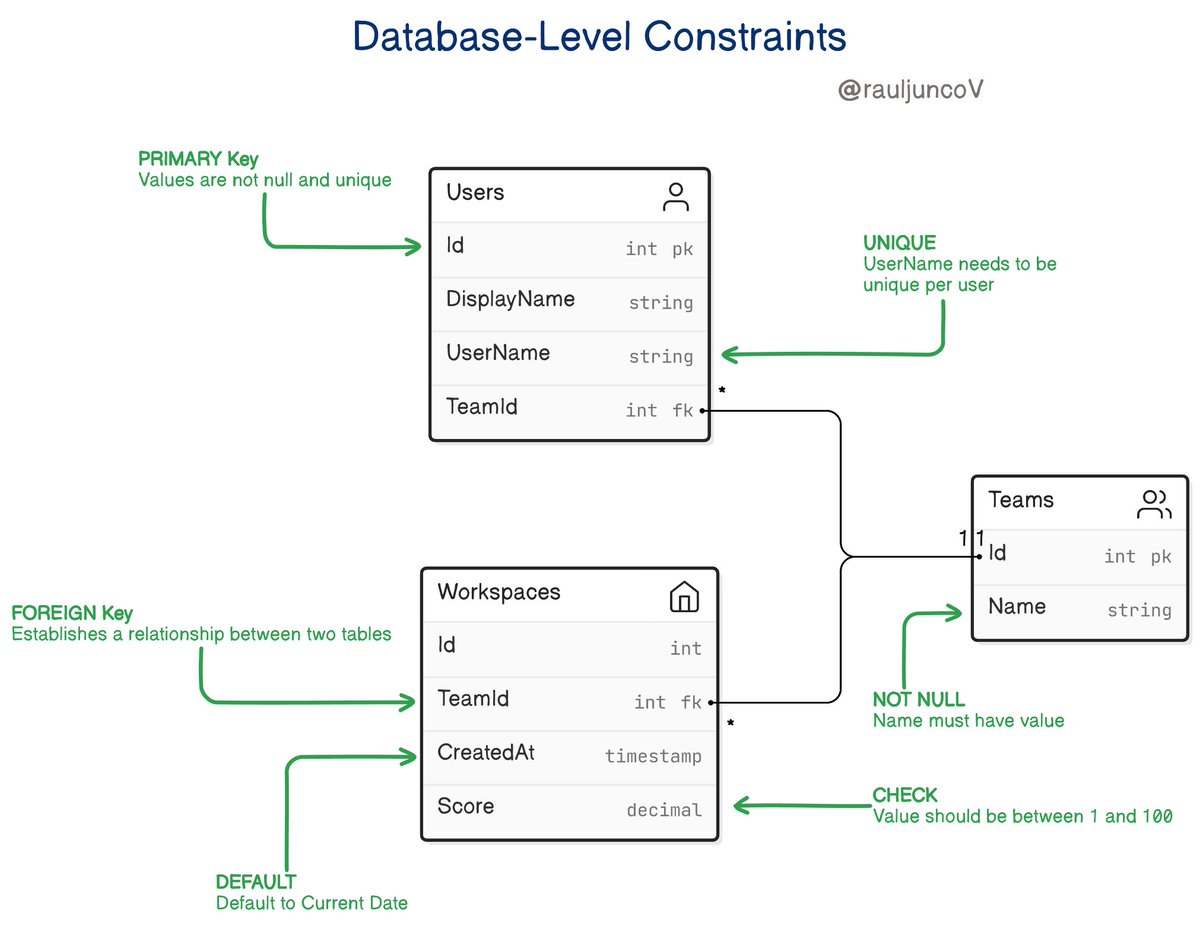
Bad data is the root of all evil. SQL constraints will help you prevent it.
Here are 6 Constraints simply explained.
PRIMARY Key Constraint
This means that the column's values are not null and unique.
Each table in the database should have a primary key to identify its records.
FOREIGN Key Constraint
This means the column's values must match those in another table column, which is usually a primary key.
Establishes a relationship between two tables using a column or set of columns.
UNIQUE Constraint
This means the column cannot have duplicate values across the whole table.
Great for a username or email field on a User's table.
CHECK Constraint
The data must meet a custom expression for acceptance.
For example, if you have a Score percentage column with values between 0 and 100, you can use a check constraint to enforce that.
NOT NULL Constraint
Ensures that a column does not contain NULL values. The column must have a value for each row.
Define NOT NULL columns when your application assumes the existence of a value.
DEFAULT Constraint
The system assigns a default value to the column if you don't provide an explicit one.
It is Useful when you want to provide a default value instead of leaving it NULL.
Better Data = Better Software!
New blog post is out: https://t.co/yD9MuBjCJP
We explore how several Elixir idioms will interact with Elixir's upcoming type system.
A huge thank you to @remote, @CNRS, @heyfresha, @starfish__team, and @dashbit for their continuous sponsoring of the type system work!
I've published the first release of tremorx, a phoenix component library. Its also been about 1 year since I wrote my first line of code in elixir 🤩.
Check it out at: https://t.co/b0sLyEfV3N
#myelixirstatus