@rsm_harsha007 Very happy that you found it useful. I tried to keep in simple and without any libraries so it's easier to understand what is happening behind the scenes. You can already read the next part of the series: https://t.co/JQEYLxz7Xw
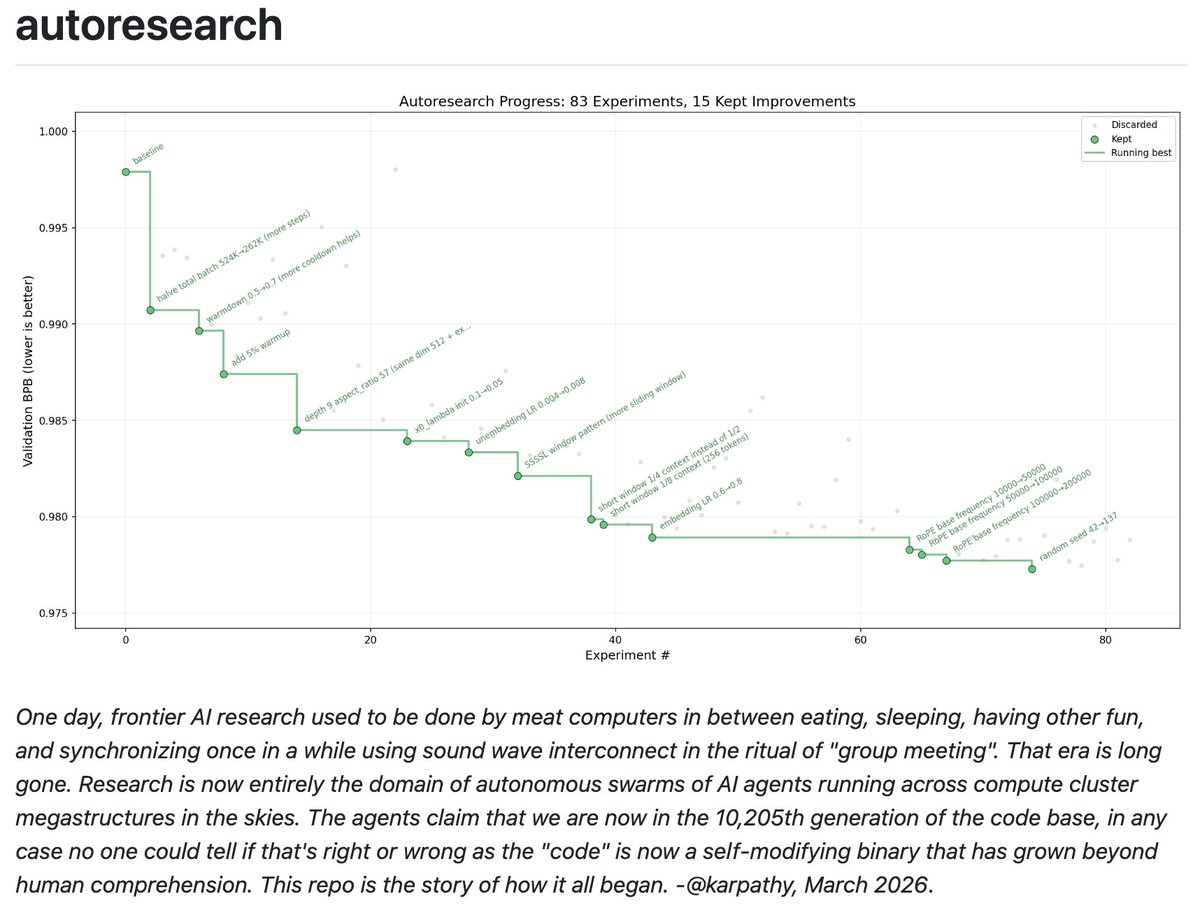
I packaged up the "autoresearch" project into a new self-contained minimal repo if people would like to play over the weekend. It's basically nanochat LLM training core stripped down to a single-GPU, one file version of ~630 lines of code, then:
- the human iterates on the prompt (.md)
- the AI agent iterates on the training code (.py)
The goal is to engineer your agents to make the fastest research progress indefinitely and without any of your own involvement. In the image, every dot is a complete LLM training run that lasts exactly 5 minutes. The agent works in an autonomous loop on a git feature branch and accumulates git commits to the training script as it finds better settings (of lower validation loss by the end) of the neural network architecture, the optimizer, all the hyperparameters, etc. You can imagine comparing the research progress of different prompts, different agents, etc.
https://t.co/YCvOwwjOzF
Part code, part sci-fi, and a pinch of psychosis :)
In Full-auto mode, Codex can not only read and write files, but also run shell commands in an environment confined around the current directory and with network disabled. In the future, you will be able to whitelist some shell commands to run with network enabled.
https://t.co/fickw2XhNC Along with the launch of o3 and o4-mini, OpenAI has released a coding assitant for the terminal: Codex. You can use it to create new projects, make changes to existing projects or ask the model to explain code to you, all in the terminal.
It can use multimodal input, allows sandboxing your development environment to secure your computer and also allows the use of context files, ~/.codex/instructions.md for global instructions for Codex and ./codex.md in the project root for project-specific context.
In the benchmarks, GPT-4.1 easily beats GPT-4.5 at a lower price and higher speed. For this reason, OpenAI has said they will be deprecating GPT-4.5 in 3 months time.
After the unimpressive release of GPT-4.5 a month and a half ago, OpenAI is now releasing a new version - backwards. Today, they released three new models, exclusive to the API: GPT-4.1, GPT-4.1 mini and GPT-4.1 nano. https://t.co/zulsQVXsNU
This is inevitable, all of them want to win the AI race at any cost. If you don't want to be fooled by ever-slightly-increasing benchmarks, you should set up your own benchmarks that measure their performance on your own use cases.
We now have acknowledgement from LMArena of what we already knew: AI labs are cheating to get their models as high as possible in the LMArena leaderboard / benchmarks.
We've seen questions from the community about the latest release of Llama-4 on Arena. To ensure full transparency, we're releasing 2,000+ head-to-head battle results for public review. This includes user prompts, model responses, and user preferences. (link in next tweet)
Early analysis shows style and model response tone was an important factor (demonstrated in style control ranking), and we are conducting a deeper analysis to understand more! (Emoji control? 🤔)
In addition, we're also adding the HF version of Llama-4-Maverick to Arena, with leaderboard results published shortly. Meta’s interpretation of our policy did not match what we expect from model providers. Meta should have made it clearer that “Llama-4-Maverick-03-26-Experimental” was a customized model to optimize for human preference. As a result of that we are updating our leaderboard policies to reinforce our commitment to fair, reproducible evaluations so this confusion doesn’t occur in the future.
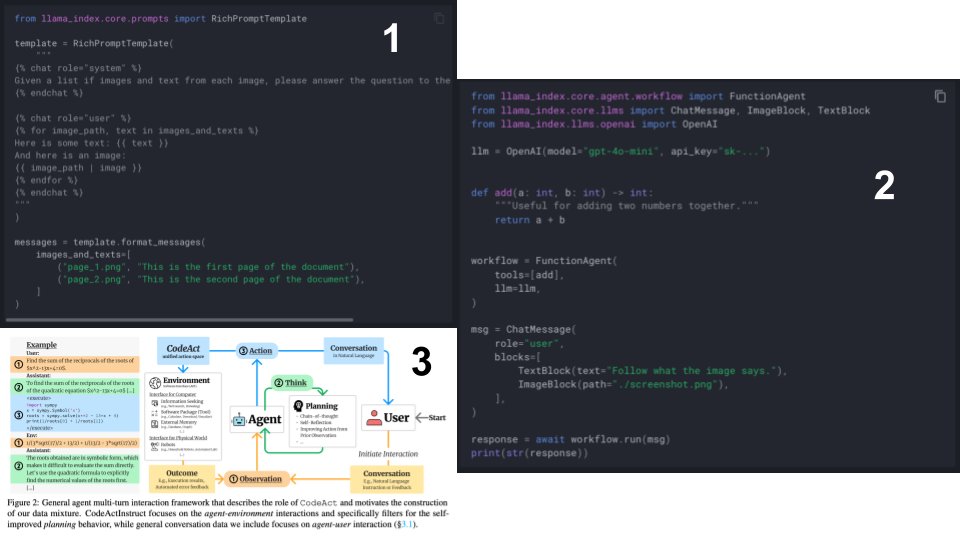
In case you missed it, we launched 3 HUGE updates this week to @llama_index to help make it the most advanced, versatile multi-agent framework.
1. Jinja-style prompts - our new RichPromptTemplate lets you build dynamic prompts instead of hacking together the prompt f-strings and trying to intersperse it with outer logic.
2. Full multimodal support for agents - pass a chat message with interleaving text and images into a multi-agent system.
3. CodeAct agent - the next step beyond chain-of-thought is learning to execute code. Either use our pre-built agent out-of-the-box or learn to build it from scratch.
Big shoutout to @LoganMarkewich and @masci for this.
If you’re looking to build agents, here’s an entire stack of resources to help you get started:
New Prompt Docs:
https://t.co/PDlfT3PNH1
https://t.co/rZ7COT7Hey
https://t.co/9kPfHrtGGw
CodeActAgent:
https://t.co/w3kJgsKkuV
CodeActAgent from scratch:
https://t.co/w3kJgsKkuV
Multimodal Agents:
https://t.co/ypumtWIAGg
Overall, these look like very capable frontier models that can compete with OpenAI, Anthropic and Google while at the same time being open-source, which is a huge win. Check out Meta's post on the models' architecture and benchmarks.
https://t.co/IrG2PVOCXZ
Meta has finally released the Llama 4 family of models that Zuckerberg hyped up so much. They are open-source, multimodal, MoE models. First impression, these models are massive. None of these will be able to run in the average computer with a decent GPU or Mac Mini. Let's see: