@petoro@pickover That’s an excellent question, and as far as I know, it hasn’t been calculated.
Kind of surprising in fact because it shouldn’t be too hard, probably similar to the calc of the number of permutations for the Megaminx.
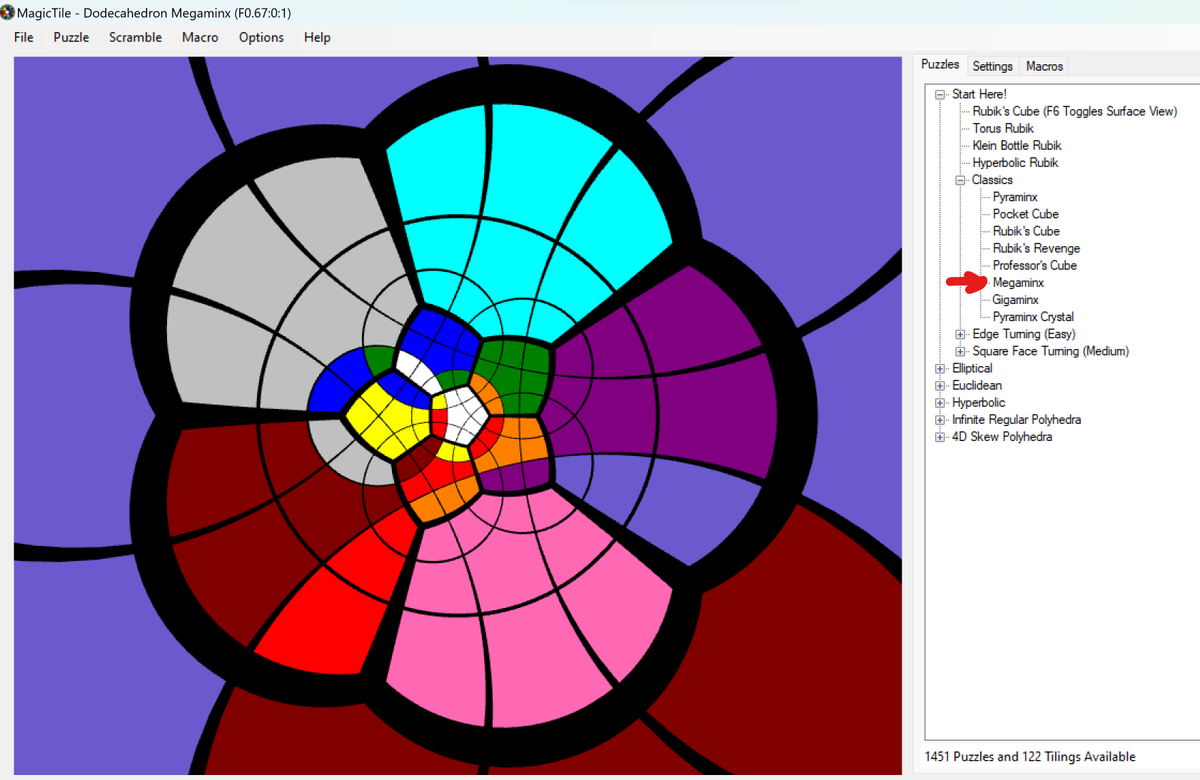
@jagarikin Very nice! Just like the Rubik's cube, if you want to try to solve Megaminx this way, you can try
@roice713's MagicTile https://t.co/WIjzBiTlld Choose Start Here -> Classics -> Megaminx. I find it easier than a physical one cuz I don't need to rotate the puzzle to find pieces
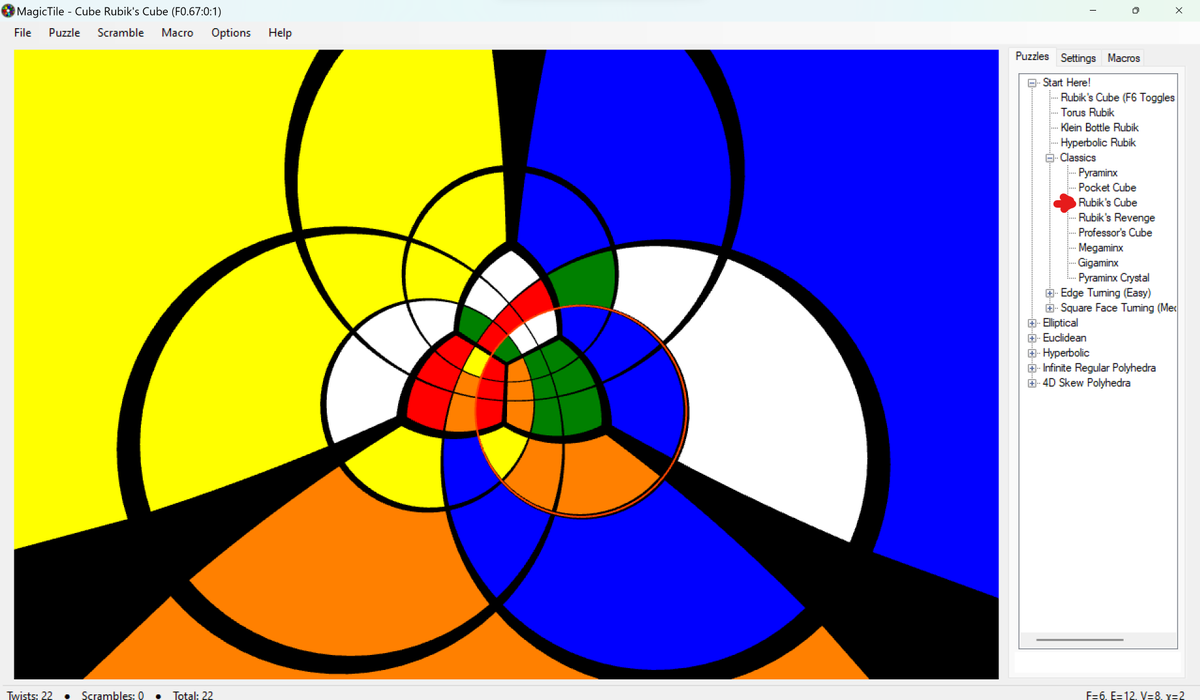
@jagarikin If you want to try solving the Rubik's Cube this way, you should try @roice713 's MagicTile https://t.co/WIjzBiTlld You can choose the Rubik's cube among hundreds of puzzles. The stereographic projection makes it look like the animation in this post.
@Thalesdisciple @TilingBot I haven't yet looked into what that requires. I think I'll watch how things evolve for a while since I'm not yet confident in the future of Mastodon.
For better or worse, I have also been seriously considering retiring the bots from Twitter.
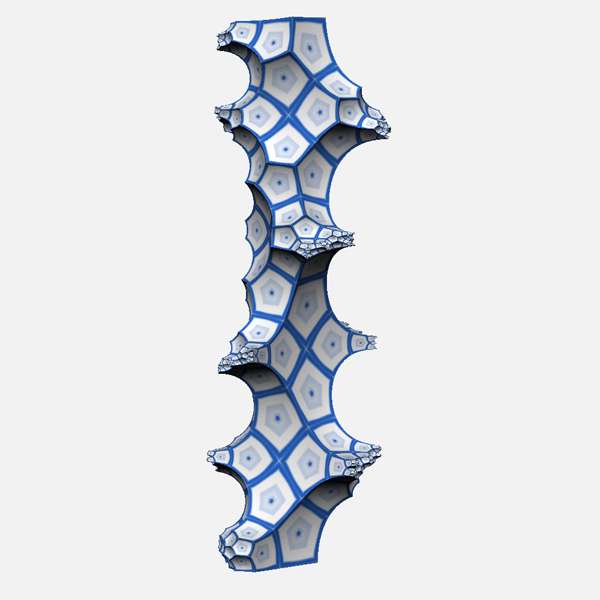
@Tom_Ruen@NonEuclideanDr1 Yes, only a single (ideal!) point of each edge remains “in” the honeycomb.
I imagine that within the space, the square faces may not even appear so square… the only clue being that they connect with 4 of these ideal points.
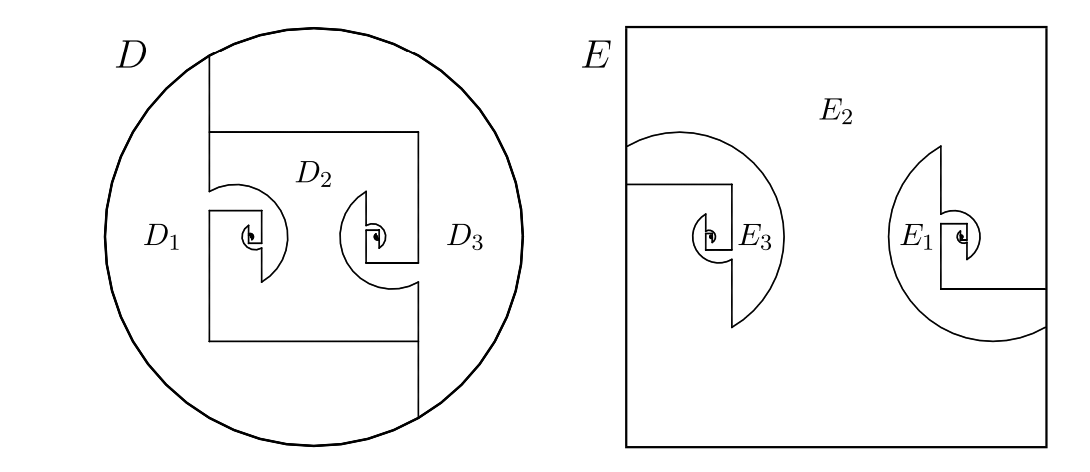
Can we cut the square into finitely many pieces and rearrange the pieces into a circle, if we allow ourselves to dilate the pieces as well as simply translate them? Surprisingly, yes!
Source: https://t.co/TSEgk7ncs1
@neozhaoliang Idk, but the easiest way for me to think of it is as a diminished 600-cell. From wiki: “removing 20 vertices that lie on two mutually orthogonal rings and taking the convex hull of the remaining vertices.” This leaves a bunch of tetrahedra and 2 orthogonal chains of anti-prisms.
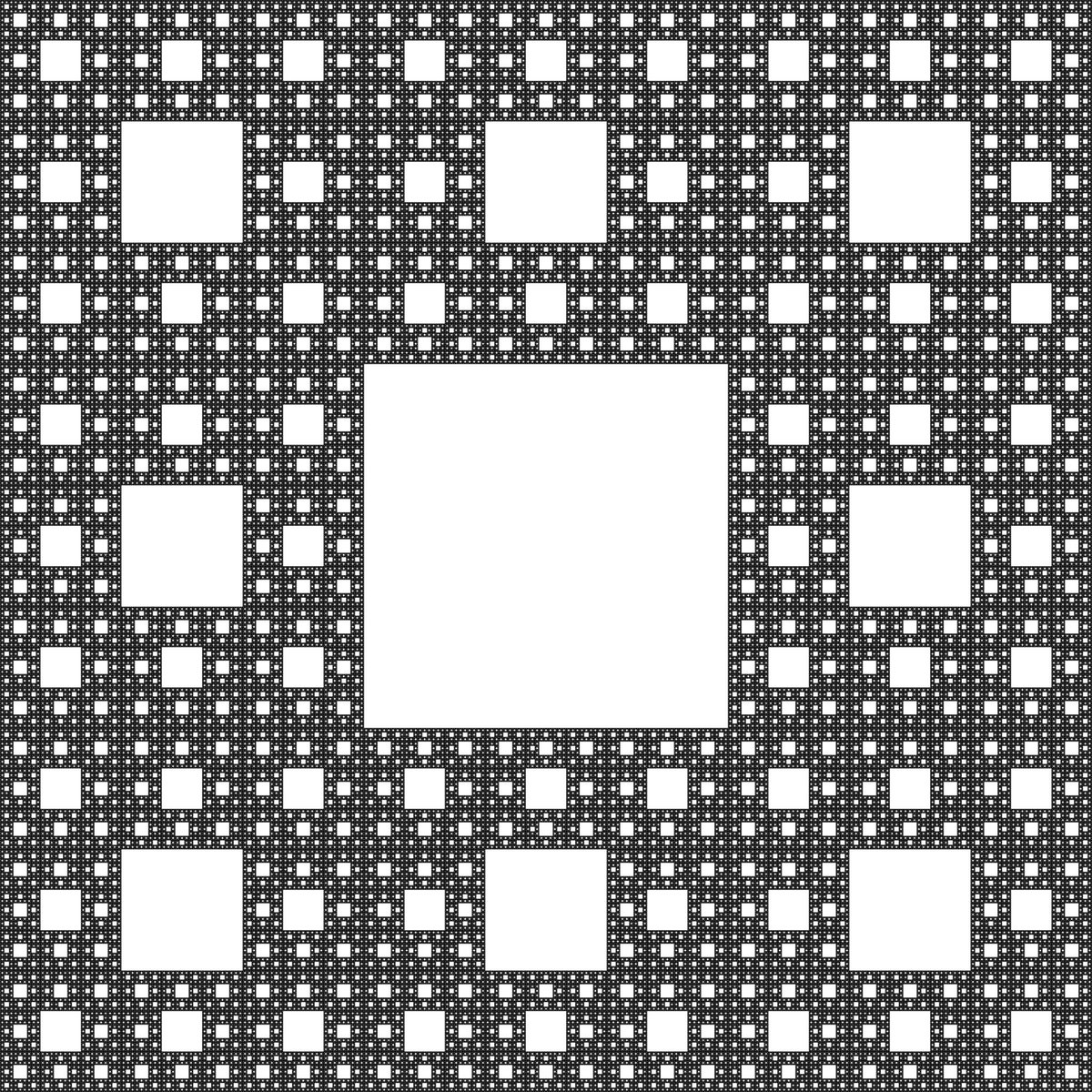
@bengineer8u It means that the image above is “the same” as the following one.
Some links for further study…
Sierpinski carpet: https://t.co/IyJxvuO7JC
Homeomorphism (a topological sense of being “the same”): https://t.co/p9q1bWQKqz
Took me a month, but the blog post is finally finished! 🫡
Here I'll explain how to write up a generalized space time geodesic ray tracer in GLSL, as well as going in-depth into Lagrangian/Hamiltonian mechanics with derivations of the geodesic equations!👀
https://t.co/q0VBZDTBXY
@saksham0961 The link wouldn't work for me without prepending www. Here's one that did work, in case anyone wants to go check out the talk.
https://t.co/QNk0gQVR9h
I was kidding about any real study of NSE, but I do enjoy trying to glean insight from Terry Tao :)
I've been diving into the Navier-Stokes equations the past few years, taking an intuitive and immersive approach. Finally starting to get them a little :)
https://t.co/zG4zqUlTti