the only way to move forward is to declare a multi decade time horizon for yourself to "make it." anything less is blatant insecurity and a self induced handicap. The permanent underclass meme has done insurmountable damage to young people.
violently reject it and save yourself. Anyone that disagrees has slop to sell, just get good.
Doesn't even matter what happens to $HYPE price today.
Every.
Single.
Fund manager, retail investor, finance podcaster etc will be talking about it, trying it, looking into it after today.
Enormous career risk to not at least have an educated view on @HyperliquidX when your investors start calling you up tomorrow.
Irreversible mind share step function gain today.
Doesn't even matter what happens to $HYPE price today.
Every.
Single.
Fund manager, retail investor, finance podcaster etc will be talking about it, trying it, looking into it after today.
Enormous career risk to not at least have an educated view on @HyperliquidX when your investors start calling you up tomorrow.
Irreversible mind share step function gain today.
I am excited to be an investor in trade(xyz) as they partner with ICE to bring 24/7 perpetual futures on Hyperliquid to the United States. As a market participant, I am looking forward to to using their innovative product to enhance my investment process.
Strap in and consider this my official update on the kinetiq:native thesis, specifically regarding @Enter_Elysium.
Best way to do this is to refute some arguments I've seen:
1. "L2's are parasitic"
It's very lazy to compare Elysium to other L2s from the past. Robinhood Chain has generated a little over $50m in fees, of which $5m went to Arbitrum, and a whopping...$70k went to $ETH blob fees.
HyperEVM hyperliquid:native fees are burnt, whereas sequencer fees on Elysium go to kinetiq:native buys and builders (more on this later), but HyperEVM fees only account less than 1% of Hyperliquid total revenue. Papertrade is actually much more directly parasitic to hyperliquid:native; HyperEVM fees are peanuts even if Elysium vamped them entirely.
An under appreciated dynamic that a lot of people don't know is that HyperEVM USDC applies to AQAv2 hyperliquid:native revenue too, and USDC on Elysium will as well. Assuming the HyperEVM burns around $25k of hyperliquid:native a day, every additional $1b USDC that Elysium onboards in TVL would burn 4x that same amount due to AQAv2.
For reference, Solana has ~$7.5bn USDC and Base has $5b. Robinhood chain is predominantly USDG, which they monetize on, and ETH obviously gets nothing from. Imagine if Base contributed to $175m (3.5% of $5b) of value accrual to $ETH via their USDC TVL...maybe my $5k/7k $ETH calls would actually hit then 🙃
Beyond this, the entire selling point of Elysium is that it sits adjacent to HyperCore. propAMM's are functionally impossible on HyperEVM now due to the 1s block time (amongst other reasons). Additionally, on the HyperEVM, you can only read Hypercore price, not order book depth.
As a result, Solana does 25-50x the spot trading volume that Hypercore/HyperEVM handle. If Elysium can eat even a moderate chunk of on chain spot volume from Solana, especially in tokenized RWAs, the implications for corresponding hedging flows to Hyperliquid are enormous.
Elysium explicity enables net new flow and TVL to Hyperliquid, both of which are very accretive to hyperliquid:native itself. I would not be surprised if Elysium directly contributes an additional low 9 figure ARR for hyperliquid:native in 2027.
2. "L2's are bad investments and down only tokens"
As stated above, $ARB made about $5m so far from Robinhood Chain. Of that amount, a whopping...zero dollars made it to tokenholders. No buybacks, no burns, nothing.
50% of Elysium sequencer fees are directed at kinetiq:native buybacks. Even if you assume that Elysium only generates half the current sequencer fees of the current ghost town that is the HyperEVM, that'd still more than double their current revenue.
Currently, kinetiq:native buybacks as a % of market cap are about 1.5%, compared to 4-5% for hyperliquid:native. If Elysium generates only half of the sequencer fees of the current HyperEVM ($5m/yr), they'd be retiring token off the market at the same rate that hyperliquid:native does relative to market cap.
If Elysium can do closer to 50-75% of Base annualized sequencer fees ($30m), they'd be doing kinetiq:native buybacks at double the rate of hyperliquid:native as a % of market cap.
This is completely negating a likely increase in kHYPE TVL and other revenue streams (which there are numerous), like from launchpads like @AscendLaunch.
Ascend actually deserves their own section because they've commited to doing 30% of gross revenue as kinetiq:native buy/burns (50% to buys, 60% of that to burn). $PONS has generated $200m revenue in the last 2 months, but is currently only annualizing about $125m revenue, so we'll use a very conservative ~10% of the more conservative number. That'd add another $4m of kinetiq:native buybacks, which brings buyback yield/mcap well into the double digit %, over double hyperliquid:native.
3. "Why would there be activity on Elysium if there wasn't on the HyperEVM?"
Probably because the HyperEVM operates at the speed of smoke signals and has 0 support from Hyperliquid.
You have @Uniswap, @fomo, @Pumpfun etc all announcing integrations and deployments on Elysium day 1 after ignoring the HyperEVM all this time. @0xOmnia and the @Kinetiq_xyz team is putting on a master class in distribution, and you're seeing it play out this week.
Jeff and company are focusing on building the best perps platform in the world, and that's great, but this hands off approach has come at the expense of any support or curation of an on chain ecosystem.
That's left a massive gap that other chains have filled, but Elysium can bring all that activity back into the "house of all finance". Having a team that's fully dedicated to making this a reality will look nothing like the lack of attention the HyperEVM received.
4. "It'll be a flash in the pan memecoin chain and die out just like RHC activity has"
This is more speculative and it's hard to say. Elysium could have an epic and unsustainable PvElysium memecoin season by inheriting some of the wealth effect from both hyperliquid:native and kinetiq:native. Obviously this would absolutely moon kinetiq:native from sequencer fees/Ascend revenue, but that's shortlived.
Lively trenches aren't mutually exclusive with a real and innovative DeFi ecosystem though. As I mentioned before, Elysium will be uniquely able to plug in with, leverage, and read Hyperliquid orderbooks and liquidity. DeFi applications that couldn't be built anywhere else are made possible here.
A performant general purpose blockchain adjacent to HyperCore is the natural home to propAMM and HFT arbitrage against HIP3, which incentivizes deeply liquid spot RWA markets, which enables much higher LTV lending, which enables unique structured products and DeFi primitives to be built.
I do imagine that the trenches are built before more serious innovation comes about, but an important note here is that builders are getting 25% of sequencer fees as well. What builder wouldn't want to deploy on a new ecosystem, adjacent to the most successful app in crypto history, with a built in rev share agreement with the chain itself? Based on my conversations with Ascend and Montra, lots of serious teams want to build, not just memecoin deployers.
TLDR: It's not that complicated guys. kinetiq:native is a $120m mcap token that has a very clear path to buyback % yields multiples higher than hyperliquid:native, with an unprecedented ecosystem flywheel. It's both beta to hyperliquid:native and enhances the hyperliquid:native bull case. It might be the most asymmetric bet in crypto right now, and it's not conditional on some long shot thesis, just that there will be a large on chain ecosystem for the most important app in crypto.
Maybe it's a flop and a sell the news event on launch...or maybe it's all the best parts of Base/Hood sequencer fees combined with the revenue streams of $PUMP, $CAKE, solana:jtojtomepa8beP8AuQc6eXt5FriJwfFMwQx2v2f9mCL, ethereum:0x5a98fcbea516cf06857215779fd812ca3bef1b32 etc and heads towards billions of TVL and 9 figure annual revenue.
If you pattern match too hard to "L2 bad" or "HyperEVM sucks", it's from a place of being too 🏳️🌈🐻-pilled and/or lazy research.
A note on transferability.
Papertrade is a complicated primitive, and managing it from a risk standpoint is a complicated problem. The PAPER token is far more integrated into the economics of the primitive than most tokens are in their respective protocols today, and, broadly, was designed to act as a counter insolvency incentive coupled with a rebate mechanism to losing traders. Market makers and exchanges are by far the two most profitable businesses in crypto, and our goal was to try and externalise as much of their margins back to users as possible. We are now just over a week into the life of papertrade and we are becoming increasingly confident that this is both possible, but also a likely outcome as agentic led software becomes the norm.
As it stands, the paper token traded as a perp becomes a leveraged bet on bankroll solvency - and being able to short bankroll solvency materially changes the payoff curve of a manipulation attack. The target number goes from the bankroll, to the bankroll + short side exposure on paper. We can, and do limit bankroll size specifically to control this payoff curve and ensure it never becomes existentially problematic, but external perp markets are not something we would have any control over if left to float of their own accord. For example, if our bankroll is $10m, an attack costing $15m manipulating the price of bitcoin or ether is not viable. You simply lose money. If however you were also able to put on $10m of PAPER short side exposure, suddenly an attack costing $15m is very viable indeed.
If we were to make the token transferable at this point, we are confident we would quickly enter a state too dangerous to allow any material exposure to be taken on papertrade, an end result that benefits no party beyond the wolves who have done the math on the short and are waiting in the wings with sharpened knives.
We would also like to thank the various perps teams who have reached out about pre-market listings for their understanding and patience regarding this issue, and especially to the paragon team who, despite jumping the gun on us, have behaved with the utmost integrity and transparency once a dialogue was opened.
Perps on PAPER will always act as a self-limiting exposure ceiling for a token with this type of utility, and we think it would be a shame to limit the growth of papertrade to the extent that allowing perps would necessitate. As such, at this juncture we do not have plans to allow off-contract token transferability.
Structurally, papertrade is limited by the quality of the data it receives from hyperliquid, but we strongly believe that hyperliquid has a very large part to play in the future of global exchanges, and expect their books to continue to thicken and strengthen over time.
A note on fees.
Papertrade launched with a deadband fee from entry of 0.2bps. This means you don't earn anything until the price has moved by 0.002% in your favour. Over the months before launch, we played around with many different curves and fee structures affecting exclusively positions closed very close to entry price in order to try and devise a structure that removed the edge against the bankroll low time frame scalp bots have, whilst also minimally impacting the traders around which and for whom the product was devised. We were never able to find anything we were absolutely happy with and so decided to stay with the 0.2bp deadband fee through launch. This has however meant we have had to be very restrictive when it came to certain parameters, such as OI caps.
Now, however, we have enough live data to fully understand exactly which strategies work, and to make the necessary changes to stop them. The changes we are making will have an on hours and off hours fee mode to account for the relative differences in liquidity the hyperliquid books see between these two time periods, and the ease with which low time frame moves are signalled. The changes we are making will only affect positions closed within 6bps of entry (0.06%) in on hours, and 10bps (0.1%) in off hours. Any trades closed above these threshold price shifts will see no change to their fees at all. On a look back to launch basis, these changes affect the profitability of bot strategies roughly 15x more than they do normal traders, for whom a very small proportion of overall winnings come from within this band.
These changes should serve to flatten much of the edge our microfee structure necessarily creates on low time frames, and will help with long term exchange sustainability. This should hopefully allow us to open up parameters such as OI caps a little more so those of you who wish to can put on the size you want to, when you want to.
It is possible these changes are still too lax, and that further revisions to this structure may be necessary going forwards. If so, we will notify users ahead of time.
A note on paper tokenomics.
In conjunction with the fee changes, we will also be implementing a change to the token issuance curve.
Going forward, every $1 lost mints a fixed share of PAPER's supply at that moment, roughly 0.1% of supply per $1M lost (the exact number depends on the mint rate at the time the contracts are upgraded). PAPER minting in and near insolvency will also change, switching from a flat 100 per $1 of loss, to a time weighted multiplier on the curve growing over time, effectively acting as the house running a discounted auction on its own future cash flows. This change also removes the risk of the paper-mint-straddle-attack, temporarily pushing the protocol insolvent by closing only the winning side of a large straddle position and then attempting to mint as much paper as possible.
In the immediate term these changes will only have a very subtle effect on PAPER minting, but in the long run will structurally change the outlook of the system beyond the first few weeks, serving to slowly dilute out older holders and leaving more recent users with an advantage. Reconstituting the PAPER system into something much closer to the exchange rakeback it was intended to be.
We have been very reticent to touch this particular aspect of the system for obvious reasons, but ultimately we believe that these changes provide all users with the optionality to take a smaller piece of a potentially much larger pie than the current dynamic might necessarily allow.
Other, miscellaneous notes.
These contract upgrades will include a few other contract changes, including the addition of builder codes so that builders can utilise papertrade in whatever capacity they choose to. This will be a whitelist only to begin with and we will have more for you later in the week on where/how this will be rolled out. A small change to contract permissions on the reward distributor and a change on how below bust closes are processed by the exchange are also included, largely to block gas griefing attacks.
These changes will be pushed to docs in full over the coming day, and we will further announce once the changes are queued into the timelock pending final security passes, scheduled to go live 24 hours after that point.
Final note.
We'd like to thank everyone that has tried out papertrade over the last 10 days. It has been a labour of love building this product and both of us have been taken aback at all of the positive feedback we have received. We'd also like to thank all those of you who have spent considerable time musing on the system we have built, and much of your advice has been taken onboard and will likely affect the colour of what papertrade becomes going forward. We know some of these changes will be unpopular with some, but we would not be making them if we did not feel them to be absolutely necessary.
- blurr, jez
having tried my best to intuit the motives of the protesters in France today, I am struck by the fact that two of the most treasured pillars of the European postwar order are colliding:
1. unfettered immigration, especially from former colonies, justified by historical obligation and postcolonial guilt
2. protecting pensions and the elderly at all costs, even to the point of extreme fiscal strain
now you have first and second generation immigrants, as well as young native french people, taking to the streets because the french state is hell-bent on extracting whatever it can and feeding it into the maw of boomer luxury communism.
the younger generation is being asked to accept a deteriorating deal: pay more, receive less, and abandon the expectation of matching the living standard of their parents or grandparents.
the young immigrant newcomers have even less incentive to accept any kind this bargain. they are not bought in to the french social contract. they have no common identity with the french boomers they are being asked to sustain. they resent the fact that the entire machinery of the state is designed to exploit the young to serve the old.
the old do not care about the immigrants enough to trade away any of their entitlements for them. they have the advantage as they wield the franchise reliably and their share of the electorate is only growing, so they won't accept a decline in their own standard of living to fund a future they will never live to see.
now these two groups are on a collision course.
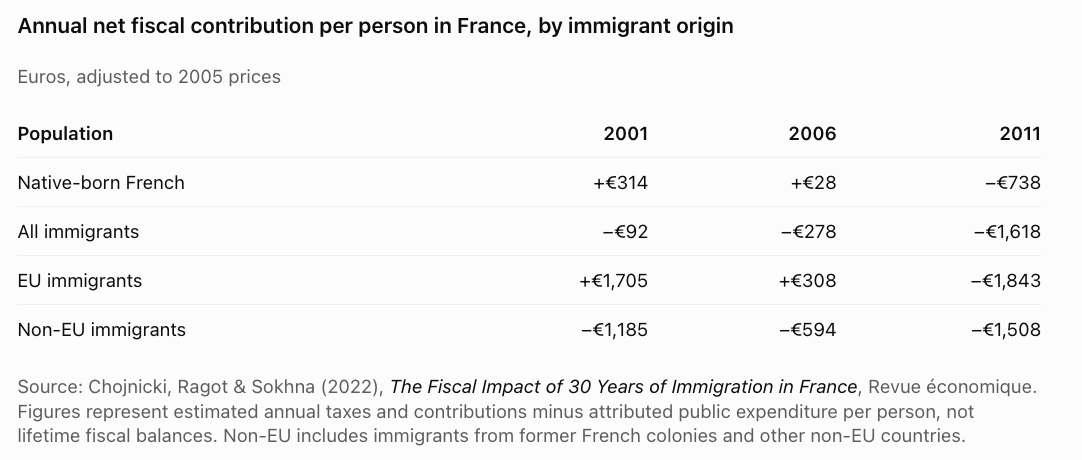
ironically, immigration was intended to ameliorate the worsening fiscal picture brought about by a demographic transition. but this did not happen. studies have repeatedly shown that immigrants do increase aggregate GDP (by simple brute force, by adding to population), but not the fiscal picture [1]. the most comprehensive paper using real-world data [2] segments immigrant types to France and finds non-EU immigrants to be persistently fiscally negative. EU immigrants by contrast are the most fiscally positive group, meaning that studies that consider immigrants as a whole are masking the negative impact of non-western immigrants (and Algeria, Morocco, and Tunisia rank #1 and #2 and #4. Africa accounts for 50% of the 8 million immigrants living in France today.)
immigration has not caused France's fiscal crisis. but it hasn't bettered the economic picture at all – it has deteriorated it somewhat – and it has created a combustible demographic that has little allegiance to the French nation. far from helping France deal with its aging workforce, immigration has added fiscal burden and created a permanent, non-assimilated disenfranchised underclass. the original justifications for immigration – labor scarcity, postcolonial obligation, and more recently workforce aging – have largely failed to manifest the promised results.
the pro-immigrationist policy has been defended in Brussels as necessary to defend the welfare state, but it has expanded the population making claims on the state, without eliminating the need for fiscal adjustments.
France now has an aging electorate aiming to preserve the benefits it was promised, mingled with a younger more diverse population that questions whether it will ever receive a similar deal. the young are vastly outmatched at the ballot box and so they take to the streets.
the french establishment is now trying to preserve a tenuous status quo: unlimited intergenerational obligations alongside a neverending immigration regime that continually changes the composition of the society intended to honor those obligations. the immigration regime also actively worsens the fiscal picture while creating these cultural fractures and inculcating a society more prone to sectarian violence.
the french state will have to renegotiate its social contract and disempower one of these groups. electoral gravity suggests that the old will continue to win until France finally reaches default and creditors renegotiate the welfare state for them.
the major contenders in 27 take different approaches to this tradeoff:
- the right in Le Pen looks to reduce immigration-related expenditure and focus public spending on French citizens, while resisting retirement age increases
- Macron in the center aims to control immigration somewhat and reform pensions by raising retirement age
- Melenchon's left, largely behind the protests this week, denies the tradeoff and aims to keep funding pensions and retirement at 60 while increasing immigration. as France has very little fiscal space it's unclear how this would be paid for
whether the french social contract can be peacefully renegotiated remains to be seen.
[1] For France, immigrants' net fiscal contribution averaged -0.85% of GDP over 2006-2018 when all public expenditure was allocated (and this includes ALL categories of immigrants including European, American and Asian) See: https://t.co/DZcE2FrRmS
[2] See table 4 (translated below) https://t.co/FccZ1CKiUX
No where safe to hide anymore
> Software at risk of being disrupted by AI
> AI at risk of getting commoditized
> Gold at risk of being discovered on asteroids in Space
> Bitcoin at risk from quantum
> Quantum computers at risk of being blown up
> Cash at risk of inflation
Ahh
Quick lesson in portfolio construction:
* Cut Lit, no need for beta unless you think it actually can catch up to the leader
* Cut cyph, just use perps or calls on zec if you want more juice out of this squeeze. keep your destiny in your own hands and avoid DATs for obvious reasons. Keep in mind if zec goes to shit, Cyph does too. You’re not protecting anything in your port with this “diversification”
* same thing for Hype, cut Purr and leverage hype as needed
* near I’m not a huge fan of personally but it’s fine
^ make these cuts and you have functionally the same exposure to the market but with 3 less names. That simplification is what makes the trades easier to manage (read: you should be able to get more out of the charts)
I think you can just keep down cost averaging zec and pump dips all cycle and outperform everyone
winners win narrative or whatever, market will just keep choosing them etc