Pessimism feels like the easy path: a quick reaction to life’s uncertainties and a defense against disappointment. We find comfort in it, and pessimists may aim to appear smarter. The reality is, it limits our view of the possible horizons. True intelligence lies in optimism.
“This feels like 1999 again.”
No, it doesn’t. And I was there (here).
I joined Cisco in January 2000 as a co-op, then full-time in May 2001. At the time, Cisco was the hottest infra company on the planet, riding the wave of the dot-com boom.
But by the time I started full-time, the crash had already begun. A month in, my manager was laid off. The party was over. Entire industries vanished.
Here’s what actually happened:
1. The users weren’t ready.
Most people were on dial-up. Mobile didn’t exist. E-commerce logistics were immature or non-existent. Everyone had ideas, but the end user wasn’t there.
2. Capital vanished.
The IPO window shut. Venture funding dried up. Startups that depended on future growth couldn’t raise and died fast.
3. Metrics were fake.
Companies like Kozmo, Webvan, https://t.co/G88Rs4MaDI burned cash chasing usage that never converted. Things like CAC/LTV wasn't common enough vernacular.
4. Infra got overbuilt.
Telcos like Global Crossing and WorldCom spent billions on fiber and data centers. The demand never showed up. Cisco’s customers disappeared, not because they lost but because their customers died.
5. Business models were broken.
Most dot-coms were never real businesses. They scaled early and hoped revenue would catch up. It didn’t.
Now look at today.
OpenAI, Meta, Google, xAI, Microsoft are all scrambling to keep up. Jensen put it plainly (h/t @BG2Pod)
“Every hyperscaler has realized they dramatically underbuilt.”
“Every forecast we’ve seen has been too low.”
“We’re not building for speculation. We’re building for active workloads.”
So no. This isn’t 1999.
This isn’t https://t.co/G88Rs4MaDI IPOing on vibes.
We are not in a hype cycle.
We are in a compute bottleneck.
Mercor (@mercor_ai) scaled from $1-500M in revenue run rate in the last 17 months, making us the fastest growing company of all time. Our growth is accelerating. We averaged 11% week over week growth in July, 18% WoW growth in August, and 19% WoW growth in September.
One trend driving this meteoric growth: the Economy is Becoming an RL Environment Machine.
Reinforcement learning is becoming so effective that agents can hillclimb any benchmark, but humans need to define the rewards to automate everything.
While everyone fears job loss, we’re creating a new category of knowledge work faster than any other time in history. The future of work will converge on training agents.
We're paying out over $1M / day to people in our marketplace and hiring experts rapidly across nearly every domain: software engineers, doctors, lawyers, consultants, bankers, and many more.
@SebCouasnon Je pense que la nouvelle clef de lecture pour fixer les multiples des boites AI, c’est leur niveau d’intégration dans les **workflows** d’entreprise. Ton produit coule littéralement dans les veines du client? Tu passes de 12-15x des SaaS tradi à 30-40x.
Not so long ago, we saw AI as our “co��pilot,” meaning AI would fix the errors we humans make. Actually, we got it backwards: we are the AI’s co‑pilot. Our job is to fix the AI’s mistakes. The good news? We still have jobs!
@Amonteil@GerardAraud On embarque déjà des systèmes complets (GPU, capteurs, batteries) dans une voiture (Waymo, Tesla). Et complexité autonomie voiture centre-ville > drone/vol. Alors en 2035… Meme trend que le semi (mainframe -> iPhone)
I’m wondering how many salespeople use deep research - I mean OpenAI Deep Research - to prep before customer meetings. So easy to get hyper-personalized pitches with prospects’ public sentiment & product usage patterns. The number of one-size fits-all pitches I see blows my mind.
One of the biggest implications of an AI-first enterprise will be that the AI stack an enterprise chooses will be a critical driver of any individual’s productivity in a company, which eventually compounds to determine the firm level productivity and thus competitiveness.
This means that specific technology decisions that a company makes will determine the rate of software they can code, contracts they can review, leads that can be generated, campaigns that can be launched, breakthrough innovations that are discovered, customers that can be supported, and so on.
The AI-first enterprise -and one that makes the right technology decisions- will see compounding returns and acceleration in all of these areas; conversely, the slower moving companies will tend to fall behind over time. As a result, AI will likely accelerate differences between firms based on their tech decisions, and even impact the kind of talent they can attract and retain, further hastening these competitive differences.
We’ve actually seen this with software in the past, albeit at a smaller scale. For instance, for years employees at Facebook and Google benefited from a unique developer stack and tooling that’s long created efficiencies for shipping or scaling software that the rest of the world didn’t have. Fast growing startups notoriously leverage their lack of tech debt, and ability to implement a modern tech stack, as a means of moving faster than incumbents. Companies like Netflix leverage data to make better acquisition decisions. It all comes down to the tech stack.
AI just takes this far further, because it will be a meaningful force multiplier on the execution of any employee. And with AI Agents, it’s almost akin to the quality of colleagues that you’re working with. Even subtle differences in the AI Agents you use for customer support, code writing, question answering, or workflow automation will lead to very different business results over time.
And the need will only accelerate in the future as a new demographic enters the workforce. A younger workforce coming into the enterprise will have completely different technology habits than generations before, ultimately requiring an AI-first stack to be productive.
We’re only in the earliest innings of fully understanding what an AI-first enterprise will look like, but it’s clear that work will likely look very different in a decade from now. And there’s a huge opportunity for those that are adapting early.
Einstein's philosophy was simple:
"If at first an idea doesn't seem absurd, there's no hope for it."
He believed true breakthroughs come from those willing to question everything - even what seems obviously "correct."
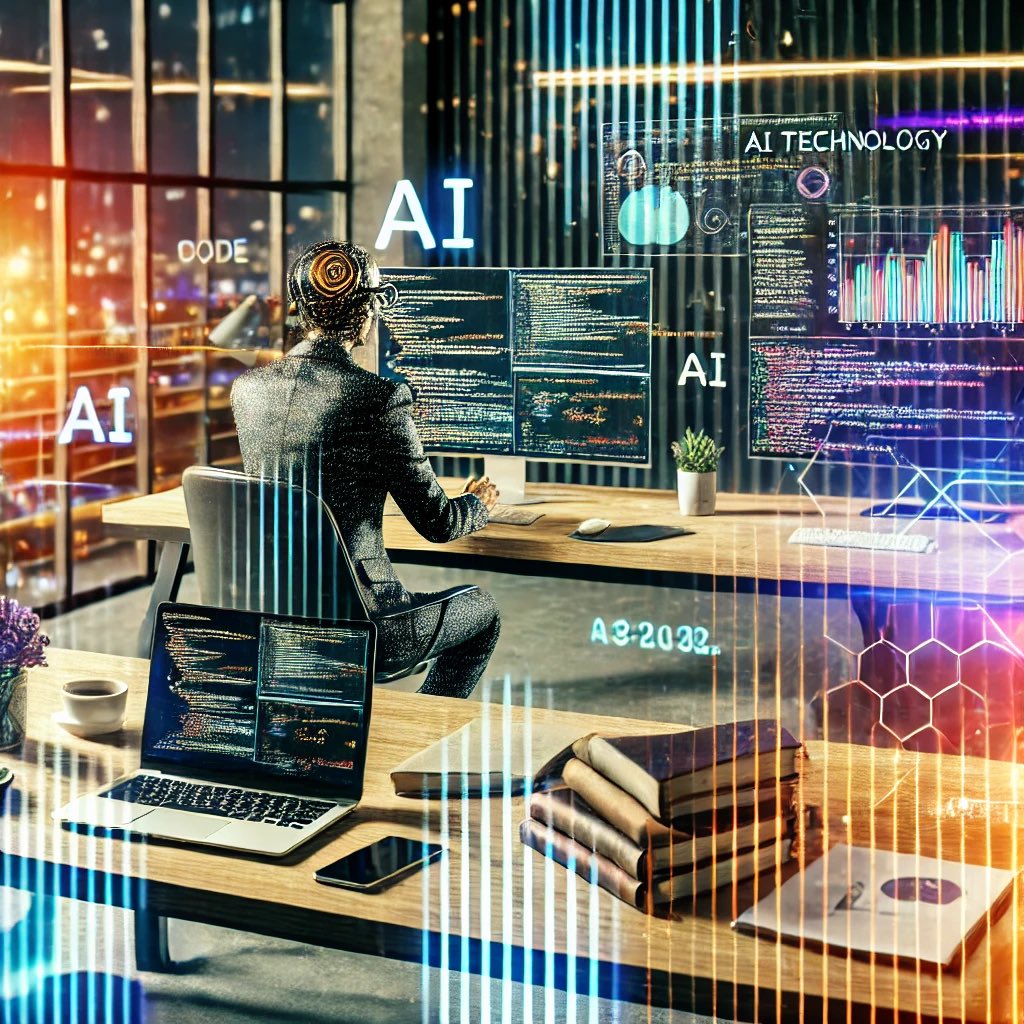
Asked GPT 4o: “based on what you know about me, draw a picture of what you think my current life looks like.” Got this - books, emails, code, coffee & AI. Some other stuff missing, not my clothes, but pretty accurate overall. Try it!
Enterprise pricing. Most founders don't have a game plan beyond throwing up a "Contact Sales" button on the site. When I started my co at 23 y/o, I remember making all the pricing mistakes in the playbook.
10+ years later and having now worked w hundreds of founders as an investor, here’s a few bits of pricing advice I wish id known sooner:
As if it wasn’t clear already VW illustrates the giant, ticking time-bomb at the heart of Europe’s economic model.
The European economy is based on two things, industrial production and selling the past.
S. Korea spent $200b trying to increase its birthrate. Hungary spends 5% of GDP.
Both are failing.
Yet the small country of Georgia spiked its birthrate massively without spending a dollar. How?
They understood that fertility isn't about money. It's about status.