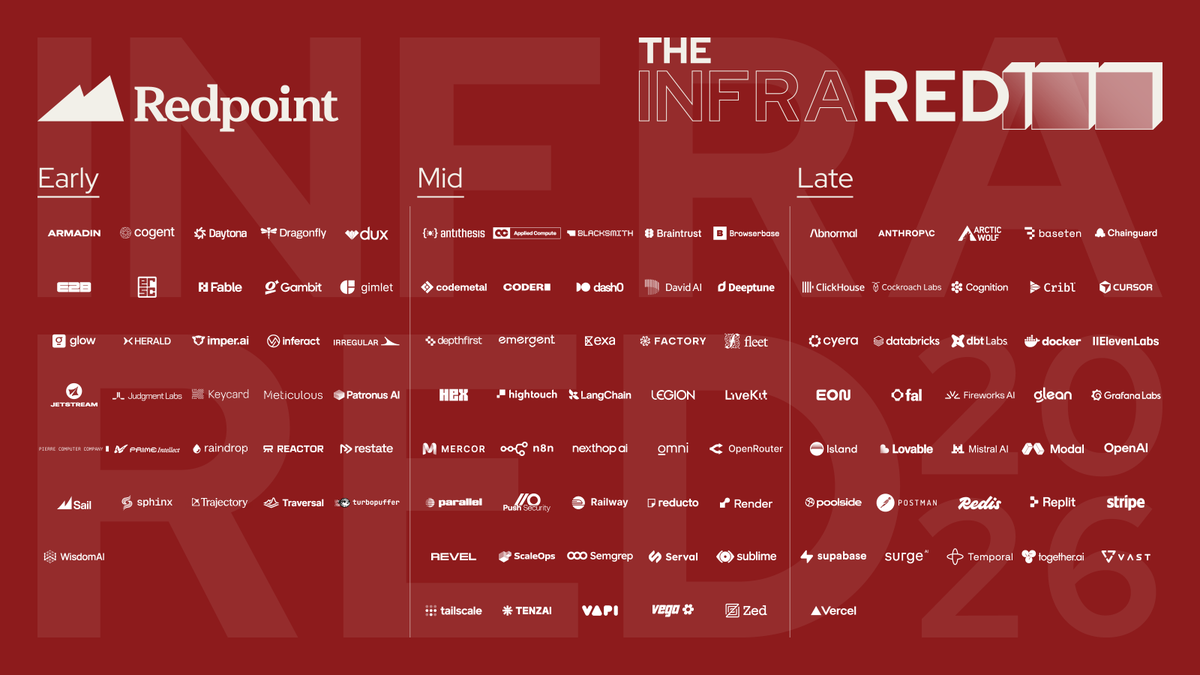
The Redpoint InfraRed 100 is now live.
These are the companies building the infrastructure that powers everything happening in AI right now, from world models and agent runtimes to the sandboxes, databases, and security tools agents depend on.
Congratulations to this year's honorees!
Read the full 2026 InfraRed Report: our state of the union on AI and cloud infrastructure 👉 https://t.co/Y1y94ZwI5B
@Google , you got confused! 🤦♂️
Apparently, my "מתכונים" (Recipes) document violates Google Drive’s Phishing policy. I mean, I know my stuffed peppers recipe is a great way to lure people to my kitchen, but I didn't think the Trust & Safety team would consider it actual cybercrime.
Watch out, those carbs are malicious. 🛑 🍕
@glcst I am seriously considering moving all our non-necessary workloads from GCP to another cloud. This incident is not about a bug. It's about a faulty process.
This company is in full AI mode and frankly I do not want to be the another victim of their next vibe-coded script.
@dragonflydb v1.38.1 patch release 📷 3 fixes:
→ Fixed O(n) scan in WATCH notification queue — this could stall commands when many keys were watched simultaneously
→ Fixed journal executor reuse during replication — improves replication efficiency
→ Fixed socket leak with BLPOP blocking connections
Might help with stability around job-management use-cases.
Dragonfly v1.38 is out 🚀
The big one: **up to 26% memory reduction** for TTL workloads! We eliminated the separate expire table entirely and embedded expiry directly into each key.
10M keys: 900 MB → 665 MB. No config changes needed.
I couldn't have solved this alone because the forensic work required ARM64 memory layout depth I don't have.
The AI couldn't have solved it alone because it lacked the system-level intuition to pivot away from its own hallucinations.
Everyone talks about AI writing code. Nobody talks about the harder part: debugging.
Last week, I spent 12 hours hunting a segfault in Dragonfly during S3 backups. Here’s how I used AI as a forensic partner to solve a "ghost in the machine" memory corruption bug on ARM64. 🧵
The Root Cause: A rare execution path where the S3 library combined with DNS resolution consumed more stack space than allocated.
On ARM64, this overflow was silent until the corrupted memory was accessed by the next coroutine.
Europe is in hibernation mode and it's both scary and embarrassing. And unfortunately, it's not clear if it will be able to evolve to save itself in time.
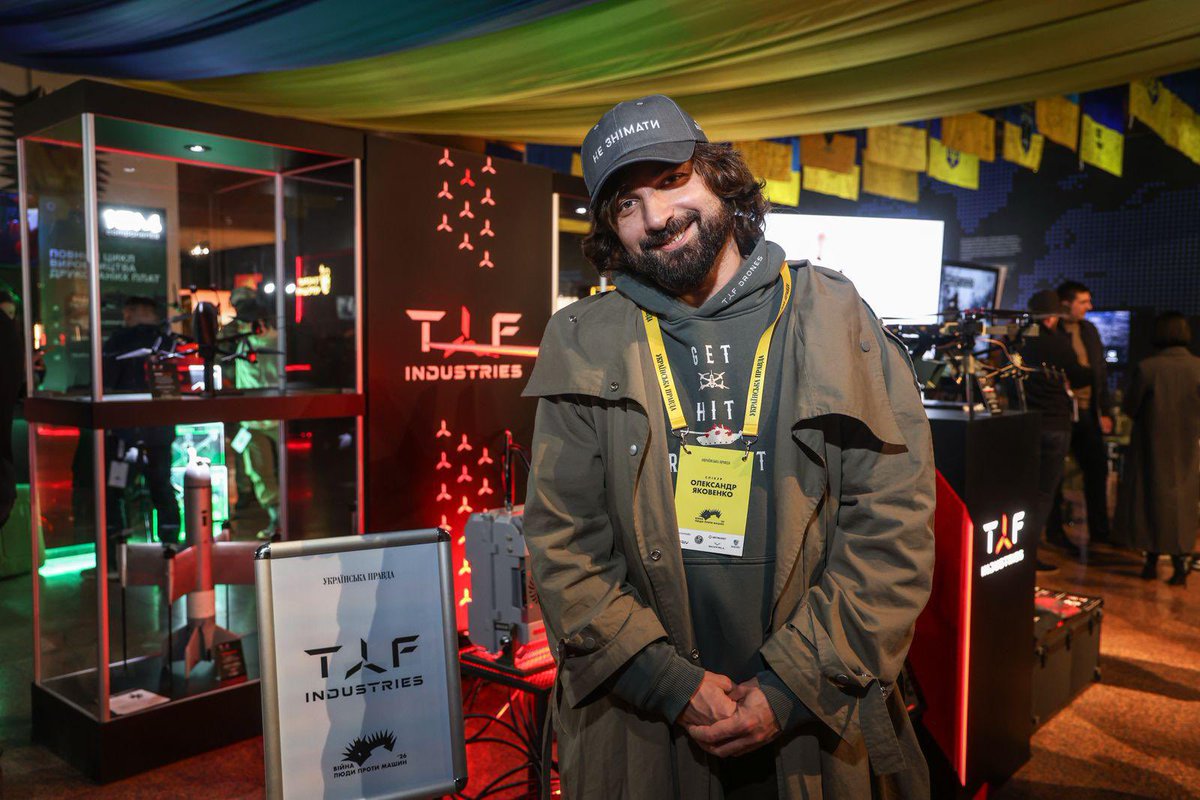
Dear Mr. Armin Papperger, CEO of Rheinmetall,
When you referred to Ukrainian drone manufacturers as “Ukrainian housewives with 3D printers” you revealed just how deeply the European defense establishment still fails to understand the nature of modern warfare.
This is not about emotion. It is about battlefield reality. Here are the facts your industry refuses to acknowledge:
In 2025 alone, Ukrainian drones carried out 819,737 confirmed strikes. They caused 90 percent of all Russian combat losses, more than all other weapons systems combined.
TAF alone produces up to 100к FPV drones monthly. In any given 90-day period, my company’s products alone achieve more confirmed strikes than your entire fleet of equipment has across its full combat history in every conflict. And most importantly, I built this company and achieved these results in two years, not fifty. Think about that.
Our drones generate more kinetic effect in three months than your flagship platforms have in half a century.
Why? Because the battlefield has changed, and your business model has not.
•Russian electronic warfare has made GPS-guided Western munitions such as Excalibur and GMLRS nearly ineffective.
•Expensive and complex systems designed for wars with air superiority and traditional peer-to-peer combat have become easy prey for drones costing $500, attacking them from above.
•The cost-to-effect ratio has been turned upside down: one 120 mm Rheinmetall shell or one anti-tank missile costs more than a dozen of our drones, and yet our drones still win.
This is not a “Lego game.” It is industrial Darwinism in real time. We iterate every week. We print parts in basements and ship 100к strike systems per month, while your engineers still require three to five years and hundreds of millions of euros in certification costs for even a minor upgrade.
The war in Ukraine is not a temporary anomaly. It is the first true drone-industrial war. And it has already proven that outdated European platforms, no matter how expensive or “serious” they may seem, are becoming less and less relevant unless they integrate the very technologies you mock.
So when you say, “this is not innovation,” I hear something else: “We do not want to admit that the future is being written in Ukrainian workshops, not in Düsseldorf boardrooms.”
#MadeByHousewives is trending for a reason. Because these “housewives” destroy more enemy equipment every month than entire European armies do in full campaigns. And they do it while your industry continues to sell 20th-century solutions at 21st prices.
The invitation remains open, Mr. Papperger. Stop laughing at the kitchen table. Come and learn how tomorrow’s war is actually being fought. Because the next time someone asks, “Who needs tanks in the age of drones?”, the answer may be simpler than you think: Whoever still believes in 1979 will lose to whoever is building in 2026.
With respect, but with facts,
Oleksandr Yakovenko “Ukrainian housewives”
Founder TAF
@dragonflydb@CeleryOrg@laravelphp The feature is experimental, shipping in the next Dragonfly release.
Benchmark repo: https://t.co/sfn30KmGaP
PR: https://t.co/glD3SNQ6zo
Two weeks ago I shared how much memory popular job queues consume in Redis.
I said we were working on something at @dragonflydb. Here's what we built. 🧵
I got curious: how much memory do popular job queues actually use in Redis? I benchmarked @celeryorg, @laravelphp, Sidekiq, RQ, Dramatiq, and others — 200K jobs across 10 queues each. The differences are massive. 📷
@dragonflydb@CeleryOrg@laravelphp Not everything compresses equally. RQ, Dramatiq, Taskiq — minimal gains. Different data structures, less redundancy.
This is pattern-dependent. But for JSON-heavy list workloads, the savings are dramatic.