Couldn’t be happier to share the news of our new platform - CLASSIC - which combines short (@illumina) and long-read (@nanopore) sequencing and #ML to build and characterise huge gene circuit design spaces in a single experiment! @krai_ostat@PieperTC https://t.co/4TUWrBCZde
We are pleased to share a paper from our lab out in this week’s issue of @Nature, where we show that HT + ML can dramatically speed up the synbio DBTL cycles, profiling gene circuit design spaces at unprecedented scale: https://t.co/7FwDVN4259 (1/16)
Really happy to see my work from grad school was published in @Nature this week. I had a phenomenal time leading this work along with @ronan_oconnell and all of our collaborators!
A deeper dive into what's new in this manuscript coming very soon from the @BashorLab!
What a great way to start the year! Thrilled to see my PhD work out in the world, co-led with the incomparable @kshitij_raiguy. Keep an eye out for a full overview of the paper from @BashorLab coming soon. Huge thank you and congratulations to everyone involved!
Our paper on functional discovery of protein degradation and stabilization effectors with proteome-scale induced proximity screens is out in its final version! 1/ https://t.co/vzNbJyR2rk https://t.co/5S9i7UG7JL
Just posted a preprint on our new spatial genomic recording system, baseMEMOIR.
https://t.co/ef5i8FnIOw
Motivation: Cells divide, differentiate, and migrate to form exquisitely organized tissues. Reconstructing the dynamic histories of individual cells, including their lineage relationships and ancestral states, is essential for understanding how intrinsic and extrinsic signals generate tissues during development and in regenerative medicine.
Engineered genomic recording systems can reconstruct cell lineage histories from endpoint measurements. However, existing methods either require sequencing (disrupting spatial organization) or have been limited in memory size and scalability.
To address this need, @ChadlyDuncan, Kirsten Frieda, and others in the lab created a high memory capacity image-readable recording system termed baseMEMOIR.
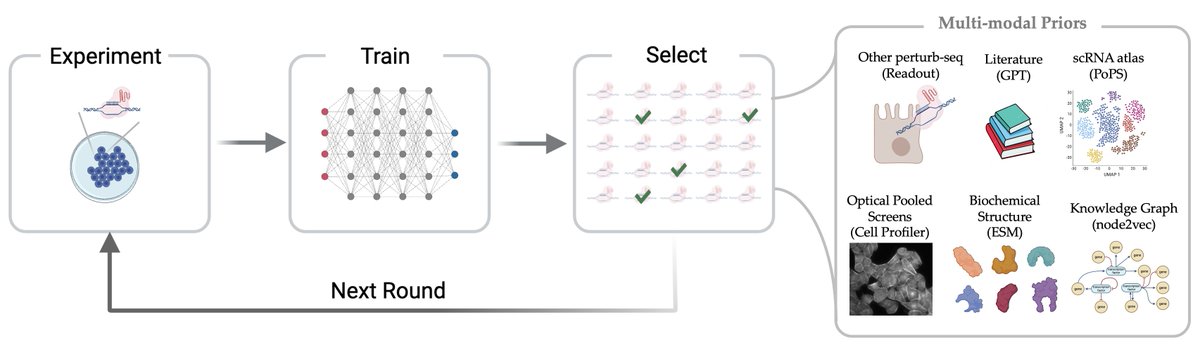
1/🧵Introducing Perturb-seq-in-the-loop: a sequential experimental design strategy for perturbation screens guided by multimodal priors, with 3X speedup over state-of-the-art active learning methods!
With amazing @_romain_lopez_@jchuetter Taka Kudo @antonio_science Aviv Regev
This weekend, myself, @krai_ostat, @tweetsatpreet and a few others are hosting a workshop at the ACM-BCB in Houston, TX (Sun. 9/3 at 8am) that centres around constructing explainable and biophysically-grounded models for genotype-to-phenotype mapping! We’d love to see you there!
In a new review (part of an upcoming series in Immunological Reviews on cell therapies) Sara Capponi (@sara_capp, IBM) and I discuss the potential of using AI to build predictive models that aid in development & understanding of cell therapies. https://t.co/n8HgR7QQSJ
How accurate is the new @nanopore kit14 chemistry for performing bulk and single-cell RNA-seq? In our latest preprint, we show that PCR is a major source of inaccuracy and sequencing error makes little impact. ONT accuracy is best over PacBio and Illumina. A 🧵. #ONT#Seq
Enter CLASSIC:
This system combines long-read sequencing and and short-read sequencing to create a dataset that links the composition of a genetic circuit to its phenotype in a cell.
The power of genomics 🧬
Out in @biomaterials now! Ag byproducts (rapeseed proteins leftover from canola oil production) can replace albumin in serum-free media for cultured meat, without much fuss.
This link https://t.co/rAEPtAqEsE gives 50 days free access. Enjoy! & thanks again to the whole team🤗🙌
BIG BIG day for the lab! 🎉🎉🎉 Congrats to @ronan_oconnell and @krai_ostat for leading the development of CLASSIC, an elegant combination of next-gen sequencing and ML to map the behavior for huge genetic circuit library.
A good synthetic biology read for the weekend. Gene circuits, libraries, ML, design rules, combined short and long reads to pair barcodes and construct ID