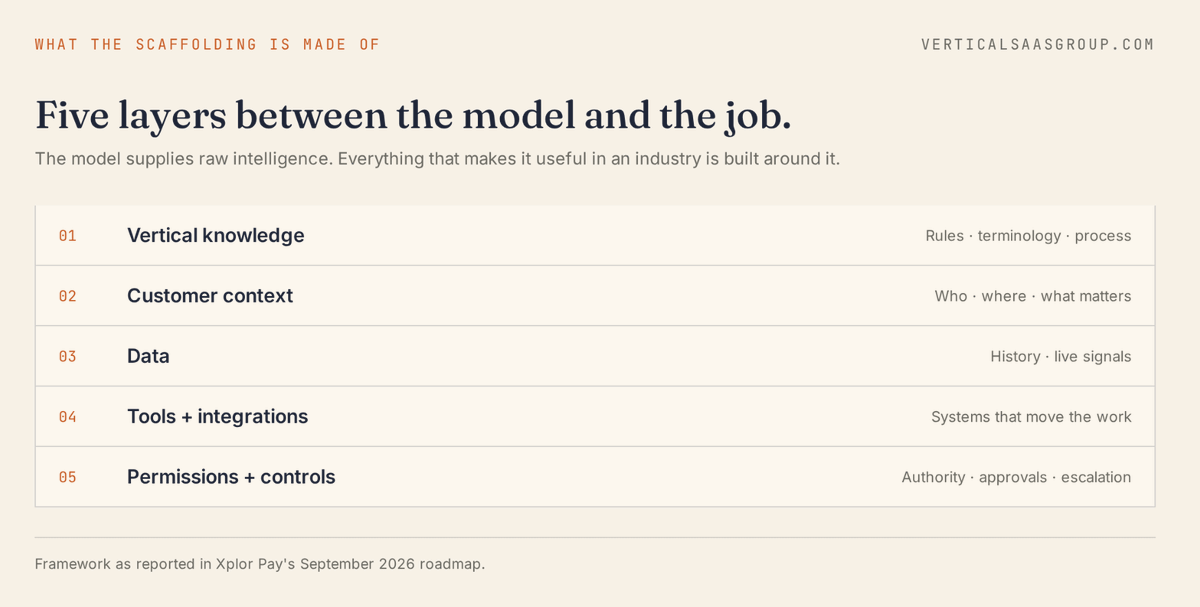
The scaffolding is what turns a horizontal model into an industry-specific gold mine.
OpenEvidence took a 55% accurate base model to 96.7% with five layers of scaffolding. Vertical knowledge. Customer context. Data. Tools and integrations. Permissions and controls.
The model companies will never build any of these for your industry. They do not want to. Every dollar you spend on their API is a dollar they get without hiring a single salesperson who understands your buyers. That trade works for them. The opening belongs to you.
Vertical knowledge and data. OpenEvidence locked up exclusive deals with NEJM, JAMA, Nature, NCCN, and Cochrane. Trained on 35 million peer reviewed papers a general model cannot legally touch. Your version is the industry data your customers generate every day that nobody outside your product ever sees.
Customer context. Hippocratic has 6,234 nurses on retainer grading every weird patient interaction their AI has ever had. Every mistake feeds back. That took them from 80% to 99.38% accuracy. Your version sits in your support tickets, escalation logs, and the heads of your best CSMs.
Tools and integrations. A model that can draft is a copilot. A model that can execute is an agent. The model companies will never wire tools into your customer's stack. Harvey turned legal workflows into tools that beat human lawyers on four of seven tasks.
Permissions and controls. Compliance rules. Approval thresholds. State regulations. Your best operators know every one of them. A horizontal AI company has ML engineers who have never worked a day in your industry. That gap does not close with more compute.
Nail one layer and you build a nice AI feature. Nail all five and you own the category.
The model companies gave you the intelligence. They will not give you the scaffolding. That gap is the entire opportunity.
I still believe a correct framing on LLM usage is that they can get you 80% of the way upfront, but that last 20% starts to become impossible to overcome. The proper way to use an LLM is to do the difficult manual 20% upfront. Once you have some decent structure, decent API surface area, decent data structures laid out, decent base libraries. Then you can largely prompt your way through the last 80%. While the first 20% which you did manually, intentionally and fully comprehend. That 20% essentially becomes part of your development harness, almost a prompt itself. Where you can steer its overall architecture, or data design, or other critical pieces by keeping a grip on that first manually done 20%.
Something real concerning with this. Knowing what to do in that first 20% requires advanced knowledge of the problem domain you are going to deal with. It is a staff or principal level engineer domain. Which most simply can't do.
Which means most people are going to run the gauntlet heavily relying on prompts, and are going to cover some incredibly impressive ground very quickly. Because 80% of the way is quite a long ways there. It looks like it could almost be done. But then they will get stuck in that last 20% and will never be able to make it perfectly polished. Nor perfectly sable. Nor remove all the odd quirks. Nor overcome the last pieces of performance or memory issues. It will basically hit a plateau where they lose control of it. Or it becomes unwieldy to take it in a new complex direction, or add some novel complex functionality to it. It will be very hard to tell from the outside if any given company or project is aimed at getting stuck in that last 20%. As they could appear to be kicking some major butt in that first 80%. But then it will reach a plateau where they can no longer do anything substantial without breaking something else, or seem unable to fix every little quirk or issue. A lot of companies will probably get stuck here. With dozens of very impressive things 80% of the way, but seem unable to get over the last final 20% to really perfect it and polish it.
Strategic congruence is the alignment of product complexity, ACV, and GTM motion. When these three elements are misaligned, everything downstream breaks.
The most common mistake: building a complex product that requires ripping out existing systems, 6 month implementations, and SEs on every call, then charging $25K ACV. The math does not work. You cannot sell high complexity at low price points. The friction will kill you.
This is not just a pricing problem. Once you lock in Product × ACV × Strategy, everything else must align: the sales leader you hire, the reps you recruit, the culture you build, the operations you design. A $25K ACV business requires completely different humans and processes than a $100K ACV business. You cannot mix and match.
The cascade works like this: product complexity dictates pricing, pricing dictates GTM motion, GTM motion dictates who you hire, who you hire shapes your culture. If the foundation is misaligned, every subsequent decision will be wrong.
I have watched companies hire world class sales leaders, build incredible products, and still fail because the three core elements were not married. Enterprise product complexity with SMB pricing. Wedge product with enterprise reps. Platform ambitions with PLG motions.
The mismatch is invisible at first. But it compounds. Deals take too long. Churn is high. Teams are frustrated. Something always feels off. That is the tax of incongruence.
Before you hire another rep, build another feature, or pivot your messaging: are your Product, ACV, and GTM actually aligned? Are they married? Or just awkwardly living together trying to make it work?
When software was expensive - thin, horizontal, best-of-breed software stacks extracted rents across every business.
Now that software is cheap - value moves to vertically integrated businesses that deliver opinionated end-to-end experiences.
When you go talk to users, don't (just) ask them what features they want. Ask them what problems they have. In the best case this will lead you to think of features they'll love but would never have thought to ask for. And expect to go through multiple cycles of ask-and-build.
The danger of selling to big companies, if you're a startup, is that they don't say no outright. They have months of meetings with you first. Since you hate meetings, that seems to you a sign of commitment. But it's not. They love having meetings! It's almost all they do.
When starting a marketplace, focus on getting more of whichever side is rarest, which is almost always buyers rather than sellers. (If it's sellers, you've discovered a gold mine.)
AI is a shortcut.
So it’s useful.
But it’s lazy.
So it speeds execution.
But it hides complexity.
So you want to use it.
But definitely not overuse it.
So the user of AI often loves it.
But the reader of AI often hates it.
Phenomenal quote by @sherylsandberg (quoted by @boztank in his interview):
Companies rarely fail by setting hard goals and missing. They fail by setting easy goals and hitting every one.
A startup doesn't have to be your life's work, but if it is, you become much harder to defeat. You play the long game and you outlast everyone. Because practically everyone else is an opportunist by comparison.
An alternative view is that as an industry matures products move from horizontal "does everything but not all of the thing" to specialized tools that do all of a thing.
Rent seeking is hardly what went on. These were real products doing things that had never been done at prices 1/100th of doing the same work without software and cheap relative to any cost of mini/mainframe software. Try writing a book without a word processor and laser printer, or M&A analysis without a spreadsheet and presentation package.
SAP is expensive. I challenge anyone to simply declare a cheaper solution exists. The complexity it embodies is not a rent seeking gimmick. We know this in part because it moved whole architectures and remains by far the cheapest solution at scale. Yes you can get cheaper expense reports or inventory parts management, but that isn't what SAP is.
MEMORY IS THE MOAT
@nikesharora, Chairman & CEO of @PaloAltoNtwks , interviewed by @HarryStebbings (@20vcFund )
Summary: Nikesh Arora took Palo Alto Networks from an $18 billion company to one worth $225 billion, and his read on enterprise AI is blunt: most companies are doing it wrong, and most of the products are not ready. His core claim is that consumers forgive AI's mistakes while enterprises cannot, so the money will flow to whoever builds the depth (the context, the memory, and the edge-case training) that lets an agent act without a human catching its errors. The companies that win will redesign themselves around AI instead of adding it to yesterday's workflow, and the lasting advantage will be the memory a system builds up about you. He expects token prices to fall 90%, half of G&A roles to disappear in 3 years, and more engineers and salespeople, not fewer.
1. Context Stickiness. The lasting advantage in AI is the context a system holds about you, not the model itself. Arora says the frontier labs are racing to remember what you asked over the last 30, 60, 90 days so each new answer gets easier and you stop wanting to leave. The more a model knows about a user, the higher the cost of switching, and that stickiness is the moat. For enterprises the same logic holds: the company that owns its context wins, not the one renting the smartest model.
2. Breadth Versus Depth. The frontier model problem is a breadth versus depth problem. Consumers tolerate false positives and enterprises have none to spare. Arora had Gemini write a passable investment memo in 4 minutes, and a wrong line or two did not matter because a person was sitting in the middle to catch it. An agent acting on its own has no person in the middle, so a false positive becomes a live failure. Consumer AI wins on breadth and brand, while real enterprise revenue comes from depth.
3. The Waymo Standard. Waymo is the biggest agentic product in the world, and it shows what depth actually costs. Replacing one human, the driver, took tens of billions of dollars of edge-case training and data that exists nowhere on the internet. You cannot drop the next Anthropic model into your Mercedes and tell it to drive you home. Every enterprise agent that truly replaces a person needs that same depth, which is why most agentic enterprise products are not ready.
4. Rethink The Workflow. Most enterprises are losing because they add a little AI to an old workflow instead of redesigning the workflow around AI. Arora's example: scanning an invoice 20% faster is the trap, while the real win is letting AI do 80% of the thinking, like reading every CV and telling you which 20 people to interview and what to ask each one. That means giving up human control, which is exactly what companies resist. The winners over the next 3 years rethink the company with AI, not the task.
5. Software With Opinions. The next wave of enterprise software will have opinions, and that is the real change Arora is pointing at. Coded SaaS gives you the output you defined for the input you fed it. An AI marketing assistant reads your copy, tells you it is off-brand, and says how to fix it. That opinion makes an average employee smarter, which is why Arora expects half the people in G&A functions like marketing, finance, and HR to be gone within 3 years.
6. More Engineers, Not Fewer. The fear that AI shrinks headcount is half wrong. Process-heavy G&A roles compress, but Arora wants more technical and more sales people. His teams keep asking for resources to rework marketing and HR, and for people who can prompt frontier models, build harnesses, and bring in data nobody else has. A good product also needs more sellers: he met 20 customers in Europe last week and half did not know what his 20-year-old company already ships.
7. Tokens At One-Tenth. Long-term token pricing should be a tenth of what it is today. Compute costs 2 to 4 times what it did 2 years ago because more than half of it feeds loss-making consumer AI, which forces the pricing pressure onto enterprise and coding workloads that have to pay. As compute gets more efficient and consumer usage gets capped, prices fall hard over the next 3 to 5 years. The model from 2 years ago was already good enough for 90% of tasks; the problem was it cost too much to run.
8. The Token Allocation Trap. Capping token spend punishes your best people. Arora runs a "use judiciously" model, not a free-for-all, because the smartest AI-savvy employee can burn 20 times the tokens of an average one. Playing whack-a-mole with cost hurts the high performers most and slows the learning you need. The better move is to track usage, leave the power users alone, and cap only the genuine outliers.
9. The Attacker's New Edge. Powerful coding models cut both ways. Trained to write good code, they are just as good at finding bad code. Pointed at his own systems, a model found in 6 weeks what would have taken his team 5 to 6 years. It cannot safely auto-patch, because it would "fix" 30% of things that are not broken, so it arms attackers faster than defenders. The result is urgency: every enterprise has to fix its systems faster, which is good for security companies.
10. The FTE Tell. If a startup needs forward-deployed engineers to sell into the enterprise, the product is not finished. Arora's read: enterprise AI is barely 12 months old, agents keep changing what the product even is, so vendors send engineers to build the product inside the customer while the technology keeps moving. A real forward-deployed engineer brings code back and folds it into the product; many are just adoption consultants. Expect customers to churn from one tool to the next, the way coding went from Windsurf and Devin to Codex, Claude, and Factory.
11. Three Missed Tricks. Miss one trick and you survive, miss two and you are partly impaled, miss three and you could be obsolete. This is why Arora spends more time than ever learning, pinging founders building things he does not yet understand. He buys early and cheap on conviction, treating an acquisition as a 10x or 100x bet where paying 1 or 2 times more does not matter, rather than waiting to buy the proven winner for a billion. He runs a twice-weekly "AI EIO" meeting so his top 15 leaders compete to show what they shipped.
12. The Sunk Cost Walk. A board member taught Arora to separate effort from wanting the outcome. After months grinding through a near-billion-dollar acquisition, he was told to take a long walk and ask one question: if this deal walked in the door right now with zero effort, would I still write the check? You have not spent a dollar yet, so the only thing that counts is whether it stands on its own merits. The same trap catches investors who confuse beating 8 VCs to a term sheet with the deal being good.
Snowflake CEO Frank Slootman explains why your company priorities are wrong
“I found out early on that if you can whittle things down to just one thing, you become unstoppable. Unfortunately, people resist whittling things down to one thing because it’s really hard to decide what that one thing is.”
The former Snowflake and ServiceNow CEO continues:
“People have a very easy time telling you what their top 3-5 things are because hopefully the right things are in there somewhere… I can’t tell you how many board meetings I’ve been in where the CEO puts a PowerPoint up and it’s one bullet after another listing all of the things that are their priorities. You just know that they’re going to be a mile wide and an inch deep, swimming in glue, moving like molasses. The energy is leaving my body already just watching a long list of priorities… You’ve basically devalued what you should be doing because you’re time-sharing now with all of these other things.”
Mr. Slootman urges founders to think really hard about the one thing that matters most to your business and focusing entirely on that.
If you can’t decide, just pick one:
“I like to do things in sequence. Even if you’re not sure, do it anyways. Because in the process of doing, you’re going to find out whether you’re right, wrong, or somewhere in between, and you can adjust.”
When you prioritize just one thing, things move much faster:
“Things are going to go much quicker because have a narrower plan of attack. It’s energizing. The pace picks up.”
Source: @twistartups@Jason (Jan 2022)
GROWTH FOUNDERS: HIRE A NEAR-PEER
A portfolio founder approaching $100M in ARR asked me about the single biggest and most impactful hire they can make.
I thought for a bit tand said: "Hire a near-peer".
In every generational company I've been part of, the founders hired a near-peer, who was essential to the company's success.
- Google: Larry and Sergey hired @ericschmidt .
- Facebook: Mark hired @sherylsandberg .
- Square: Jack hired @rabois .
- DoorDash: Tony hired @chrispa
- Coinbase: Brian hired @emiliemc
Characteristics of a near-peer:
1. They're so good that the founder will be fine reporting to them if the roles were reversed. (Mark has said publicly that he'd be fine reporting to Sheryl)
2. Their strengths perfectly complement the founder's strengths; however, they share many cultural attributes with the founder and pass the founder's airport test, since the founder will be spending a ton of time with them (example: Eric being a Computer Scientist, which was culturally very important at Google back in the day)
3. They're systems builders who have already operated at the scale you're growing into. Pattern recognition on $100M to $1B is not something you build in real-time.
A near-peer lets the founder focus on what only the founder can do (product, vision, culture). The near-peer handles everything else.
Also, near-peers stay for the long haul. Decade-plus tenure is standard.
The reason this hire matters more than any other: after $50M ARR, the bottleneck shifts from product-market fit to organizational scale. The founder is still the visionary. But the company needs someone who has already scaled a company of that size.
Most founders wait too long. They hire functional VPs first (Sales, Marketing, Engineering, Finance) and hope the collective covers the gap. It rarely does. A stack of VPs reporting into a founder who has never scaled a company creates coordination overhead, and the founder becomes the bottleneck.
The near-peer absorbs that overhead. They turn the founder's vision into daily operating decisions. They give the VPs a leader who has actually run a company this size.
Growth founders: if you're between $50M and $300M in ARR and every week feels like a coordination tax, the near-peer is the hire that determines whether you build a $10-100B company or top out at $1B. Start the search now, ideally through warm intros from your venture/angel investors and advisors.
"In order to make a decision you need to focus on the consequences (which you can know) rather than the probability (which you can’t know) is the central idea of uncertainty." - Nassim Nicholas Taleb