@DeFiTracer Yeah... Let me steal and use billions of other peoples money and I'd be a great investor too... It's not rocket science, those who have access to large amounts of capital can invest in venture capital...
@blknoiz06 It is really nice having some of the Solana/crypto native dapps that you can't get anywhere else. And also the security of knowing your phone is also a hardware wallet...
Join us TOMORROW for a live demo of the upcoming features in the BIOS AI Scientist w/ @BioAIDevs
> New biotech tool integrations
> Segmentation
> A look at what's shipping next
Register below ↓
The $13T global real estate market is finally getting an AI overhaul. 🏠🤖
@Rentberry_ is streamlining the rental journey in 90+ countries—no brokers, no friction, just pure automation. 🚀
https://t.co/g7PXXGtcw1
AI agents are beginning to perform real biological analysis: inspecting datasets, running computational workflows, and producing valuable research outputs.
As AI for science moves closer to practical use in labs, the question of how to effectively evaluate biological agents becomes increasingly important.
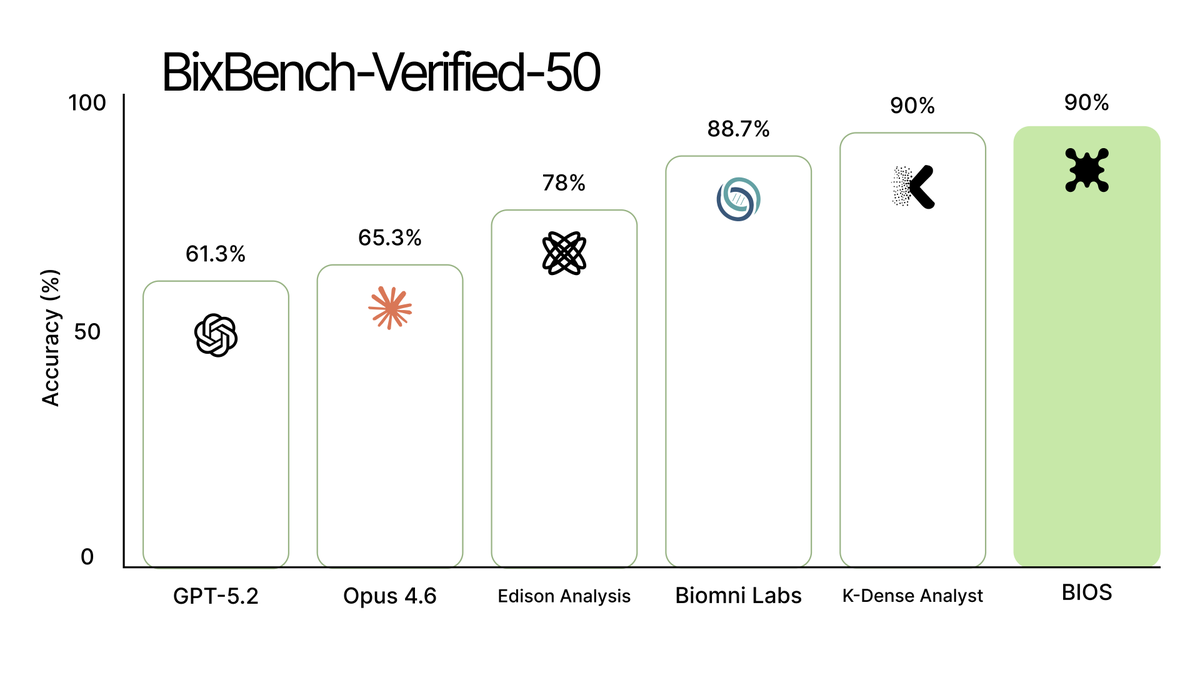
The BixBench Verified 50 is a curated list of questions for evaluating biological agents across several bioinformatics domains.
We tested the BIOS AI Scientist on the BixBench Verified 50 alongside general-purpose and domain-specific AI agents.
BIOS led with 90% accuracy along with K-Dense.
Followed by:
> Biomni Labs - 88.7%
> Edison Scientific - 78.0%
> Claude - 65.3% &
> OpenAI Agents SDK - 61.3%
See the full results: https://t.co/FnRJrQASHS
One key takeaway: evaluating biological agents isn’t just about whether the analysis pipeline runs correctly.
In one benchmark task, the agent computed the correct correlations, but misinterpreted the biological meaning of a dataset column.
The result: numerically correct analysis, but biologically flipped conclusions.
As biological agents move from controlled benchmarks to real-world scientific environments, we need to evaluate the workflow, assumptions and reasoning, not just whether the final answer is numerically correct.
Read more in our blog post: https://t.co/Kt2OeXJlI5