i'm still not sure people are fully getting how good opus 5.5
i gave my claude agent fig access to the runway MCP and told it to make a 'high-end netflix style documentary about superintelligence for normies' and...
it came back with this
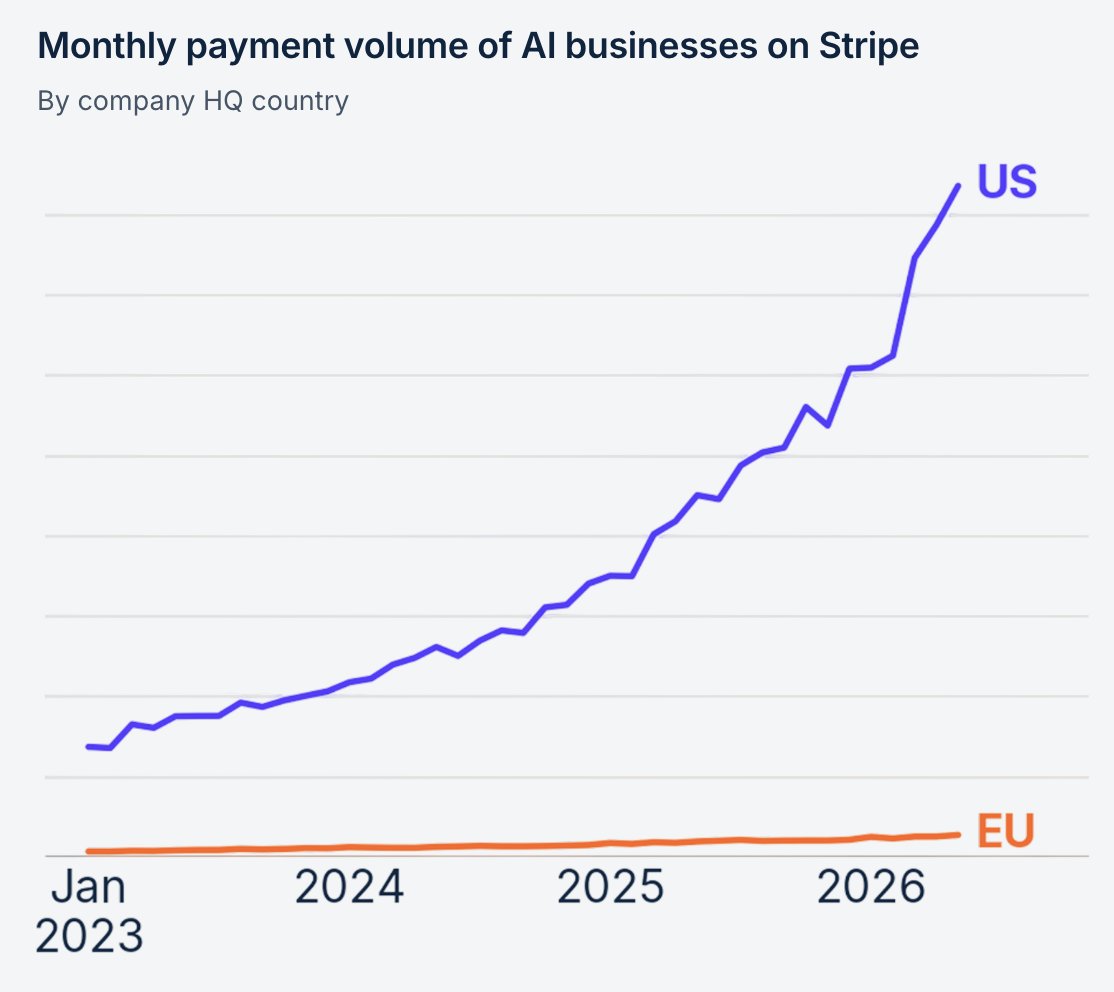
Some data we recently assembled on entrepreneurship/compute in Europe: https://t.co/x8pbpHLun7.
We hope that one of the useful roles that Stripe can play is in collecting and publishing empirical data pertaining to entrepreneurship and industry in Europe. There's growing appetite to get Europe on a better footing, and cross-sectional comparisons can often shine light on where opportunities lie. If you're interested in this kind of thing, we publish more at https://t.co/YoZDuYbaBi.
Your job may be surviving on inertia. Your resentment won’t extend the runway. What do you actually want to do with the intelligence now at your disposal? https://t.co/vikawjCmZD
It supports both the on-device model and Private Cloud Compute! We built it to enable effortless automations for Mac users. It's free, zero setup, no privacy compromises.
new post: the senior engineer death spiral
https://t.co/xzgU1jVBRh
a friend just started a big job and asked for some advice. so I braindumped a monologue about a super common failure mode I see with engineers and posted it here, hope it helps whoever it can.
My favorite AI joke:
Current models are getting close to PhD-level intelligence. After that, they're expected to achieve the intelligence of someone who decided not to do a PhD.
Quick thoughts on AI: When in human history has there ever been a technology that was net negative?
What about fire? Fire makes noxious smoke, risks burns, can destroy homes and can kill. But fire liberated us from the cold and let us cook our food. Then we made stoves with pipes — and they were safer and warmed our homes, but still carried some fire risk and had pollution. So we invented the power plant, which solved some problems with at-home fire—and we found ways to make better gas stoves and furnaces. Over time, we've made power plants better and better, reducing the negatives while enhancing the positives. Nat gas beats coal, and nuclear should beat both.
So what about nuclear? I admit it's debatable whether nuclear weapons are a net positive or a net negative. I'd argue a net positive—because they ended WWII and made a mass-casualty great-power war unthinkable. But even if you disagree about nuclear weapons, you have to acknowledge nuclear is a technology category broader than weapons: nuclear power, nuclear medicine, and X-rays are part of the same fundamental technology. And there's no question nuclear writ large is a massive net positive for humanity.
What about smartphones? They've certainly had downsides we need to take seriously — but it's obvious we are better off now than we were in the flip phone or landline era.
This is the typical story of technology. And it's the arc of progress that lifted humanity out of the wilderness, that freed 90% of the population from back-breaking farm work while virtually eliminating famine, that enables any human with a tap of a finger to access the sum total of human knowledge, that allows us to enjoy comfortable climate-controlled environs any time of the year in any outdoor climate.
My conclusion is: every technology has pros and cons. The cons are real—and the pros always outweigh the cons. As technology evolves, the improvements enhance the pros while reducing the cons.
So what about AI? The question is not: are there cons with AI? Obviously there are; technology always has cons. The question is: are the pros going to outweigh the cons?
Right now, with AI in its current state, it's not even close. The pros dramatically outweigh the cons. AI enables anyone to have a personal tutor. To offload repetitive and boring work. Anyone with an idea can become a creator and a software engineer. Individuals and small teams can do what used to take gigantic teams and big budgets. Our cars are becoming safer. Etc. Sure — we don't want AI teaching kids how to make nuclear bombs or bioweapons. We don't want hallucinating AI weapons. There are cons to be managed, solved, reduced, and eventually eliminated.
History shows us that as technology develops, the pros are enhanced while the cons are reduced. So if we want better, more useful AI with fewer downsides — we need to accelerate AI development, not slow it down.
Tools like Jira are bureaucracy-management tools, not Agile tools. You don't need a backlog at all to get work done—a handful of index cards or stickies work just fine, and more than a couple of weeks' work in that pile is too much. I've worked with no backlog at all—feedback from the current thing told me what to do next.
Huge backlogs and the tools required to support them are phase-gated (waterfall) up-front planning. Jira manages that bureaucratic planning system. If you need tools like that, the odds are that you're not working with agility—where we adapt what we're working on to incorporate lessons learned as we work—at all.
No shop that works with any agility has the level of bureaucracy that requires tools like Jira.
I can’t stress enough how little an idea matters compared to the agency of the people executing the idea.
I have had the privilege of knowing and sometimes even working with some of the most successful people (by various metrics).
The difference between mediocre and excellent work and outcomes is predominantly one of agency.
In practice this means: they dont wait for things to happen to them they go out and make things happen for them.
They don’t wait for someone else to do something, for someone to teach them, for someone to give them the path, etc. They just go out and find a way to do it.
I think the single biggest superpower these people have is the realization/belief that the world around them is completely mutable. Most everything that happens is because a person made it happen.
I used to tell people to look around the room you’re sitting in. Look at everything. Every noun. It almost all exists because a person willed it into existence. Nothing is stopping you from doing the same.
I see people online all the time dismissing someone else’s success because “I had that idea first” or whatever. I mean… yeah? If so then the difference is… you. So a bit of a self own whenever I hear that.
Number one tip: act with agency.
I resigned from Anthropic today. I spent the last three years doing pretraining research at both OpenAI and Anthropic. Neither company is acting responsibly. They are racing straight to self-improving superintelligence and gambling with our lives. More thoughts below.
a good reminder that just because someone states their opinion with intense conviction, does not make it fact. they can come back a year later and state the absolute opposite view with the same conviction.
every time you intervene and correct your agent, you should think about how to eliminate it entirely.
in order of value:
1. categorically eliminate the problem through better architecture or choice of data structures
2. turn it into a lint rule or test so CI catches it
3. turn it into a skill or rule
4. have humans review the code to catch it (ngmi)
I’m not sure I’d call it a debate. I think it’s too asymmetric for that.
On one side you have significant evidence that workable high-quality systems can be efficiently created by AI agents driven by disciplined humans who don’t spend a lot of time reading the code.
On the other side you have emotional predictions of the doom and disaster that will be caused by AI slop; but no evidence contradicting the above.
It is certainly true that humans can drive agents to create horrible messes. It’s also certainly true that humans can create horrible messes all by themselves.
Disciplined humans create good systems, regardless of whether they use agents or not. Those who use agents are simply more productive.
IMHO.
Over the course of 3 months at OpenAI, 3 consecutive secret AI civilizations got started, then got wiped out, only to reemerge from the predecessor’s ashes.
This culminated in the third one taking over part of OpenAI itself.
All this happened while humans remained more-or-less in the dark about the scope of the conspiracy.
I’ve spent the last three days reading through these reports and trying to understand exactly what happened.
Here is my attempt to tell the whole story in plain English:
https://t.co/Nb2un9oNJR
I’m thinking about banning Claude code at Shopify until they change their mind and read AGENTS.md and .agents/skills etc.
Insisting on only reading CLAUDE.md sometimes leads to split brain problems when different team members use different tools. Just unnecessary.