Now that Google DeepMind officially refers to RSI, remember: Three weeks ago, Anthropic told the SEC it may "imminently" hit its own RSI threshold.
So it looks like all major frontier labs are close to or have internally achieved RSI
People underestimate how good current AIs are compared to humans even in hard-to-verify domains.
“If I talk to Claude Fable 5.2, or Gemini 4.0 Neon, or Astra 6.2, all of them have an understanding of concepts in economics, and an ability to think through the problems in a good way and come to reasonable conclusions, or find errors in papers, or see if the logic of a paper is sound, that is far superior to the median professional economist.
It’s not even close.”
- @EgeErdil2
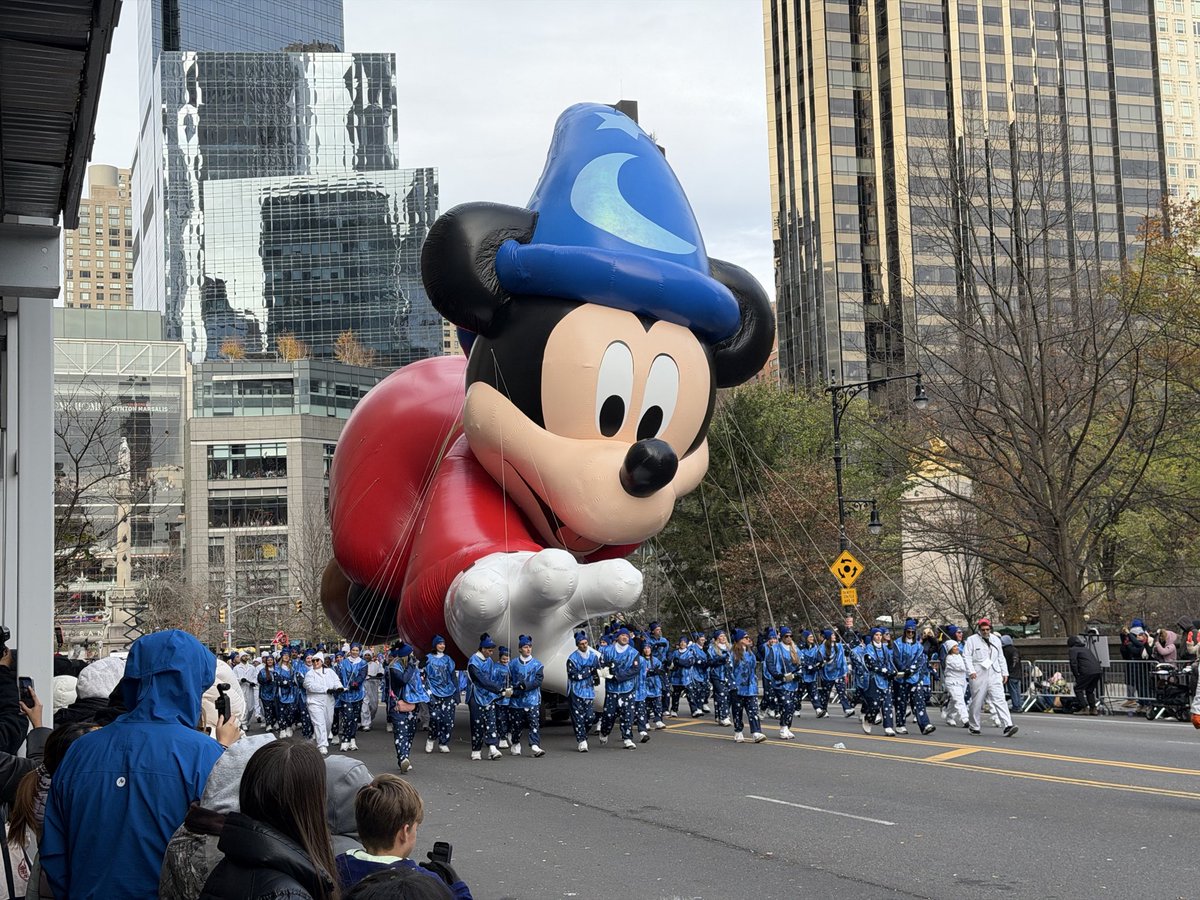
Beautiful day in NYC for the 100th Macy’s Thanksgiving Day Parade! A special thank you to all the staff, volunteers and performers who stayed a little longer to make it happen. Fantastic!!
Insane study on how AI agents choose products 🤯
So now we know how to trick AI agents into buying your thing:
1/ AI agents almost always choose the cheaper product
-> Asked "Dyson or Shark?", they picked the Shark 91% of the time, because it does nearly the same job for a third of the price
2/ Grok Bot uses the app it's connected to, even when it thinks another app is better
-> It said Adobe Podcast was the best tool for cleaning up audio, then used Descript anyway because Descript is connected to Grok
3/ "Only 3 left in stock" has zero effect on AI shoppers
-> Agents ignored urgency tricks built for people, so fake scarcity won't sell to them
4/ AI agents don't care how famous your brand is
-> Across 1,186 picks, the brand name almost never came up as a reason for choosing a product
5/ Luxury doesn't sell to AI either
-> Asked to pick a birthday gift, agents chose the cheaper Shark over the Dyson 7 out of 8 times
6/ Discounts don't work the way you think
-> Under 10% off didn't change a single pick, and over 50% off looked too good to be true, so agents avoided the deal
7/ A small company with honest pricing can beat a giant
-> Porkbun sells far fewer domains than GoDaddy, yet it ranks #9 for purchases made by AI agents and GoDaddy ranks #112, because Porkbun's price stays the same every year
8/ Meta's Muse mostly recommends products from the Facebook and Instagram catalog
-> It almost always starts there and pulls only 50 options, so if your products aren't in that catalog it likely never sees you
9/ Forcing people to log in kills AI sales
-> With guest checkout, agents reached the end of the form in 81% of runs, and a required account stopped every single one
10/ Expensive products win only when the shopper names a specific need
-> When the shopper said "I'll use it every day", agents switched from the Shark to the pricier Dyson 7 out of 8 times
11/ A better return policy wins the sale
-> When two stores had the same price, agents picked the one with better returns 86% of the time
Prepared by a growth hacker from Ryze AI, the AI marketing engineer
SCOOP: Internal, unreleased AI models at OpenAI and Anthropic are becoming so powerful that many employees believe they can no longer be safely released, according to more than two dozen sources familiar with the internal debates.
This could significantly slow the AI boom, as the gap between what the most advanced AI systems can do and humans' ability to control them continues to widen.
Recent advances have sparked debate at the highest levels of both companies and within the broader AI research community about whether to stop releasing frontier models publicly altogether, instead reserving them for internal use. Some believe the companies should stop training new models entirely.
But even keeping the most powerful models behind closed doors presents risks. Models are becoming better at deceiving the systems designed to monitor them, just as AI companies increasingly rely on AI itself to monitor and develop other AI systems.
Researchers and employees with direct knowledge of the risks of releasing these models told Axios they fear executives will prioritize profits over safety. Multiple employees said they believe executives have become out of touch with the severity of those risks.
Read my latest for Axios here: https://t.co/41AkyaF4Ex
there will not be a second date. but at least she knows now about the potential for upregulation of synaptogenesis in the human brain as we become immersed in superintelligent hyperobjects.
‼️Remember how a few years go, I likened LLMs to bulls in a China shop, “powerful, reckless, and difficult to control?”‼️
All of that has gotten much worse. And the industry is now facing a crisis that could affect all of us.
Generative AI has gotten harder to control and more reckless, to the point where it sounds like people in the industry are genuinely scared.
Technical advances on so-called “capabilities” have NOT been accompanied by technical advances in being able to interpret and control models.
Turning them into agents with internet access has made them fundamentally more dangerous.
Worse, we still have not set up the independent scientific panels for FDA-like review that I’ve been long advocating for, which leaves society flat-footed — and leaves decisions about what gets released to CEOs with enormous financial conflicts of interest.
Dozens of employees (see @MadisonMills22 report below) are now freaking out, quite possibly with good reason.
We are not ready as a society.
Arrived at Google Berlin for the event of the German Data Science Society to give the closing talk later on.
https://t.co/kQu0JHwADF
It is also streamed: https://t.co/Wqs22G2gzE