AI Safety at @coeff_giving (fka Open Philanthropy). Formerly economist at @NuffieldCollege / @GPIoxford. Interests: AI/GCRs, development econ, animal welfare
Very pleased indeed to see this from OpenAI too. Let's get going!
"As frontier AI development continues, we expect national and global coordination to become more important. We have long believed there should ultimately be an international organization that helps coordinate leading AI efforts to reduce catastrophic risk. Cooperation and shared safety standards are an important part of the path forward, especially because the incentives around commercial and national competition are hard to escape. One goal of such an organization should be to make it possible for the world to take coordinated action, including slowing frontier development when needed, so societal resilience, safety, and alignment can keep pace."
This track—and MATS more broadly—is a great way to develop an idea for a new AI safety org to the point where it's ready for CG funding. I bet we'll end up making some seven- or eight-figure grants to new orgs that come out of MATS this year.
Today, @coeff_giving is launching the Strep A Vaccine Fund, a multi-donor initiative to accelerate vaccine development against one of the world's most neglected infectious diseases relative to its scale.
Strep A kills ~639,000 people a year. There is no vaccine. I think that can change 🧵
Today we're launching the Strep A Vaccine Fund: a new multi-donor initiative to accelerate vaccine development against one of the world's most neglected infectious diseases, relative to its scale 🧵
It's not yet visible from the outside (though it will be soon), but CG has shifted gears recently and is making some very big plays. E.g. the new "short timelines" team.
If you have creative ideas for using millions of dollars to prevent AI catastrophes, you should apply.
We're hiring grantmakers and senior generalists across our Global Catastrophic Risks teams.
Right now, our biggest constraint is people, not funding, which means every strong hire directly translates into more critical work getting done. 🧵
We're hiring Research Fellows and Strategy Fellows to help us prioritize and launch new $100M+ Global Health and Wellbeing funds, design systems to evaluate our impact, and conduct research to inform our grantmaking approach.
Apply by May 10: https://t.co/XRTM6vgZSt
Excited to share: the Development Innovation Ventures (DIV) Fund officially launched this week as an independent nonprofit.
@coeff_giving is proud to be an anchor funder. 🧵
New column: I went to visit @METR_Evals, the 30-person AI nonprofit that makes the Most Important Chart in the World.
I learned a lot, but the most striking thing was how soon some of them think AI R&D could be fully automated. (This year!)
https://t.co/EWnYZ7WG0p
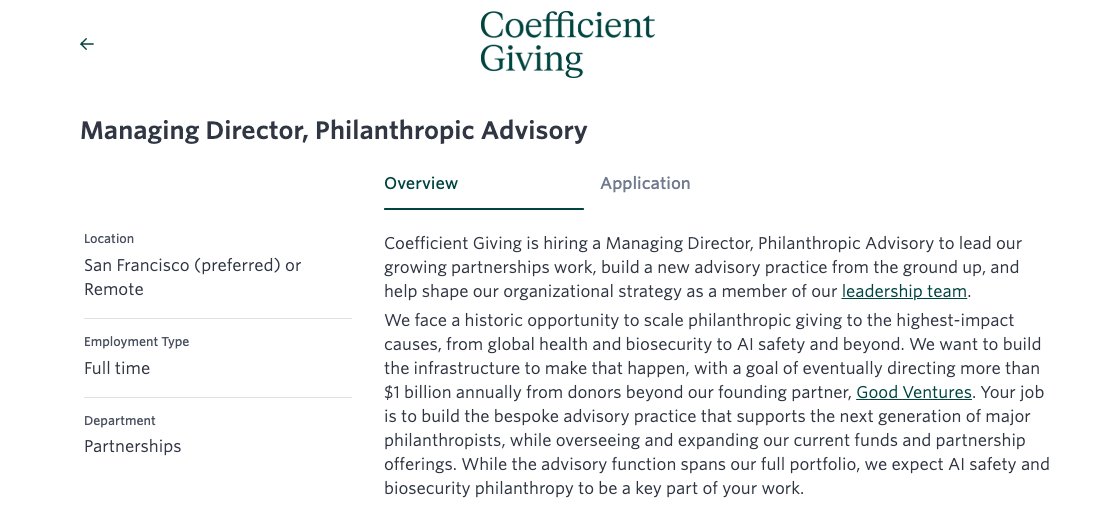
In the coming years, billions of dollars in new philanthropic capital could be unlocked. Whether that money is matched to the highest-impact opportunities is far from guaranteed.
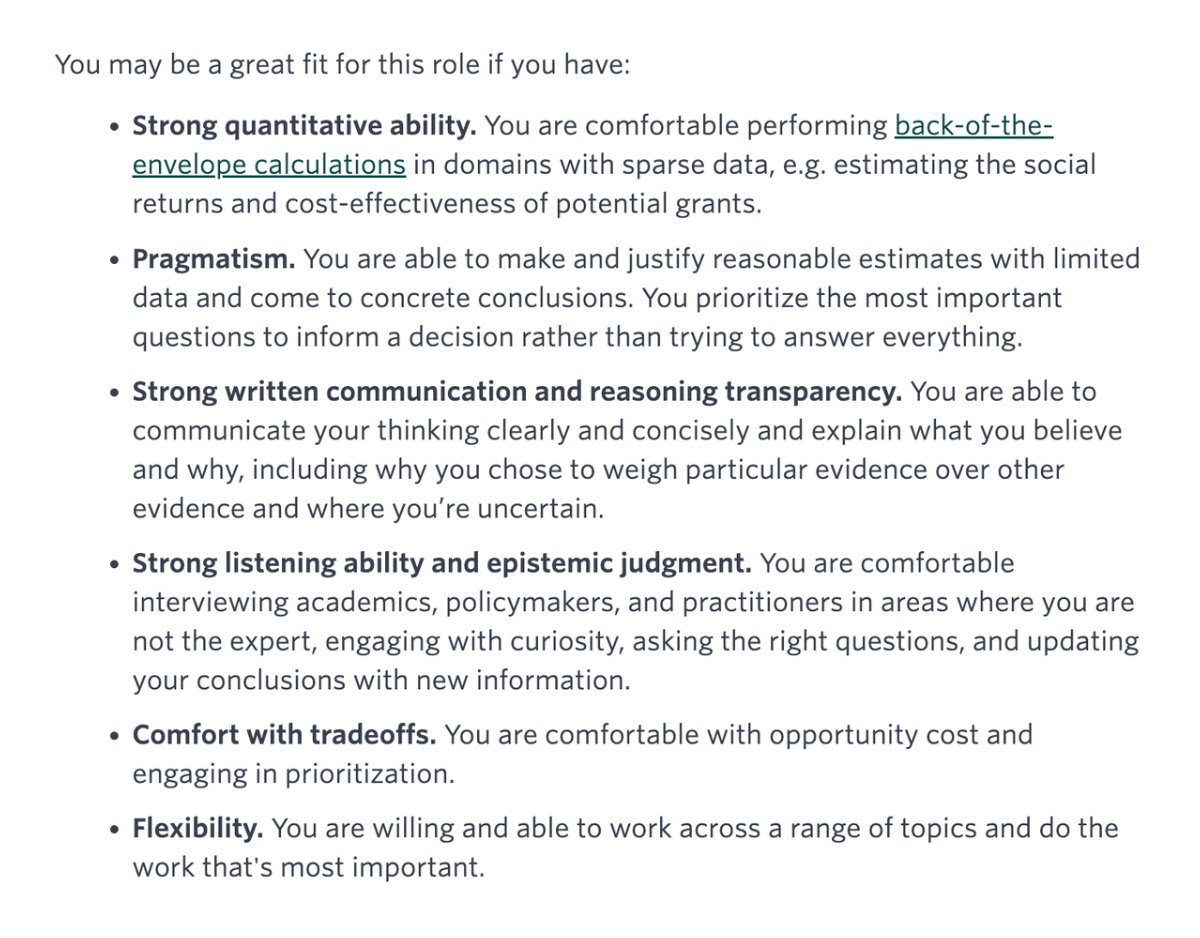
At @coeff_giving, we’re hiring for a Managing Director, Philanthropic Advisory to make this influx of capital go as well as possible. This person will build a bespoke advisory practice from ~scratch, lead our partnerships team (12 people and growing), and sit on our leadership team. The ideal candidate is:
• Strategically sharp and substantively deep on CG’s cause areas
• An effective executive that can build a strong team
• An excellent external representative of CG’s work to major donors
We’re not looking for a conventional fundraising background. We want someone with the capability and drive to be a “general manager” of directing new funding to impactful causes (h/t Nan Ransohoff) https://t.co/BNz2t85Lfs
The application form is here: https://t.co/18iF2Gv64F
This is one of the most important roles I’m hiring for this year - if you’re in doubt, please apply!
AI timelines update: @DKokotajlo and I have updated our timelines earlier by ~1.5 years over the last 3 months, primarily due to (a) expecting faster time horizon growth, and (b) coding agents impressing in the real world. During 2025, we had updated toward longer timelines.
In 2022 and 2023, tiny teams of researchers drew straight lines on graphs that predicted the US was headed for an energy bottleneck in AI. But the government had no idea.
The future of AI is too important to make the same mistake again. We need talent-dense, AI-focused offices that can skate to where the puck is going and implement President Trump’s AI agenda.
In a new piece for AFPI (@A1Policy), we discuss 2 promising offices that could act as hubs of government AI foresight: the Center for AI Standards and Innovation (CAISI) in the Department of Commerce and the Bureau of Emerging Threats (ET) in the Department of State.
We found that they have the density of talent to succeed but still lack resources: funding, headcount, and authorization. Here’s a summary:
1) The Center for AI Standards and Innovation (CAISI) lacks resources
> It has talented technical staff and a strong track record in evaluations, industry relationships, and insight into China
> But it’s chronically underfunded. It’s been around for 3 years but only received $30M in total, not annual, funds. That’s 11 times less than the UK’s equivalent. (It’s even short of Canada and Singapore)
> It’s only has 20-30 employees who are swamped with workstreams and external requests from agencies like the IC
To solve this, Congress should fund CAISI with an annual budget of $50-100 million.
2) CAISI lacks authorization or a focused mission
> Between Department asks, inbound from other offices, and the AI Action Plan, it has more missions than staff
> Its critical mission could be threatened by future administrations, who would externally pressure it to pursue DEI initiatives
Congress needs to enshrine the office and give it a clear mission. We present an America First vision for CAISI, in which it acts as a technical strike team, bridge between industry and government, frontier analysis unit, and technical standards organization.
3) The Bureau of Emerging Threats (ET) lacks authorization
> ET is similarly talent-dense, with experts in cyber, AI, and international relations
> But it lacks congressional authorization and could be destroyed or co-opted by future administrations
The Bureau needs concrete support from Congress and levers of interagency influence, like regular reports to national security leaders.
With appropriate action, Congress can help ensure the President has the resources he needs to help America win the AI race and usher in a new golden age of human flourishing.
Always fun to collaborate with @CrovitzJack and @YusufSMahmood, who have posted about other sections of our piece.
Up to $20m is available, primarily for late-stage clinical trials targeting high-burden, neglected diseases in LMICs. We've supported around a dozen repurposing trials to date, and early indications are promising.
Coefficient Giving recently passed $5 billion in total grants directed since we started in 2014. A few things about what that number actually represents 🧵
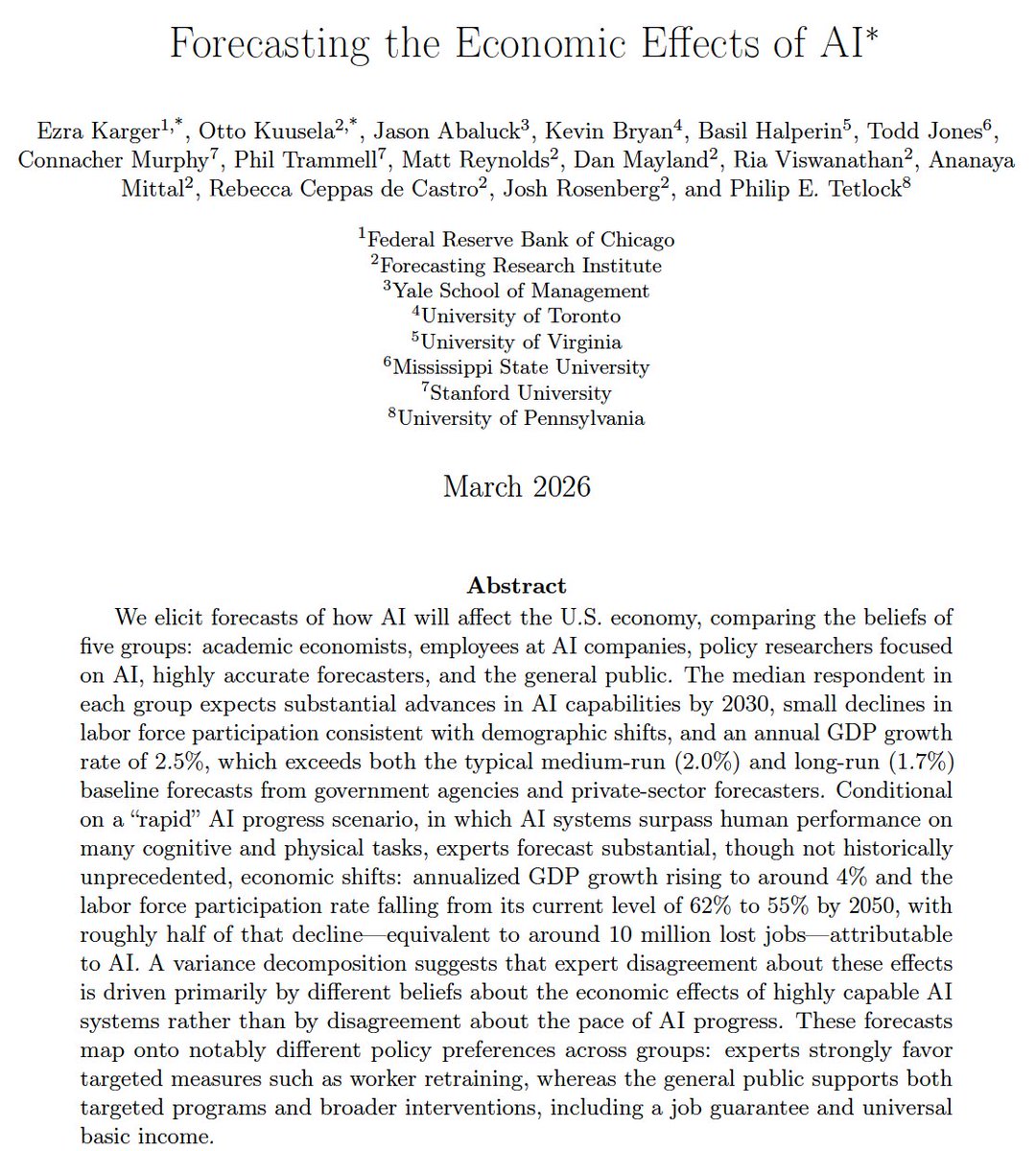
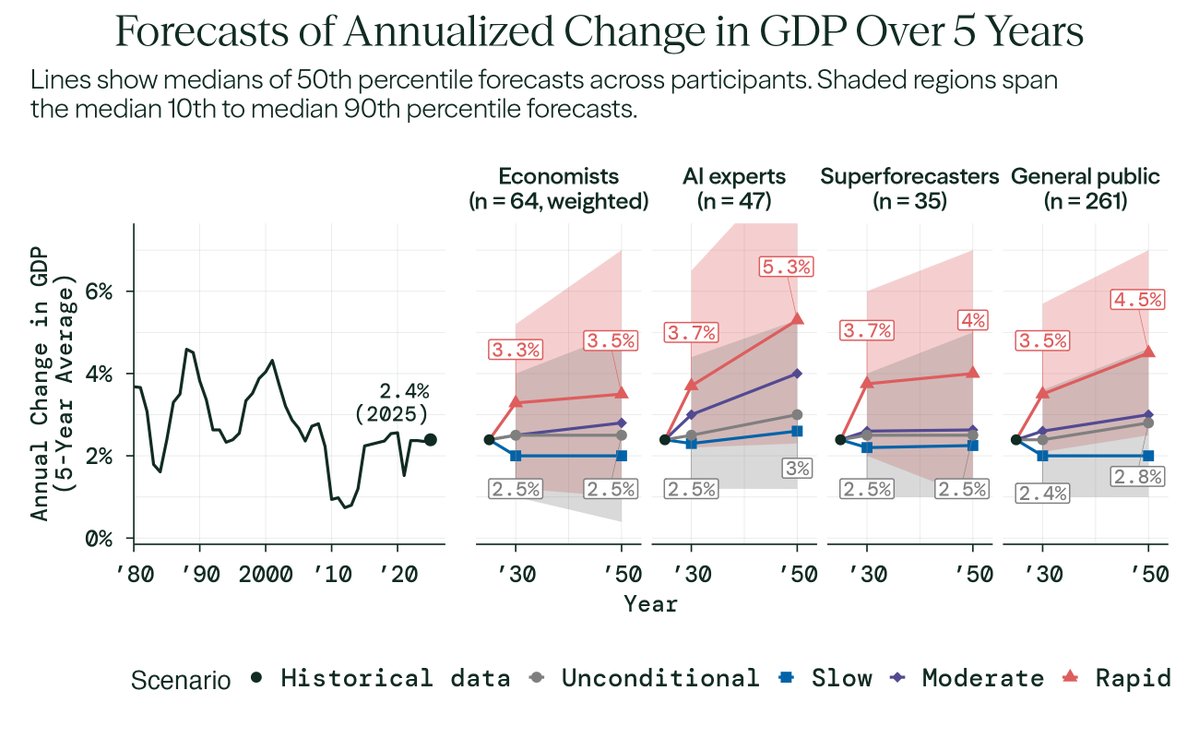
We completed the most comprehensive study of how economists and AI experts think AI will affect the U.S. economy.
They predict major AI progress—but no dramatic break from economic trends: GDP growth rates similar to today's and a moderate decline in labor force participation.
However, when asked to consider what would happen in a world with extremely rapid progress in AI capabilities by 2030, they predict significant economic impacts by 2050:
• Annualized GDP growth of 3.5% (compared to 2.4% in 2025)
• A labor force participation rate of 55% (roughly 10 million fewer jobs)
• 80% of wealth held by the top 10% (highest since 1939)
🧵 Here's what we found:
I'm joining the OpenAI Foundation to lead the Life Sciences & Curing Diseases program.
We're starting with three areas of grantmaking:
* AI for Alzheimer's
* Public Data for Health
* Accelerating Progress on High-Mortality and High-Burden Diseases
Time to get to work!
Life update: after 7.5 years, I’m leaving @coeff_giving. I love it, always have. When I joined we were small, and last year we gave away over $1 billion to charity.
I helped fund science alongside some of the most thoughtful, brilliant people I know. Time to pass the torch ❤️