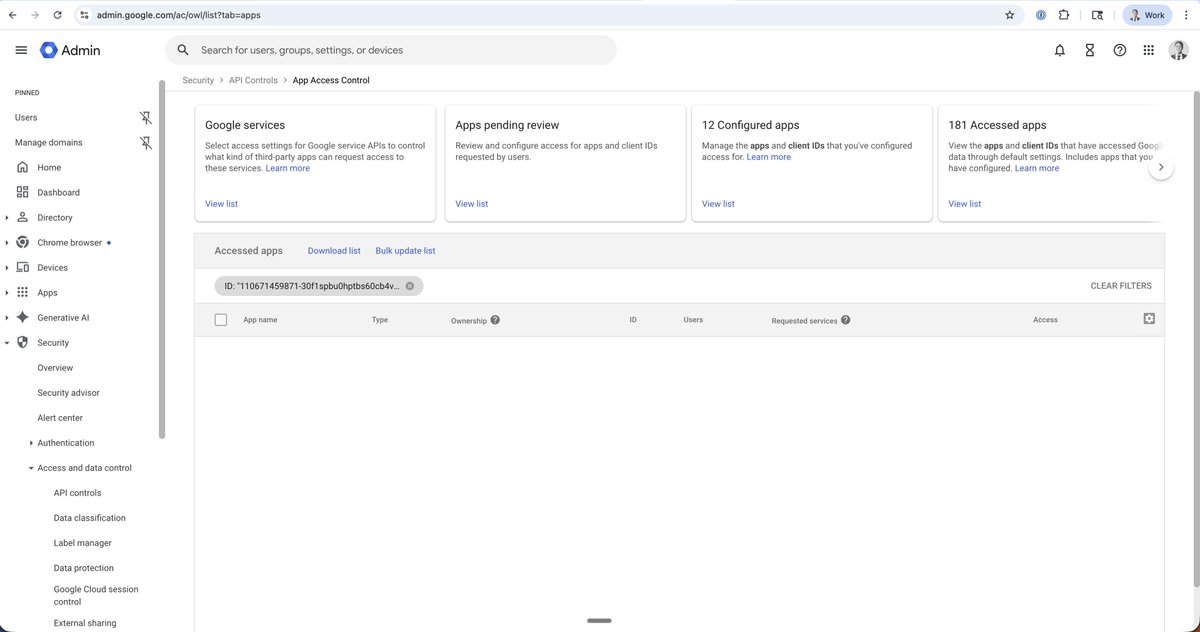
To check if your Google Workspace has been compromised by the same tool that compromised Vercel:
1. Go to https://t.co/TpuIOW5Fwg
- This is Google Admin Console > Security > Access and Data Control > API Controls > Manage app access > Accessed Apps
2. Filter by ID = https://t.co/uqJnCqp5Ah
- This is the ID of the compromised OAuth app
If you see an app after filtering, you have potentially been compromised
It has been almost three months since I became CEO of Crazy Egg.
Last month we shipped Free Web Analytics.
The month before that we shipped Free Website Surveys.
Today we’re shipping something we invented twenty years ago and rebuilt for the modern web.
We’re releasing Instant Heatmaps.
Heatmaps that work on any page of your website the moment you want to look. No setup. No waiting. Just clarity.
We invented the snapshot model of heatmaps for a static web in 2005. The modern web moves differently. So we built something that matches the speed of the questions builders ask today.
Snapshots remain the best tool for the deep study. Instant Heatmaps are for every moment in between.
They are available in the free plan because understanding your own website should not require a long setup or a big commitment.
👉 Live today on Product Hunt: https://t.co/ZTOYZ403WO
When we first built Crazy Egg in 2005, we made a rule after watching people struggle with traditional analytics.
Dashboards were cluttered. Reports were confusing. We wanted clarity so we focused on showing, not telling. That’s when we invented heatmaps for websites.
That rule served us for almost two decades. But the world changed.
One of the hardest parts of building products is knowing when your own rules start holding you back. The things that made you successful can quietly become unnecessary constraints if you don’t keep questioning them.
Analytics has gotten louder and slower. We went back to basics to make it simple again.
Next week, you’ll see what it looks like when we rebuild analytics around clarity instead of noise.
This is the critical next step for us at @CrazyEgg to help reshape analytics and experimentation for the next 20 years.
Every new startup launch seems to have a twin. Either a competitor already exists or one gets announced within days. Add every incumbent quietly building the same thing, and it’s no wonder products feel like déjà vu. Been on all sides. It’s wild.
What’s old is new again.
After 20+ years building product teams, I keep returning to the same habit:
Once a week: pick a friction point, ask one real question, ship based on the answer.
Micro-surveys are the original feedback loop that still works.
Most teams talk about being customer-centric. Few run the weekly rhythm.
Ask the right question, right where it matters.
That's how you get less guessing, more momentum, features that ship for a reason, and clarity that sticks.
If you’re rebuilding this habit (or want to), reply or direct message me.
Most product teams live and die by analytics.
We obsess over every click, every drop-off, every chart on the dashboard.
But ask anyone what their users were actually thinking when they left and you’ll get silence.
Every company has the same blind spot. Data tells you what happened. It never tells you why.
Now imagine this: the answer was hiding in a forgotten tool. Nearly every founder once used it. Then it disappeared.
Back in 2009, analytics set the pace for every product decision. Heatmaps tracked every tap and funnel, but no tool could explain what users felt in the moments that mattered. Everyone in product knew the gap. Interviews took too long and reached too few. Traditional surveys were exhausting and went unanswered.
That gap became our mission. Alongside Sean Ellis, we built a survey tool to assess product/market fit. That tool was just the starting point.
We built a way to embed the whole product/market fit survey on a website. That was the original inspiration that started it all.
The tool evolved into an entirely new product.
What changed everything was giving teams a way to listen directly, right as decisions happened. The survey appeared on the website, not in an inbox. Thousands of startups started using the tool to catch answers in real time.
A SaaS founder could ask, “What almost stopped you from signing up?” and see insights appear before the next deploy.
E-commerce brands dropped, “What made you leave your cart?” right at the point of hesitation and saw patterns emerge in a single afternoon.
One team learned their pricing page was confusing after hearing it from dozens of users in just a week. Another caught the phrase “missing features” so many times that their roadmap shifted overnight.
The lesson was simple. Context is everything. If you ask at the right moment, even the quietest users will tell you what matters most.
We wanted to go even further. Early prototypes were scrappy. Hand-drawn boxes pasted on screenshots, phone calls with a single question, landing pages that promised, “Ask your users in 30 seconds.”
Every version focused on one goal: make it effortless to ask a question right at the point of friction.
KISSinsights became the purest form of this idea. Teams dropped a small script onto their site.
Instantly, a question box appeared wherever it was needed. There were no settings to configure and no training required.
Founders put surveys on pricing pages to ask, “What’s missing before you pick a plan?”
Marketers added them to sign-up flows, asking, “What almost stopped you from joining?”
Product teams set a survey for users about to leave, asking, “What didn’t you find today?”
The answers landed instantly in the team’s inbox, often within seconds of the user’s decision.
What surprised us was how users responded. They answered, and many even thanked the team for caring enough to ask.
One customer wrote, “This is the only pop-up I actually want to see.” Another founder said they learned more in two days from KISSinsights than from months of analytics reports. By meeting users where they were, teams finally heard honest feedback from people who would have otherwise stayed silent.
There was an unexpected growth loop, too. Every survey ended with a simple line: “Powered by KISSinsights.” Curious users clicked, set up their own micro-surveys, and the idea spread.
A founder who saw the pop-up during checkout added it to their own launch page a week later. Teams swapped stories in forums and group chats about the best questions to ask. One growth marketer shared how a single survey on the pricing page led to a thirty percent jump in conversions after they fixed a confusing headline.
Within months, more than twenty-five thousand teams were using KISSinsights. It spread founder to founder, blog to demo, and conference to Slack channel.
For a time, micro-surveys became a default part of every serious product and marketing team’s workflow. The best teams made it a habit to ask a real question at the moment of truth, every week.
But change came quickly. Voice-of-customer suites and enterprise vendors took over. Free plans disappeared or became heavily limited. The simple experience was replaced with dashboards and paywalls. Multi-step surveys became the norm. The original discipline of ask one real question, at the exact right moment, was left behind.
What was lost went beyond speed or simplicity. Teams lost the habit of meeting users in context. Today, most teams have more dashboards and less clarity. The most honest answers that surface the why in the user’s own words have almost vanished.
If you want to know why people leave, or what’s stopping them from buying, you still need to ask the right question in the right moment. Micro-surveys were about making it so easy to listen that no team could ignore the answers.
It’s easy to forget how much a single, well-timed question can teach you. But if you built products in those years, you remember the little box that changed everything.
Think about how you use Google.
You type in a question, maybe just a few words. Instantly, the search results you see are crafted for you.
Where you are, what you’ve searched for, the links you usually click. You expect this. Google has trained an entire generation to believe that the answer is out there, and that your answer will show up at the top.
Personalization is the engine behind this magic.
Google doesn’t run a single version of the web. It assembles the web around you, every time. Two people searching the same word will see a different set of results.
Sometimes a different order, sometimes completely different links. It does this because relevance wins. If every user got the same answers in the same order, the results would be less helpful, and eventually people would drift away. You’d feel like no one was listening.
The same pattern shapes everything you do online.
Netflix builds an entire homepage that changes with your viewing habits, your tastes, even your time of day. Your Netflix is not my Netflix. It’s never been more obvious that the “homepage” is dead. There are only “my pages.” Amazon, eBay, and Spotify lean on the same principle. What’s shown, recommended, or featured is never fixed. It’s tuned to your history and context.
Personalization is now the default expectation, not a bonus feature. Customers are conditioned by every search, every binge, every “Because you liked…” moment. Once you’ve had a tailored experience, it’s hard to accept anything less.
Yet many businesses still cling to one-size-fits-all playbooks. Their website makes you dig for what you need.
Campaigns go out with the same message for every segment. Landing pages ignore how someone found them, even when the data is right there.
This approach isn’t just inefficient. It quietly erodes trust.
The moment an experience feels random or disconnected, attention drops, and someone clicks away.
Take a paid ad campaign. When the landing page lines up with the ad’s promise and the visitor’s intent, conversion rates improve. When it’s out of sync, interest fades fast.
Or consider SaaS onboarding: a product manager needs depth, while a CMO wants business outcomes. Tailor the walkthrough, the case studies, and the follow-up emails to watch engagement jump.
The best companies know how to use context as their compass. They study where someone came from, what problem they want solved, and what they’ve tried before. They tune what’s delivered and how it’s delivered. Over time, the product begins to feel alive. It comes responsive, not robotic.
Every customer is looking for signs that you “get” them. When the message fits, you get more than a sale. You get advocacy, feedback, and another chance to learn.
The playbook is simple: make relevance the rule, not the exception.
Personalization is the architecture of belonging. Google made it invisible. Netflix made it addictive.
Now, it’s becoming the minimum standard everywhere.
If you’ve ever sat through a meeting where nobody trusts the numbers, you know the feeling.
A room full of smart people, five different metrics on the screen, and by the end nothing ships but the spreadsheet gets bigger.
“We’re drowning in dashboards, but nobody trusts the numbers enough to act.”
When we built Crazy Egg, heatmaps solved that. You saw where people clicked. There was nothing to debate. If the button was cold, you fixed it. If people ignored a section, you reworked the layout.
“Nobody remembers the last time a dashboard told us what to do next.”
With heatmaps, teams spent their time shipping, not arguing definitions.
Now, every hover, scroll, and micro-conversion is tracked. AI points out patterns nobody could spot alone. But with every new tool, agreement gets harder.
Teams say, “I open three tools, get three different numbers, and then the meeting is about the data, not improving our website.”
More data was supposed to move us faster. Instead, “every quarter, the stack gets bigger and the meetings get longer. Clarity never shows up.” It’s become normal to spend more time arguing over definitions than shipping features.
This isn’t just a personal pain. Harvard Business Review found only 23 percent of companies are excellant at turning data into action. The rest? “Paralyzed by analysis, not empowered by it.”
Heatmaps were never about seeing everything. They were about making the important stuff impossible to ignore. That kind of clarity is what teams are missing. Tools should cut through the noise and make the next move obvious, no matter how much traffic you have, how many metrics you collect, or how advanced your AI gets.
If you’re tired of dashboard debates and website reviews that go nowhere, you’re not alone. Teams everywhere are hungry for clarity. And moving fast has never mattered more.
We’re building for teams who want to get back to momentum, to decisions that stick, and results you can trust. If that’s you, let’s talk.
I have exciting news to share 🎉
@Vimcal just closed a $4.5M seed round led by the amazing team at @altosvc!
A big thank you to @IndianIdle & @TechCrunch, our world-class team, and you, our users.
Big things to come. LFG!! 🚀🚀
https://t.co/LQfMPcZ8Rh
The older I get, the more I realize that success at most things isn't about finding the one trick or secret nobody knows about.
It's consistently doing the boring, mundane things everyone knows about but is too unfocused/undisciplined to do.
Get good at boring.
There are TWO jobs in startup sales ...
1. know the problem better than the customer
2. project manage the sh*t out of their buying process
Somewhere we got way off track and put way too much focus on demos.