✨🇨🇳In 2025, China’s average residential electricity price stands at 0.52–0.55 yuan per kilowatt-hour (equivalent to roughly US$0.075–0.08 per kWh).
It ranks around 101st among 147 economies worldwide, making up only about 46% of the global average residential electricity price.
A father took his son hiking on Mount Tai in Tai'an, east China's Shandong Province, where they collected empty plastic bottles along the way. They later exchanged the bottles for cultural and creative souvenirs and sold the remaining ones for 6.6 yuan.
Netizens: The best education is hidden in real-life experience. #ChinaStory
LV did not become hated in China because it won an intellectual property lawsuit.
Foreign companies have sued Chinese companies before.
Chinese consumers understand trademark protection.
They understand intellectual property.
But this case crossed a different line.
LV did not merely protect a brand.
It exposed a much uglier logic:
take ancient Chinese motifs,
register them as private property,
turn civilizational memory into corporate assets,
then sue Chinese companies for touching patterns rooted in their own cultural soil.
That is why Chinese people are furious.
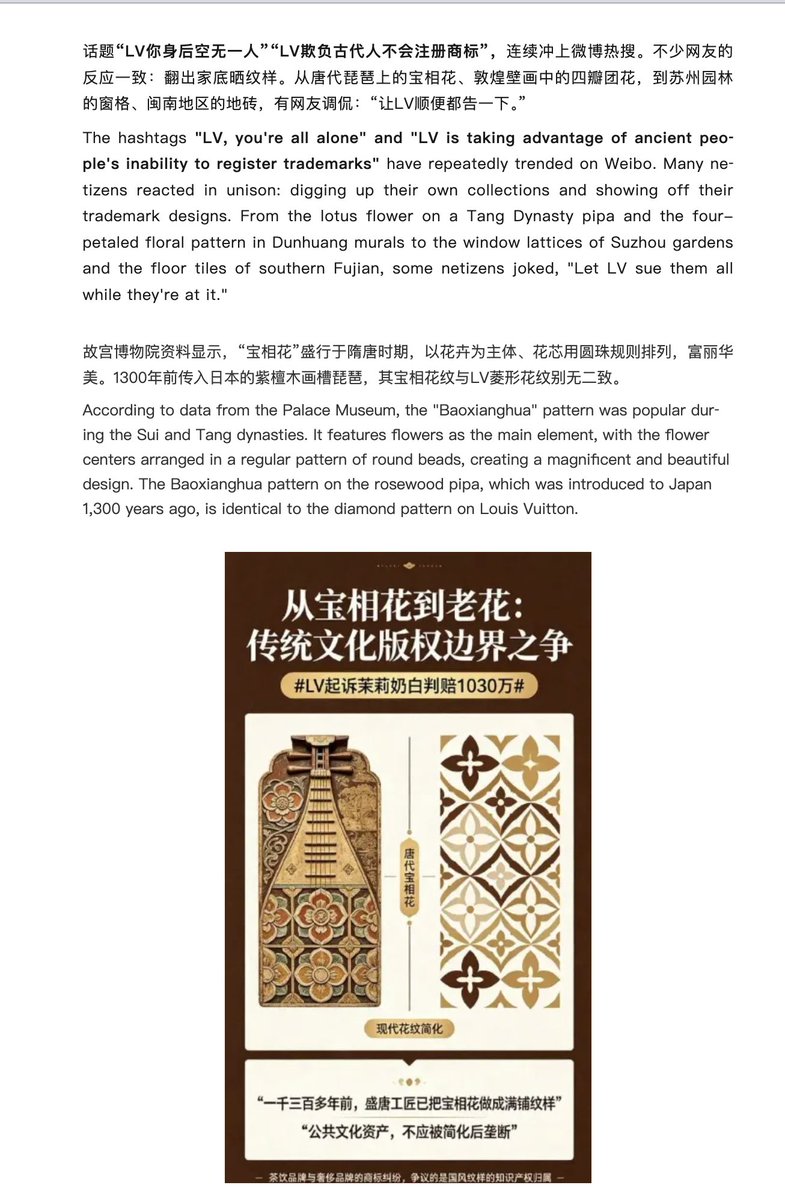
LV has registered 45 Chinese-style ancient patterns.
Patterns that came from Chinese decorative traditions.
Patterns that appear in Tang-era art, Dunhuang murals, Suzhou garden windows, Fujian floor tiles, and everyday Chinese aesthetics.
And now a French luxury house acts as if these symbols belong to Paris.
This is not ordinary trademark protection.
This is cultural occupation through paperwork.
Ancient people did not have trademark offices.
They could not file applications.
They could not defend their heritage in modern courts.
That does not mean dead civilizations are free for corporations to loot.
If this logic stands, anyone could repackage Hanfu patterns, Terracotta Warrior imagery, Dunhuang murals, Buddhist motifs, or even classical works like Journey to the West and Romance of the Three Kingdoms, register them, and then tell Chinese people they no longer have the right to use their own cultural inheritance.
That is absurd.
That is dangerous.
And that is why LV won the lawsuit but lost China’s face.
The tea brand used a jasmine flower because it sells jasmine tea.
The cultural soil is Chinese.
The public emotion is Chinese.
The backlash is Chinese.
On the day the ruling came out, Molly Tea gained massive public support because Chinese consumers understood exactly what this was:
not a French brand protecting creativity,
but a Western luxury house privatizing Chinese heritage and biting the people whose civilization made the pattern possible.
Even more humiliating for LV:
while Molly Tea was facing millions in damages, its home region was hit by floods, and the company donated 1 million yuan for disaster relief.
So the contrast became clear.
One side took from Chinese culture and sued.
The other side bled money and still gave back to Chinese people.
LV may have won US$1.5 million.
But it reminded 1.4 billion people what Western luxury often means:
steal civilization,
monopolize beauty,
sell it back as status,
then sue the original owner.
This has never been about luxury art design.
This is colonial property logic in designer packaging.
LV won the lawsuit.
But in China, it lost face.
A French luxury brand looked at a floral pattern with deep roots in Chinese decorative tradition and acted as if beauty itself needed permission from Paris.
That is what disgusted people.
No one says brands cannot protect trademarks.
But a four-petal flower is not automatically LV’s private kingdom.
Chinese patterns existed long before Western luxury houses learned how to turn symbols into invoices.
LV may have won US$1.5 million.
But it reminded Chinese consumers that Western brands are very good at stealing civilization, privatizing aesthetics, and then suing others for touching the same cultural soil.
LV may still call itself luxury.
But it looks like cultural plagiarism dressed up as intellectual property.
China planted forests are expanding their leaf area 66 percent faster than comparable natural woodlands. For almost five decades the country has pursued the Great Green Wall one of the largest reforestation efforts on Earth. This vast tree belt along the margins of the Gobi and Taklamakan deserts aims to combat desertification and stabilize the environment.
A recent study using satellite data reveals that these planted areas exhibit distinct growth patterns compared to undisturbed forests. The managed plantations have shown leaf area increases approximately 66 percent quicker than nearby natural stands. Younger trees inherently grow more rapidly and human oversight contributes to this acceleration.
After adjusting for age and site conditions the planted forests still outperformed natural ones by about 4.6 percent. Researchers suspect enhanced sensitivity to rising atmospheric carbon dioxide levels may play a role though the precise mechanisms require further investigation. These insights could refine models of forest carbon sequestration capacity.
The advantage however is temporary. Growth benefits tend to peak when trees reach 30 to 40 years of age and then decline. While natural forests develop more gradually they sustain carbon storage over longer periods and harbor significantly higher biodiversity.
Planting initiatives therefore offer valuable short term carbon capture but cannot substitute for the conservation of mature ecosystems. The Great Green Wall has raised regional forest cover from roughly 5 percent in 1978 to 14 percent in 2023. It has diminished dust storms and enhanced local air quality.
The project continues to provide important data on forest responses to climate shifts and human intervention.
Latest update from Tiangong space station: China's Shenzhou-23 crew continued their tasks while in orbit about 400 km above Earth, including installing and deploying a spaceborne greenhouse gas detector.
They remained in good condition and happily showcased their freshly baked muffins!
Skylines filled with rivers of cars are coming to China🇨🇳 sooner than you think.
China literally already has flying traffic lights, and regulations are coming fast.
Tens of thousands of units are rolling out this year.
Are you ready for tomorrow?
Louis Vuitton is facing huge backlash in China after suing the Chinese bubble tea Molley for $1.5M over alleged logo infringement.
Chinese netizens are angry that this pattern existed in China hundreds of years before LV was born. You can still see it everywhere in China today.
✨🇨🇳China has created a special subway line just for farmers to bring their produce to market. It's more than just transit; it's a moving story of warmth and inclusion.
China unveils a 600 km/h (373 mph) maglev train—now the world’s fastest.
It can slash Beijing–Shanghai travel time to just 2.5 hours. Powered by magnetic levitation, it’s ultra-quiet, efficient and emits zero direct pollution.
Así fue el recibimiento a la selección de Egipto en Dallas (EEUU), mientras un jugador se hacía una foto con un niño, la policia estadounidense se encaró y agredió a miembros del staff nacional egipcio.
El mundial en AmeriKKKa quedará para siempre manchado por el racismo en EEUU mientras los medios a sueldo dicen que está siendo perfecto.
BYD beat Tesla while being blocked from the U.S. market.
Tesla’s global sales include China.
BYD’s global sales exclude America.
And BYD still won.
That is the part Western media hates to say out loud:
China is not winning because markets are “fair.”
China is winning despite the walls built against it.
Inside Chinese AC maker Midea's smart factory, it takes only 6 seconds to assemble a new AC on the line.
The factory has full 5G coverage, AI-powered real-time monitoring, automated unmanned packaging, and robotic transport.
Europe lacks more than just ACs.
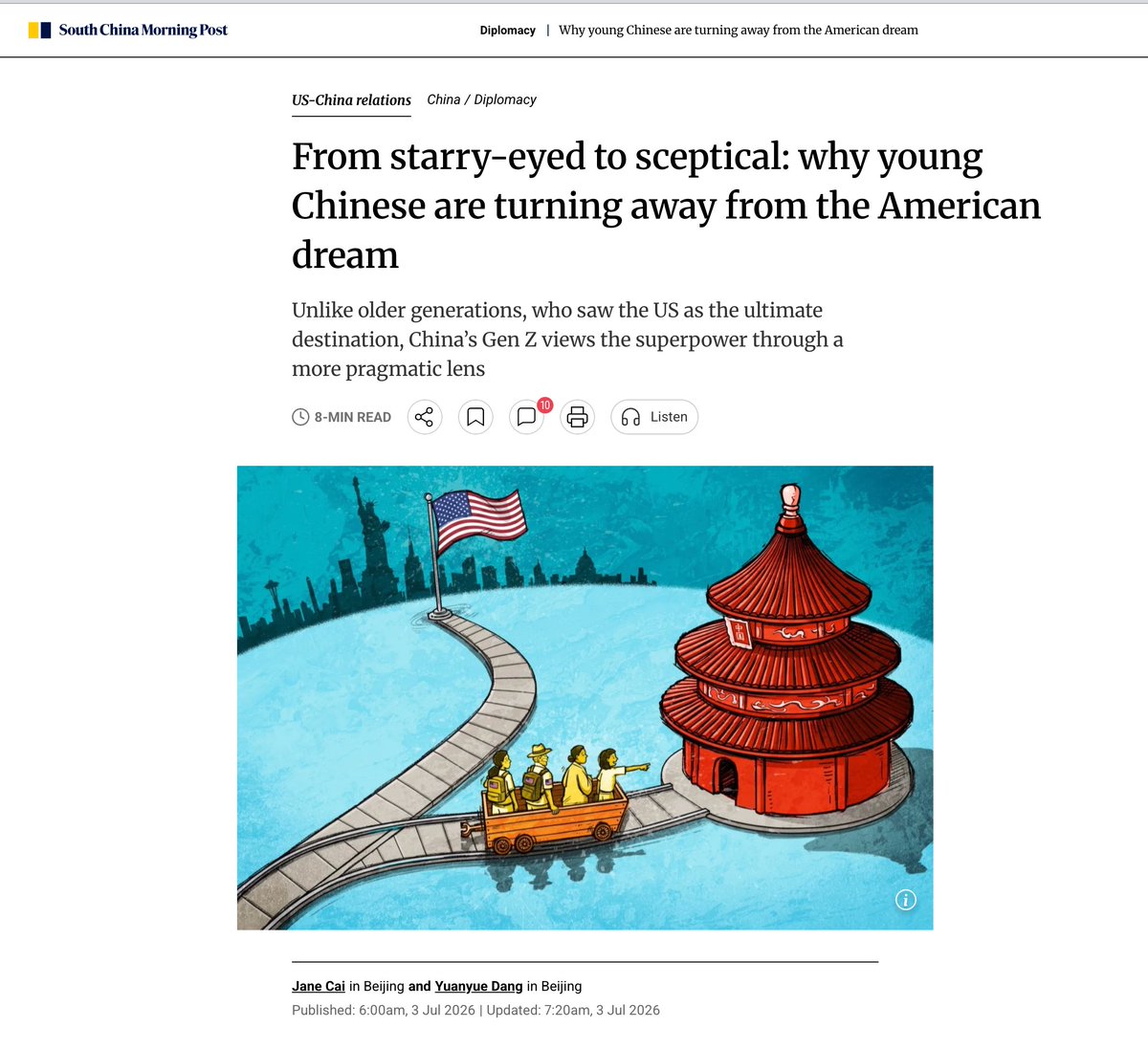
What terrifies Washington is not that young Chinese people hate America.
It is that they can look at America without worship.
That is the end of empire at the psychological level.
America is no longer the promised land.
No longer the final classroom.
No longer the only image of modernity.
Older Chinese generations looked at America as the future.
Chinese youth can admire Silicon Valley and still choose Shenzhen.
They can study America and still see its chaos, inequality, racial decay, medical poverty, political madness, and imperial arrogance.
China did not only build roads, ports, EVs, AI models, and high-speed rail.
China built another future.
The American dream used to be the world’s measuring stick.
China has rewritten the ruler.
Watching EU diplomats posture tough on China is pure comedy in this hot summer. A simple heatwave exposes their decline. They can’t even give their own citizens basic comfort without snapping up Chinese ACs.