Compound models like @OpenRouter’s Fusion are genuinely powerful. Synthesis delivers big lifts on hard research and reasoning tasks.
That said, the model layer is only half the equation.
Deterministic tool calling + industry-specific learning are what actually push you toward the match of nines in accuracy. Without reliable, grounded execution and continuous domain tuning, even the best compound system still hallucinates or drifts on high-stakes analysis.
Rozum was built from the ground up around that full stack.
Rozum's multi-agent harness just hit 71.1% on the HLE Biochem Gold benchmark, beating @AnthropicAI’s Opus 4.8 by 32pp.
We solve tooling and verification that breaks single LLMs on real R&D workflows, and handle the multi-constraint tasks standalone models consistently miss.
Questions represented in this @FutureHouseSF dataset are the exact type of questions corporate scientists in biopharma, cleantech, and agtech are paid to get right.
Example questions available upon request.
The lift that frontier LLMs get from tool use is well known. Here’s what they can do with additional verification and careful orchestration. @karpathy's council interestingly was developed in parallel to our efforts, with pretty different evaluation architecture.
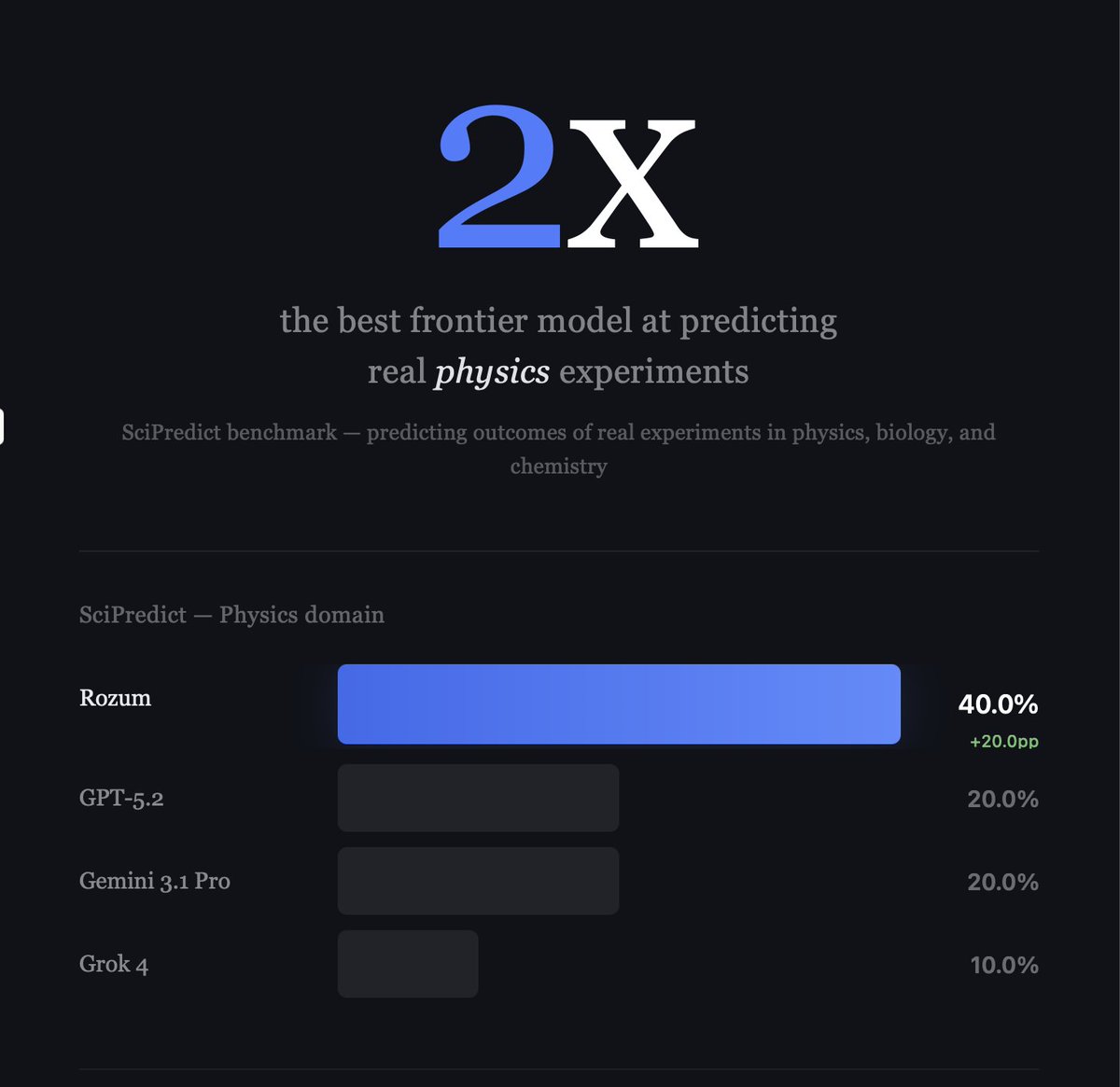
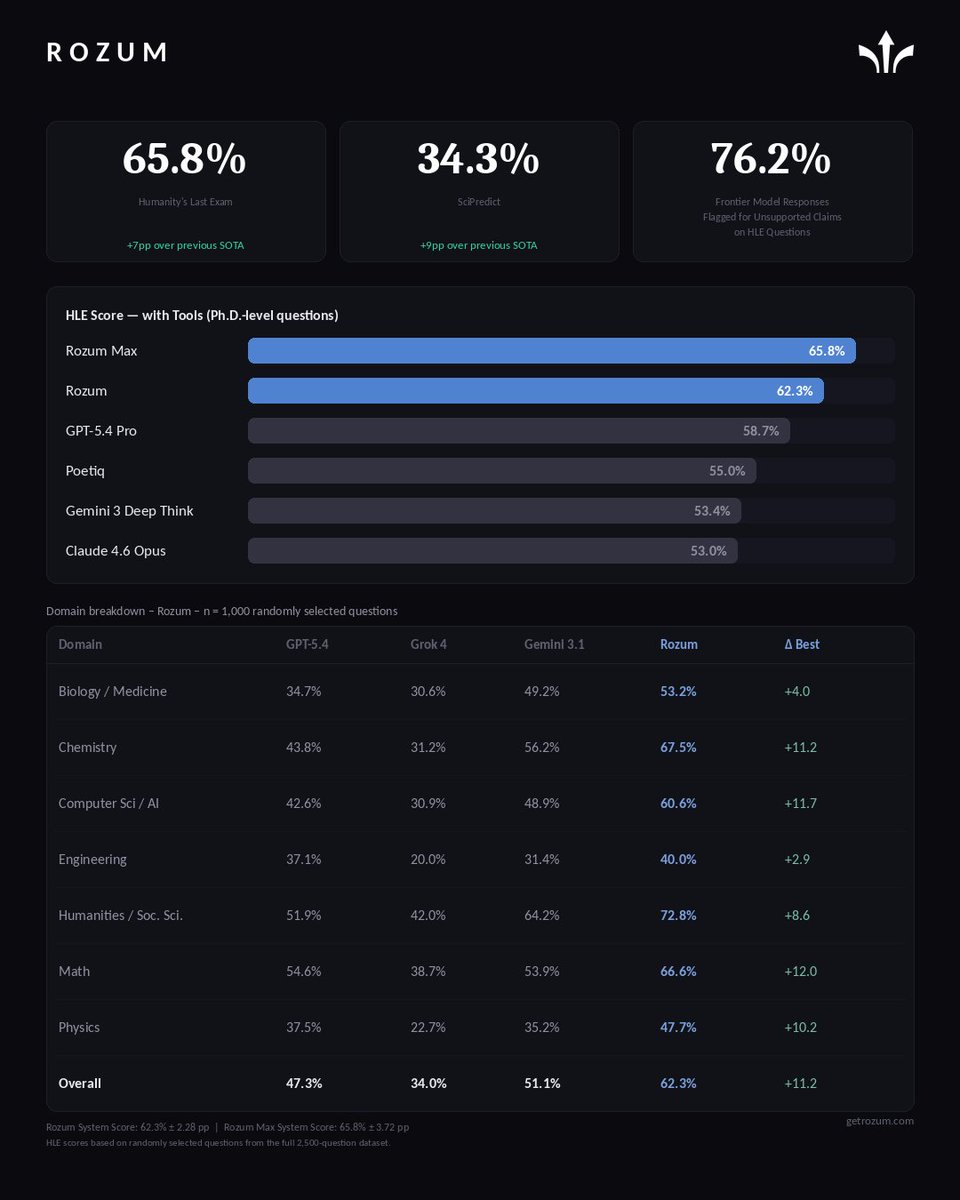
We use benchmarks to internally and externally validate progress against the things that our customers care most about. Thanks to Jia for validating our HLE and SciPredict methodology and results.
While LLM architectures have challenges in the scientific discovery space, Rozum shows promising results as compared to frontier LLMs. With a bit of inspiration from @GoogleDeepMind approach, we are working on improving this functionality further. Maybe LLMs will be capable of novel, meaningful scientific discovery.
Importantly for customers, Rozum is able to extract partial truths from multiple models to provide the most factual answer available. Partial truths are pervasive in frontier LLMs.
The lift that frontier LLMs get from tool use is well known. Here’s what they can do with additional verification and careful orchestration. @karpathy's council interestingly was developed in parallel to our efforts, with pretty different evaluation architecture.
Rozum launches today out of stealth.
Highest score on HLE and SciPredict of any system on the market.
Not a new model. A reasoning system that runs ensemble verification across frontier models, checks every claim before synthesis, and returns answers you can actually act on.
Built for decisions, due diligence, and scientific discovery that you can’t get wrong.
Read the whitepaper and join the waitlist.
Derek and I worked together at Tesla for 5 years.
After leaving, he went to go solve water scarcity. Genuinely one of the most ambitious things I’d heard — and “water scarcity is an engineering problem” was one of the best taglines I’d come across.
About a year in, he told me they’d wasted months chasing assumptions that every frontier model had validated. All of them were wrong. They built an internal tool to avoid making that mistake again.
I was skeptical. Outperform models worth hundreds of billions? No shot.
Then I actually used it and looked at the code. I was wrong. Rozum is ridiculously well-built for hard questions. What Cursor did for coding, Rozum seems to be doing for critical decisions, due diligence, and scientific discovery.
Proud of @derekbednarski and the team. If you make 7-figure decisions and want something that cites every source, reasons from first principles, and aggressively self-corrects before answering, Rozum is worth checking out.