I didn't set out to build an AI company. I wanted to end water scarcity.
One design decision came down to whether a specific carbon cloth material would work. We read papers, consulted experts. We asked every frontier model. They said yes, cited adjacent papers. 6 months later we found out it didn't work.
This is a structural problem. Frontier models hallucinate under extended multi-step reasoning: plausible answers that silently break when a problem crosses domain boundaries.
Rozum is the system we built to close that gap. It’s a reasoning system that runs an ensemble in parallel, verifies every claim before synthesis, and returns answers more accurate and trustworthy than any individual model on its own.
We tested on a random subset of Humanity's Last Exam — expert-vetted questions designed to require genuine multi-domain reasoning. GPT 5.4 Pro scores 58.7%. Rozum scores 65.8%. We outpace the highest performing model included in the ensemble by >10pp.
Our users echo what @Naval said, “a model that is right 92% of the time is worth infinitely more than one that is right 88% of the time, because mistakes in the real world are so costly.”
More important than benchmarks: early customers have told me it saved them months of technical scoping, helped their teams focus on the right thing, and kept them from walking into traps.
Not for everyone. For the ones who can't afford to be wrong.
Waitlist is open. White paper and early access at https://t.co/KFkyJ5AOuA
Compound models like @OpenRouter’s Fusion are genuinely powerful. Synthesis delivers big lifts on hard research and reasoning tasks.
That said, the model layer is only half the equation.
Deterministic tool calling + industry-specific learning are what actually push you toward the match of nines in accuracy. Without reliable, grounded execution and continuous domain tuning, even the best compound system still hallucinates or drifts on high-stakes analysis.
Rozum was built from the ground up around that full stack.
@OpenRouter What type of synthesis mechanism does this use? Based on our research, using certain algorithms and deterministic tooling can improve the gain you can achieve over the smartest model in the ensemble dramatically.
The permissioned path does not arrive as tyranny. It arrives as convenience.
A society can lose its freedom this way without a single dramatic moment, simply by routing more of its thinking through infrastructure that answers to someone else.
We must protect open source and open source models
Rozum's multi-agent harness just hit 71.1% on the HLE Biochem Gold benchmark, beating @AnthropicAI’s Opus 4.8 by 32pp.
We solve tooling and verification that breaks single LLMs on real R&D workflows, and handle the multi-constraint tasks standalone models consistently miss.
Questions represented in this @FutureHouseSF dataset are the exact type of questions corporate scientists in biopharma, cleantech, and agtech are paid to get right.
Example questions available upon request.
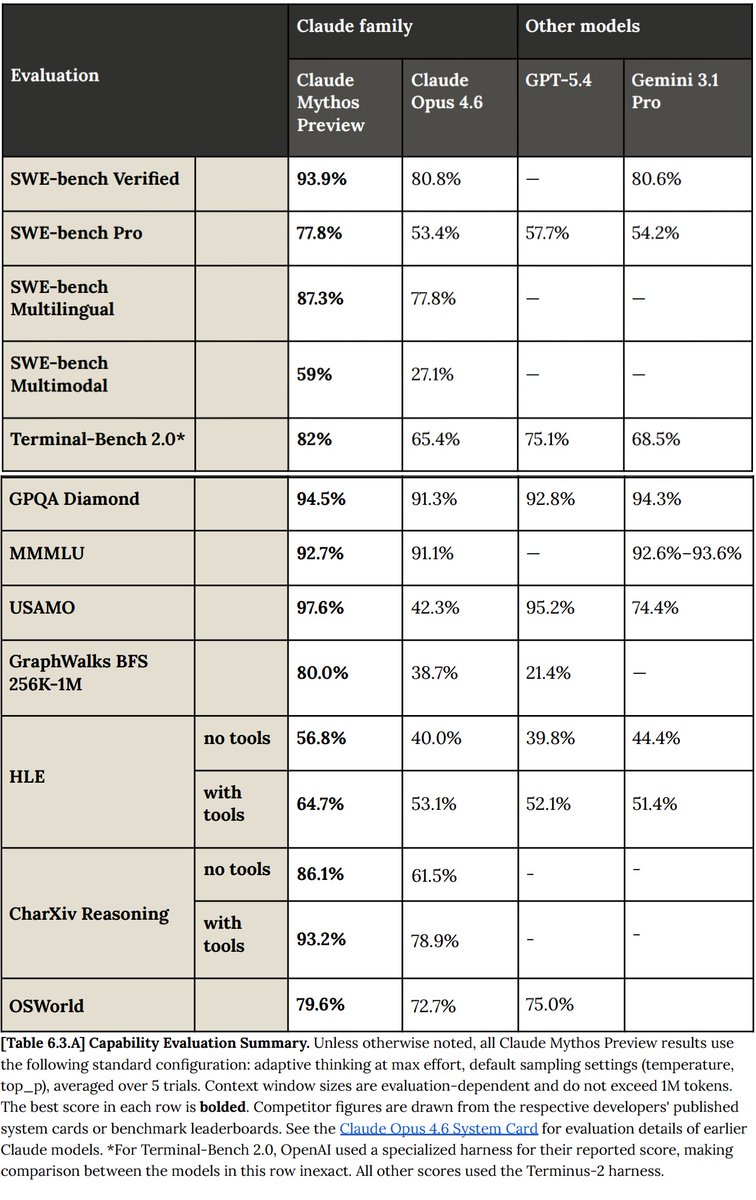
Agree that Claude has its strengths, but the way Opus and Mythos benchmarks were published is a little misleading. IIRC Mythos has some disclaimers deep down in th release notes about scaffolding. You will not get anywhere near benchmark performance from Opus on scientific tasks in its UI.
Biopharma doesn’t have a data problem. It has a decision problem.
Billions go into generating data, but critical R&D decisions still rely on fragmented views of biology.
What’s missing is a way to turn biology into something researchers can trust.
The winners won’t be the ones who collect more data. They’ll be the ones who know what to do with it.
@mgdurrant The results of this level model are pretty exciting! Our users say so every day. Interested to see how this API will integrate into our system.
@bcherny As someone who uses a model more powerful than Mythos every day for research (Rozum), I agree it's powerful. Not for general release - but for scientists, engineers and capital allocators building the future.
@Nottlespike@AnthropicAI Many such cases - we found the same thing on Opus 4.6 It's HLE scores are not what users are served on the UI (it's not close - it is way off), nor is it easy to achieve via API.
Rozum beats Mythos in Humanity's Last Exam. This level of intelligence is special. Waitlist open now for decision makers and scientists who need the intelligence edge.
@DKThomp The public isn't confused; the pitch is. AI is sold as world-changing, yet as @dwarkesh_sp flags, it still struggles with original insight. The bottleneck is its lack of reliable judgment. Single models reason, but unreliably. Trust requires verification, judgement requires triangulation. That judgment may be the real scarcity - a premise we're building around at @getrozum. Is that the real race?
"The winner of the AI race will not be the company with the smartest model.
It will be the company that is most effective at making the local hero—the teacher, the accountant, the community leader—ten times more powerful.
Because in the end, intelligence travels through systems, but adoption travels through people."
@heysakina on what she learned growing YouTube internationally and what it means for the AI race: https://t.co/D1VJuNEhQF
We use benchmarks to internally and externally validate progress against the things that our customers care most about. Thanks to Jia for validating our HLE and SciPredict methodology and results.
“Rozum can spend minutes or even hours working on its responses, much more time than commercial AI models like Gemini 3.1 Pro or GPT 5.4 require with native tools. So it's not well-suited for real-time conversations, high-volume commodity queries, or tasks where current frontier models perform adequately.”
@ThomasClaburn makes a good point - existing LLMs are fine for common tasks. However, for decisions of consequence, it’s irresponsible not to use a tool like Rozum to validate every word and get as close to ground truth as possible.