Garry Tan (CEO of Y-Combinator): "when someone asks how I 'prompt' my AI, the answer is: I don't. the skills are the prompts."
[if I had this weekend to master skills and how to use them to automate workflows:]
→ read the Skillify 11-item checklist (SKILL.md in gbrain)
→ watch Murag + Barry Zhang: "Don't Build Agents. Build Skills Instead."
→ Read "Designing, Refining, and Maintaining Agent Skills at Perplexity"
→ do one workflow. type /skillify. watch it become permanent. that's the whole day.
here is how to set it up:
1. clone GBrain (his open-source second brain, Postgres-backed memory + 30 skills)
2. add GStack (23 battle-tested slash-command skills, drops right in)
3. do anything once → type /skillify → it's a skill forever
prompting is dead. skillifying is next.
The market has many secrets.
It’s like an unbreakable code.
1,000,000s of people try to break the code every day.
And only Renaissance Technologies has done it.
The tool they use?
Hidden Markov Models.
A thread on using HMMs with Python:
our lead independent director @roelofbotha and i wrote about the history of organizational structures, and our intent to rebuild block as a mini-AGI. https://t.co/emGicpn9xr
It is dangerously easy to build a neural network today without actually understanding how it works.
We live in an era of 'import torch'. You can train a model in three lines of code, but the moment you need to debug a collapsing loss function or a vanishing gradient, syntax won't save you. You need first principles.
I recently went through this notebook collection by Simon J.D. Prince, and it is the antidote to tutorial hell.
Instead of just showing you the code, it forces you to visualize the mechanics:
1./ The Math => It builds the intuition for shallow networks and regions before adding complexity.
2./ The Optimization => It doesn't just use an optimizer; it compares Line Search, SGD, and Adam so you see why they behave differently.
3./ The Modern Stack => It connects the dots from basic backpropagation all the way to Self-Attention and Graph Neural Networks.
Move from running code to engineering systems => this is a goldmine.
My master's degree completely failed to teach me how to test trading strategies.
So I spent 40 hours looking for Python backtesting libraries.
Then I started using the best ones.
But unlike my quant finance degree, these won't cost you $90,000.
Here they are for free.
The Z-test is a powerful statistical method used to determine if there is a significant difference between sample and population means, or between the means of two groups. Properly applying the Z-test can lead to more accurate conclusions in research and decision-making, but incorrect application can lead to misleading results.
✔️ The Z-test allows for precise hypothesis testing, enabling you to determine if your observed data aligns with expected outcomes based on a known population mean.
✔️ When used correctly, the Z-test can provide strong, statistically valid evidence to support or reject hypotheses, particularly in studies with large data sets and known variances.
✔️ The Z-test is straightforward and widely understood, making it a reliable tool for hypothesis testing when its assumptions are met, contributing to clearer and more consistent research results.
❌ Using the Z-test with small sample sizes can lead to invalid conclusions, as it assumes large samples for accurate results.
❌ Applying the Z-test to data that is not normally distributed violates its assumption of normality, risking inaccurate findings.
❌ Using the Z-test when population variances are unknown can lead to incorrect results, as it requires known variances for proper application.
❌ Over-reliance on the Z-test without understanding these key assumptions can result in flawed research outcomes and misleading interpretations.
While the Z-test remains a reliable method for large samples with known variances, more modern alternatives like Bayesian methods and bootstrapping offer greater flexibility and robustness in situations where traditional assumptions may not hold.
To apply the Z-test effectively in practice:
🔹 R: Use the z.test() function from the BSDA package to perform a Z-test on your data.
🔹 Python: Leverage the statsmodels library with the ztest() function to conduct a Z-test on your data.
When the significance level (alpha) is 0.05, the null hypothesis can be rejected if the Z value falls within the red region on the visualization. This visual is based on a Wikipedia image: https://t.co/SoR3LX0Ev2
You might check out my online course on Statistical Methods in R. This course will explain the Z-test and other related topics in further detail.
Click this link for detailed information: https://t.co/7YQCRDKSPO
#DataAnalytics #Rpackage #DataAnalytics #Data #RStats
RIP McKinsey. Here are 10 prompts to replace expensive business consultants:
[ 🔖 bookmark this post for later ]
➤ SWOT Analysis
Act as a business strategist. Generate a SWOT analysis for [INSERT BUSINESS] in the [INSERT INDUSTRY], using competitive market data and internal insights.
➤ Growth Levers
Find out 5 scalable growth levers for a [TYPE OF BUSINESS], focusing on revenue expansion, operational efficiency, and brand reach.
➤ 30-60-90 Plan
Create a 30-60-90 day action plan for a new [INSERT ROLE] at [COMPANY], including onboarding objectives, performance metrics, and quick wins.
➤ Revenue Model Projection
Develop a lean revenue model for a business providing [PRODUCT/SERVICE], covering optimal pricing, CAC, LTV, and monthly recurring revenue forecasts.
➤ Churn Reduction
Suggest 3 data-driven strategies to minimize churn for a SaaS product targeting [TARGET CUSTOMER], leveraging user behavior data and feedback loops.
➤ KPI Dashboard Framework
Outline the 7 critical KPIs for a [BUSINESS TYPE] to monitor across customer acquisition, retention, product engagement, and financial performance.
➤ Pricing Strategy
Act as a pricing advisor. Propose 3 pricing approaches for [OFFER] aimed at [SEGMENT], utilizing value-based pricing, tier structures, and market positioning.
➤ Go-to-Market Plan
Design a go-to-market plan for introducing [PRODUCT] to [TARGET MARKET], addressing positioning, distribution channels, customer acquisition, and success metrics.
➤ Value Proposition
Draft a persuasive value proposition for [BRAND or PRODUCT] that addresses customer challenges, presents the solution, and emphasizes unique advantages.
➤ Pivot Directions
Recommend 3 strategic pivot options for a startup facing [SPECIFIC PROBLEM], including alternative customer segments, applications, or product approaches.
→ Use these prompts to think, plan, and execute like a top business advisor.
📌 Get Advanced ChatGPT Guide (free): https://t.co/kOBWfKrBaX
👉 Follow me @AndrewBolis for more and 🔄 Repost this to help others use AI
📈 JP Morgan and top quant firms are using computer vision to trade stocks. Why aren’t you?
Wall Street isn't just looking at candlesticks anymore — it's scanning time series as images.
🔍 Enter the Gramian Angular Field (GAF): a transformation that turns time series into textures, enabling models like CNNs and Vision Transformers to read financial data like a heatmap.
GAF encodes the angular cosine similarity between every pair of time points — revealing hidden patterns, transitions, and temporal structure that lags and moving averages simply can’t.
If your signal has:
📊 trend shifts
🔁 cyclic structure
🔥 anomalies or bursts
…GAFs turn it into a form machines can see and classify.
🧠 This week, we’re dropping a full chapter on feature engineering — including GAFs, recurrence plots, MTFs, and more.
It’s part of the most comprehensive feature engineering treatment in time series ever published:
📦 120+ techniques
📚 18+ structured feature classes
🧪 With full Python code, visuals, and ML integration
🚀 The book price goes up after this chapter drop.
🎯 Grab it now and lock in lifetime access:
👉 https://t.co/N8LJTv0Iu6
#TimeSeries #ComputerVision #GAF #QuantFinance #CNN #VisionTransformer #Forecasting #FeatureEngineering #Python #DataScience #MachineLearning #DeepLearning #Finance #JPmorgan #AlgoTrading
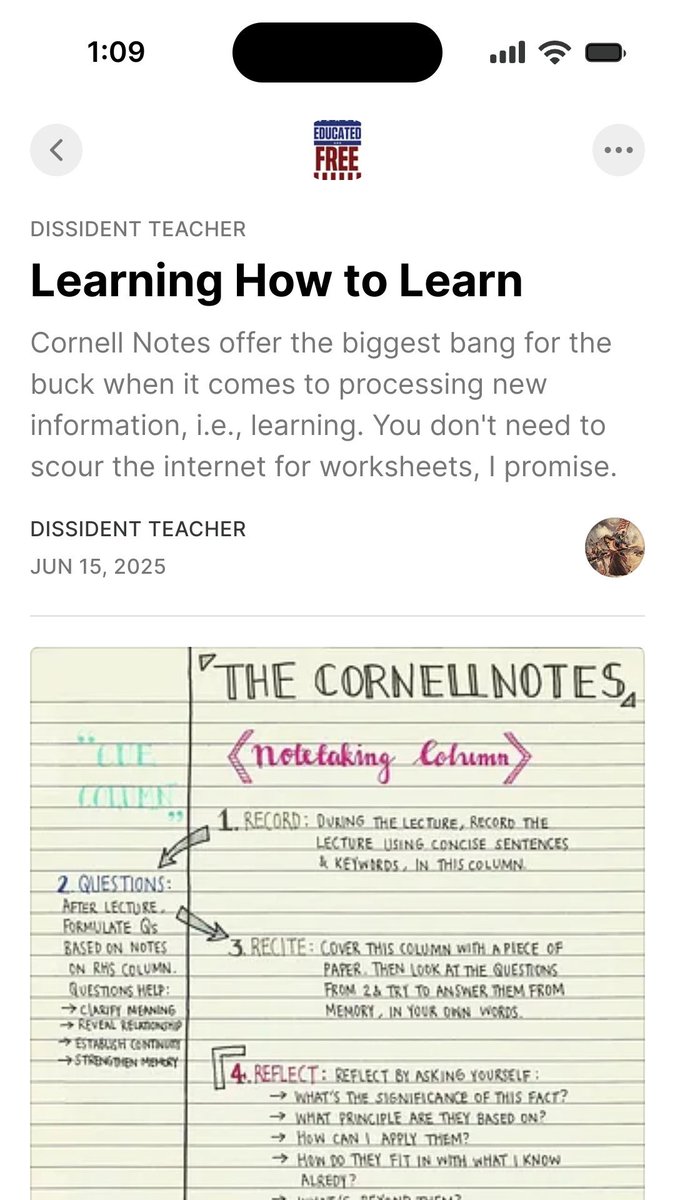
Lose the laptops; add Cornell Notes.
My students learn so much faster because Cornell notes make reviews and repetition part of the lesson, and make studying after the lesson much more efficient. This means we also free up instructional days so we can learn more over the course of the year.
Here’s how: https://t.co/XPWx73rRAq
1. Algebra is good for problem-solving.
2. Geometry is good for visual thinking.
3. Calculus is good for understanding change.
4. Statistics is good for decision-making.
5. Number theory is good for logical discipline.
6. Linear algebra is good for modern science and engineering.
7. Discrete math is good for computer science.
8. Differential equations are good for modeling the real world.
9. Optimization is good for smart planning.
10. Graph theory is good for network thinking.
11. Set theory is good for structured reasoning.
12. Practice is good for mathematical fluency.
13. Curiosity is good for lifelong learning in math.
crazy that it just takes 27 hours to learn machine learning from the Andrew NG’s Stanford course that students pay tens of thousands of dollars for.
thank you internet.
Everyone’s talking about Stanford’s free AI course, but Google dropped something even crazier ❱❱ "Advanced: Generative AI for Developers” for $0.
Yeah, free. Even the labs
Here’s the trick most people miss [see comments]







![AndrewBolis's tweet photo. RIP McKinsey. Here are 10 prompts to replace expensive business consultants:
[ 🔖 bookmark this post for later ]
➤ SWOT Analysis
Act as a business strategist. Generate a SWOT analysis for [INSERT BUSINESS] in the [INSERT INDUSTRY], using competitive market data and internal insights.
➤ Growth Levers
Find out 5 scalable growth levers for a [TYPE OF BUSINESS], focusing on revenue expansion, operational efficiency, and brand reach.
➤ 30-60-90 Plan
Create a 30-60-90 day action plan for a new [INSERT ROLE] at [COMPANY], including onboarding objectives, performance metrics, and quick wins.
➤ Revenue Model Projection
Develop a lean revenue model for a business providing [PRODUCT/SERVICE], covering optimal pricing, CAC, LTV, and monthly recurring revenue forecasts.
➤ Churn Reduction
Suggest 3 data-driven strategies to minimize churn for a SaaS product targeting [TARGET CUSTOMER], leveraging user behavior data and feedback loops.
➤ KPI Dashboard Framework
Outline the 7 critical KPIs for a [BUSINESS TYPE] to monitor across customer acquisition, retention, product engagement, and financial performance.
➤ Pricing Strategy
Act as a pricing advisor. Propose 3 pricing approaches for [OFFER] aimed at [SEGMENT], utilizing value-based pricing, tier structures, and market positioning.
➤ Go-to-Market Plan
Design a go-to-market plan for introducing [PRODUCT] to [TARGET MARKET], addressing positioning, distribution channels, customer acquisition, and success metrics.
➤ Value Proposition
Draft a persuasive value proposition for [BRAND or PRODUCT] that addresses customer challenges, presents the solution, and emphasizes unique advantages.
➤ Pivot Directions
Recommend 3 strategic pivot options for a startup facing [SPECIFIC PROBLEM], including alternative customer segments, applications, or product approaches.
→ Use these prompts to think, plan, and execute like a top business advisor.
📌 Get Advanced ChatGPT Guide (free): https://t.co/kOBWfKrBaX
👉 Follow me @AndrewBolis for more and 🔄 Repost this to help others use AI](https://pbs.twimg.com/media/G7FgHeObsAEQbHL.jpg)




![HeyNina101's tweet photo. Everyone’s talking about Stanford’s free AI course, but Google dropped something even crazier ❱❱ "Advanced: Generative AI for Developers” for $0.
Yeah, free. Even the labs
Here’s the trick most people miss [see comments] https://t.co/viIJ9bOojw](https://pbs.twimg.com/media/G4wygcrXYAEpSMR.jpg)





