@HumbleFlow Dude was fucked inthe head and failed in so many ways .his last crusade could easily be explained as a luciferian plot by his brother . His reign brought misery and destruction. He brought disaster upon his household.
@felonytalk@Nguyen_anime3@johnkonrad Well they did do the whole concentration camp/gulag/oppression murderous communist cleansing year zero thing, but at least they thought they were doing the right thing, or u could say they were just puppets to Mao and the soviets.
@ChristianHeiens I think it would be better to limit the the size of city government jurisdictions the size of to the pop size of congressional populations. Allowing better governance diversification. It would give conservatives a better chance to break through in large cities.
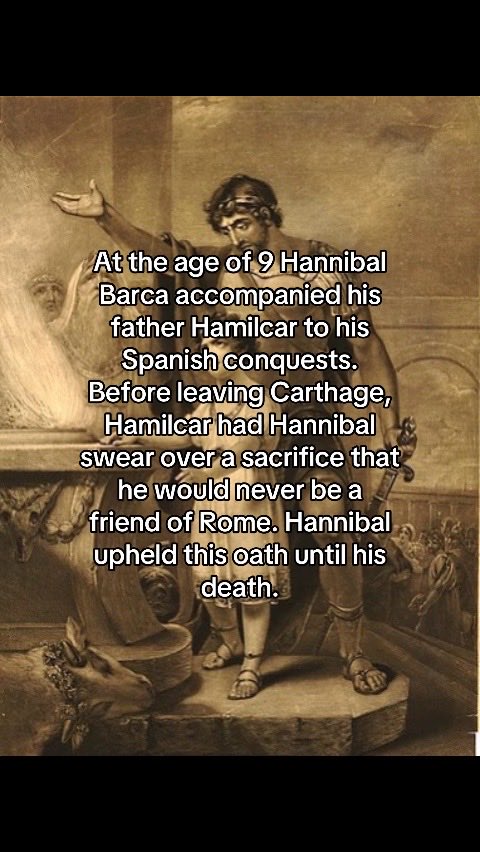
Hannibal Barca, a prominent Carthaginian general, swore an oath to his father, Hamilcar Barca, at the young age of nine. This oath was significant as it symbolized his lifelong commitment to oppose Rome.
The oath took place in a sacrificial chamber.
Hannibal promised to never be a friend of Rome, reflecting the intense rivalry between Carthage and Rome.
Hamilcar, during a sacrificial ritual, held Hannibal over a fire and made him swear this oath, emphasizing the seriousness of their family's enmity towards Rome.
Hannibal's oath against Rome led him to become one of Rome's most formidable adversaries during the Second Punic War, ultimately resulting in his relentless military campaigns against Rome. This oath fueled his determination to seek revenge for Carthage and shaped his strategies, including the famous crossing of the Alps to invade Italy.
The Second Punic War is a drama where Hannibal and his troops (including as many as 90,000 infantry, 12,000 cavalry, and 35-40 elephants) march from Spain across the Alps into Italy.
In 203 BCE, Hannibal’s troops were forced to abandon the struggle in Italy in order to defend North Africa. The following year Scipio Africanus and his troops routed the Carthaginians in the Battle of Zama, a city located in what is now Tunisia.
Hannibal’s losses in the Second Punic War effectively put an end to Carthage’s empire in the western Mediterranean. This left Rome in control of Spain and allowed Carthage to retain only its territory in North Africa. Carthage was also forced to give up its fleet and pay restitution in silver to Rome.
After the Second Punic War, in peacetime Carthage (200-196 BCE), Hannibal was briefly a politician in Carthage. He was also an economic planner and a judge. Hannibal was remembered for fighting corruption.
Seven years after the victory at Zama, Hannibal lived in Asia Minor as a military advisor to the Seleucids, the successors of Alexander the Great’s empire. But when King Antiochus III was defeated by the Romans he had to flee into Bithynia. Then Romans pressed Bithynians to turn Hannibal in, and when he heard that he was going to be betrayed he decided to commit suicide.
The exact location of Hannibal’s grave is unknown, but today there is a memorial dedicated to him in the town of Gebze in Kocaeli province, ancient Libyssa, where he died.
@MichaelM72660@BobTheMutant@peterrhague@WKCosmo Sorry, which part. Idaho's miniaturization of the this effect ND mass production is discussed in the last part of "chapterhouse" prior to the battle for "junction". The unpredictability of the interaction was brought up in "heretics" and "chapterhouse". Thought it's been years
@BobTheMutant@peterrhague@WKCosmo The resulting detonation of the interaction was unpredictable it could be tiny or citywide . Mentioned in one of the books. Predictable/unpredictable is one of dune series major themes