Giant Foundry Press
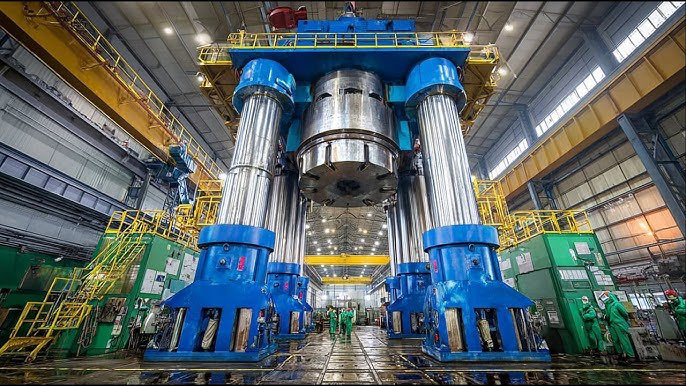
If you want to make nuclear reactor pressure vessels, wellheads, naval cannons, mega crane hooks and tackle, marine crankshafts, basically anything worthy of sci-fi cinema…
You need a foundry with a big press, so that you can forge big ingots, and work harden big forgings.
You also need an appropriately sized quench bath.
Then you need 30 years of cumulative competence with the equipment across your plant operators, your metallurgists and your quality inspectors…
Then you can make these things.
The horrible truth is that some things are so big they take 4 weeks to cool down (it’s the square-cube law), you can only make 10 per year… it takes a decade of practice to get good.
For 10 years almost everything you make will be poor, it will take 3 years of operation just to calibrate your equipment.
If you lose this stuff you never get it back, once you lose the last giant press your industrial base starts to unravel, lead times on critical components jump from 8 months to 40 months, it’s suddenly takes 5 years to repair a downed bridge, laypeople don’t understand why...
This is why.
Only 5 countries in the world can make giant ingots; China, Russia, Japan, South Korea and France… Italy and Germany the recent casualties, India probably ascend to make it 6 in a decade or so.
Russian Aerospace Forces (VKS) Mi-28N/NM and Ka-52/M attack helicopters are increasingly being used to intercept FP-1 and MICH-2000 drones, effectively serving as specialized drone hunters in rear areas alongside Tor-M2 and Pantsir-S1M air defense systems.
The Mi-28 uses its 30mm Shipunov 2A42 cannon for close-range engagements, supported by the OPS-28M multispectral electro-optical system and N025 mast-mounted radar, which can detect low-RCS targets at ranges of up to 5 km. Its automated fire-control system calculates lead angles to improve hit probability and reduce ammunition expenditure.
The Ka-52M has an advantage in poor weather, with its advanced Rezets active electronically scanned array (AESA) radar providing better resolution for detecting small drones against ground clutter than the Mi-28's N025 radar.
For longer-range engagements, both platforms can employ 9M342 Igla-S missiles and 9A1472 Vikhr-1 laser-beam-riding missiles, allowing them to engage targets beyond the effective range of the cannon.
Muzułmańscy żołnierze armii carskiej podczas modlitwy w trakcie I wojny światowej, wrzesień 1914 r.
Muslim soldiers of the Russian Imperial Army at prayer during World War I, September 1914.
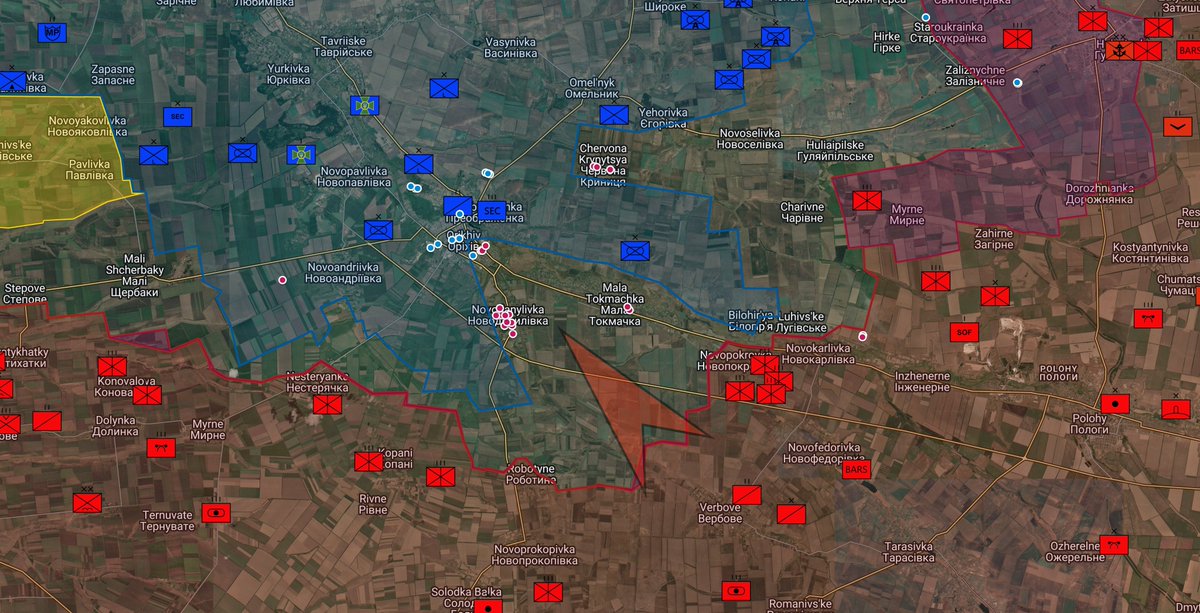
Weekend Ukraine map thread for Sunday 6th September 2026
A focus today on two directions where Russian forces are attempting to make significant advances.
South of Dobropillya, Russian forces have been sighted inside the 'other' Dobropillya as per the map, whilst towards Druzhkivka they continue their attempts to push onwards. These are not insignificant movements, and both directions warrant close attention in the weeks ahead.
Further towards west Zaporizhia, in the Orikhiv direction, Russian forces continue to be sighted within Orikhiv itself, with no indication yet that Ukrainian forces have succeeded in clearing them. We shall see how this develops.
On the long-range front, the Russian arms carrier Lady Mariia, sailing from St Petersburg towards Algeria and, presumably, ultimately Tartus, was struck north of Libya by what appears to have been a Ukrainian drone drop attack. The vessel was damaged multiple times, although it remains unclear whether she is now adrift or has continued upon her voyage. The Lady Mariia is an especially interesting case. Sanctioned by governments across the world, she nevertheless continued to carry military cargo with remarkable freedom over the years - from North Korean matériel entering Russia to weapons deliveries destined for Myanmar and elsewhere. Hell, even bringing arms through the Bosphorus, despite the Montreux Convention. The Sanctions are rather less formidable when nobody actually bothers to enforce them.
Meanwhile, further damage from the Adler strikes of 4 September has emerged, including two destroyed helicopters. The Ryazan refinery was also struck. Mid-range strikes continue apace
The tragedy, however, is that without sufficient manpower, equipment and the willingness to commit it, this pressure alone will not translate into the liberation of territory. It raises the price. It constrains the occupier. It makes the machinery of war harder to sustain. But it takes someone willing and able to go in there and kick the occupier out, of which Ukraine has precious few, and even less of a drive to increase manpower than last year.
Plenty of war left.
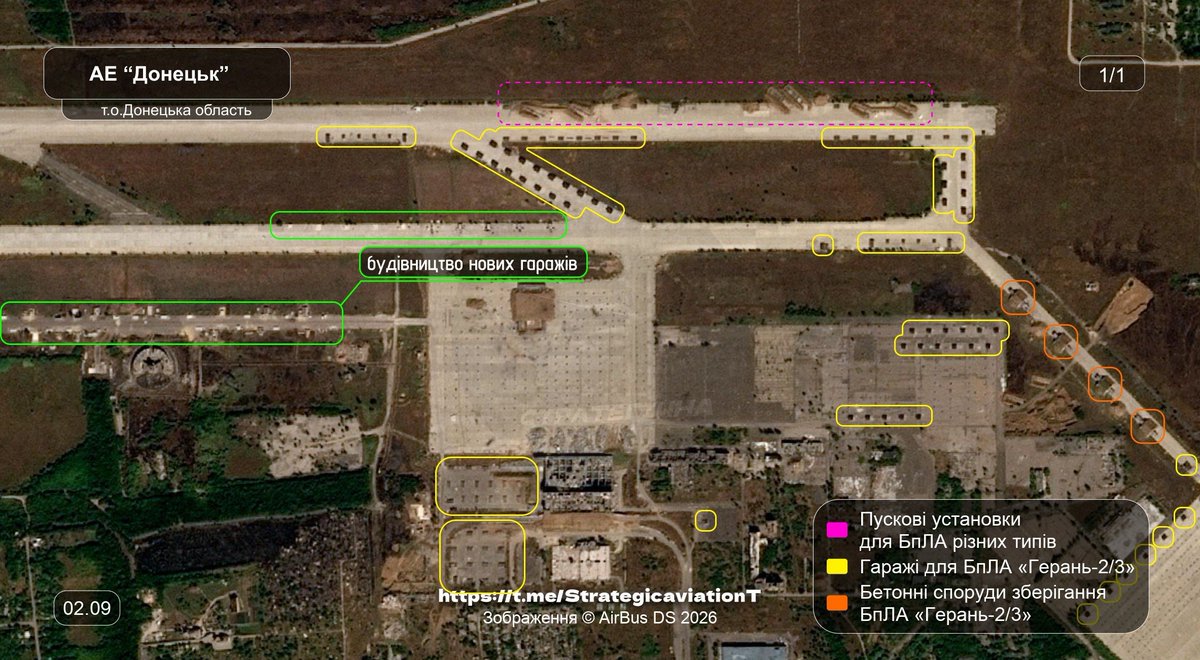
The Geran drone’s evolution over four years of combat in Ukraine offers one of the clearest views into what modern drone warfare looks like at the production level that the U.S. is not currently structured to match, write @csis_ai experts.
Explore the interactive brief here: https://t.co/sC5z6JhEJ6
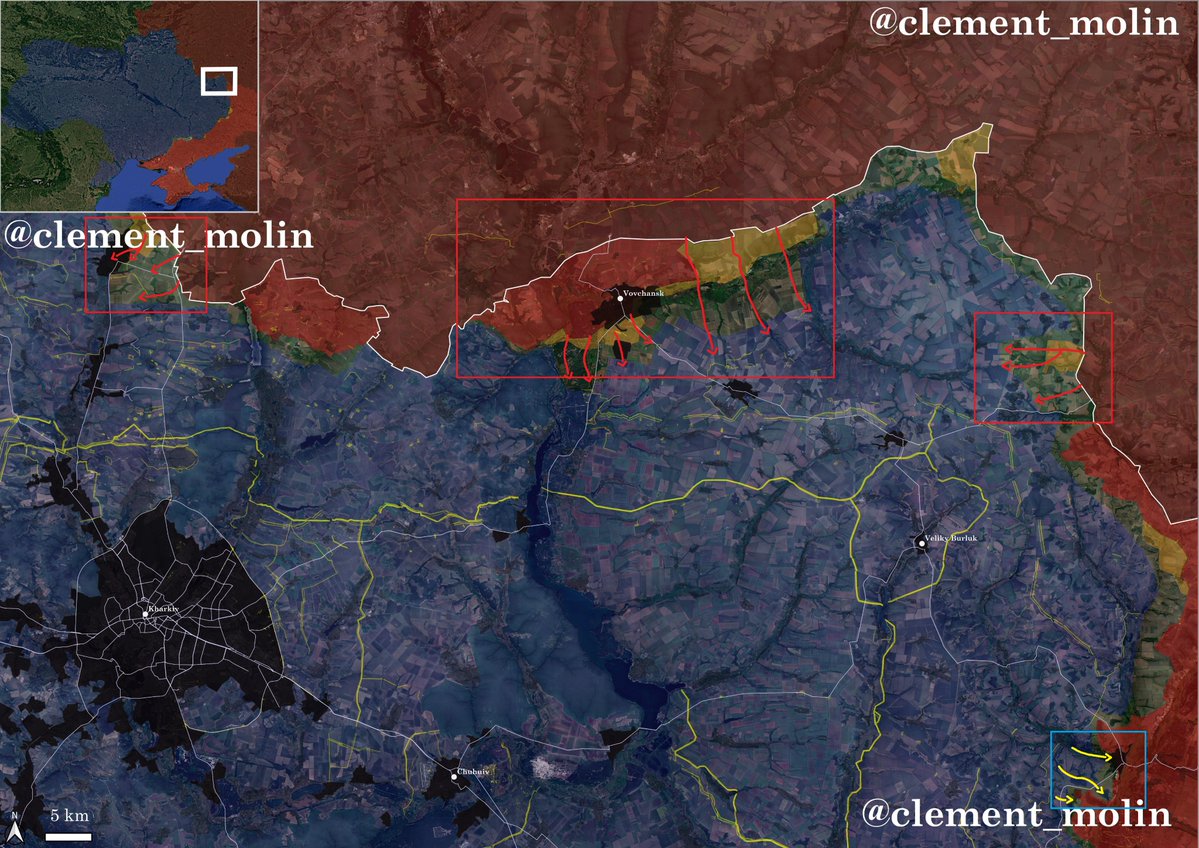
In the Kharkiv region, Russian 🇷🇺 mappers claim they encircled thousands of Ukrainian 🇺🇦 soldiers north of Veliky Burluk.
This does not correspond to the reality and is pure propaganda. We can depict 4 directions where offensive operations are ongoing in Kharkiv oblast :
🔸The westernmost is a cross border operation in and around Kozacha Lopan, with Russian forces showing their flags all over the town recently. This is part of Russian plan to create a "buffer zone" with bordering regions.
🔸The main offensive action is ongoing near Vovchansk, with long infiltrations that often reach very deep, thanks to the lack of engineering structures (the first real defensive line is much farther south). Some mappers show Bilyi Kolodiaz as contested, which is not the case. In fact, the Ukrainians still have many positions further north, to contain Russian infiltrations. Russian soldiers cross the border, walk in the forest, then try to cross the river and reach as deep as possible behind the lines.
🔸A secondary operation is ongoing further east, with cross-border crossings from small infantry teams, that managed to push 10 to 15km, supported by an intense airstrike campaign. For now, there is no threat of encirclement of Ukrainian forces further north, as long as infiltrations are contained.
🔹Further south, we talked about it already, the Ukrainians are conducting counter-attacks in and around Dvorichna, while Russian forces continue to infiltrate into Kupiansk.