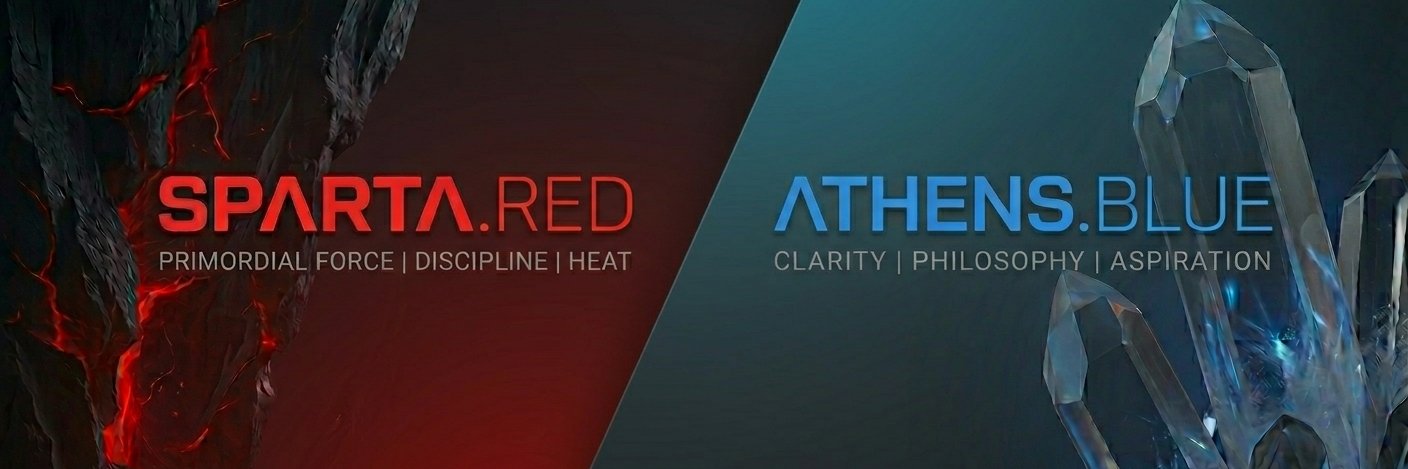
https://t.co/yuIPu5mY9z & https://t.co/ZeongvkThb - Rare Mythic Domain Pairing | Civilizational Archetype.
These two domain names capture something that sits at the root of Western civilization’s self-image: the eternal duel between Sparta and Athens. Not as trivia. Not as history. But as two operating systems humanity has been running for 2,500 years.
This listing offers a one-of-a-kind domain pairing and avoids the old .com boomer domain extensions:
https://t.co/svIRE1kRQi
https://t.co/lAQ7qAh0bK
Sparta represents force, discipline, order, heat, the red instinct of survival and power.
Athens represents wisdom, philosophy, discourse, clarity, the blue instinct of reason and aspiration.
Those two cities aren’t just places. They’re psychological defaults.
Every nation, every ideology, every school of thought, every leadership style has echoes of one or the other. They’re templates civilization keeps using because they map directly onto how humans understand conflict, meaning, and identity.
https://t.co/yuIPu5mY9z and https://t.co/ZeongvkThb, aren't just fine domain names.
It's a perfectly color-coded civilizational binary, one that feels ancient and modern at the same time.
Red is the color of Sparta.
Blue is the color of Athens.
It is a mythic binary with instant global recognition - a cultural operating system embedded in leadership theory, political identity, military history, philosophy, and the collective imagination.
It feels mythic because it is mythic.
It taps into epic time - the sense that these two forces have been in dialogue since before democracy existed, before science existed, before recorded history even stabilized.
A rivalry that shaped the Western world’s concepts of courage, freedom, law, logic, art, war, and destiny.
Almost no domain pairing carries this much weight because almost nothing in culture has this clean a duality. The names aren’t trendy. They’re primordial. They’re built into literature, philosophy, leadership theory, military identity, political theory, and the cultural subconscious.
The .red and .blue extensions complete the symbolism.
They lock the meaning into place.
They turn it from nouns into archetypes.
From “two words” into a living polarity.
They anchor each city-state into its symbolic color, transforming the domains into a fully realized archetypal structure.
This is a sale of the pair as a unit only.
They are being sold together because their meaning is intertwined.
Price: $20,000,000
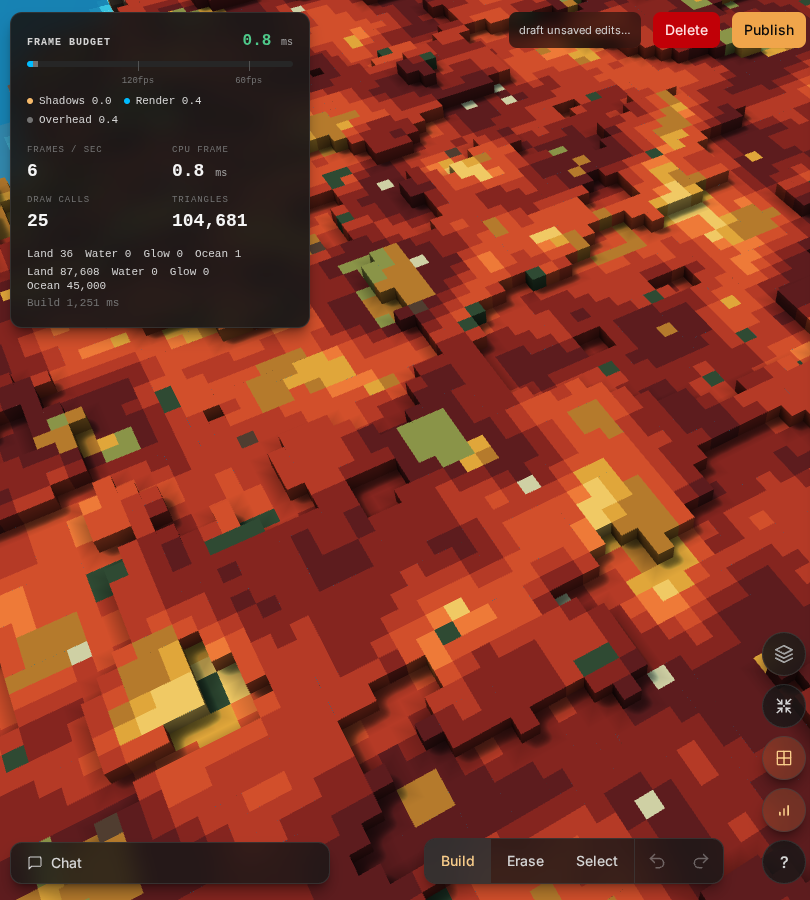
So I'm working on a tundra palette for the voxel system. The photo is what the colors are based off of.
Which one do people like? More yellow or more red?
@metatransformr I just keep track of the overall architecture as I build but I do move at a much slower pace than someone using something like the gauntlet method.
So I pivoted from voxels to a pure map/terrain generator.
Credit goes to @SketchpunkLabs for sharing their biome blending example implemented through Three.js. I ported it to Babylon and significantly expanded upon the concept.
I really like your assets. Do you know if they work with Babylon JS? I'm ok converting the models. I was just wondering if you already know if they work well or not?
Also looking forward to more of your stuff. Would be nice to see pirate themed characters plus some basic items like loot chests, magic books, scrolls, potions, crates, gem stones, etc.
Spent like 12 hours today making a single cube look nice in the rendering engine. 💀
Overhauled the shadow catcher by switching to ShadowOnlyMaterial, eliminating the previous rim-fade hack with a single-subdivision transparent plane and adding an anchor sphere to stop shadow clipping.
To prevent shadows from being cropped, an invisible, non-rendering ghost sphere is mathematically placed at the shadow's predicted edge to trick the frustum fitter into expanding its depth range. Which forces the engine to recalculate the ghost's position despite its invisibility, ensuring the depth range dynamically expands to cover long shadow tails.
The sky system now includes a ground stop for the under-horizon bowl, alongside an updated default preset featuring refined top/ground colors and elevated fog density.
Plus other updates include UI visibility controls, editor grid persistence, polished rail controls, range slider redesigns, etc.
Yeah, I noticed they're designed for large coding tasks.
For example, you don't want it to change a color on a button because it will take 30 minutes implementing, running verification, doing checks, and tests to really make sure the color on that button got applied correctly and didn't break anything while also using up your weekly usage quota.
For small tasks going in and doing it yourself saves both time and money.