Cape Verde held Spain to a 0-0 draw in their first-ever World Cup match, with veteran goalkeeper Vozinha named player of the match after a heroic performance.
Japan is facing a growing loneliness crisis. From elderly residents living alone to younger generations struggling with social disconnection, loneliness is becoming a major social challenge.
Al Jazeera’s Patrick Fok reports.
FIFA added that it does not handle immigration processes and that final visa decisions rest with the host nation, as is the case with all FIFA tournaments.
#WorldCupwithMicky#FIFAWorldCup. Pg 2/2
FIFA has confirmed that Thomas Partey will be unable to travel from Ghana’s base camp in Boston, USA, to Canada for their opening World Cup match against Panama on Wednesday, 17 June, after his visa application was refused by the Canadian government.
Pg 1/2
Globally, 43% of young people aged 18–24 are enrolled in higher education. In sub-Saharan Africa, that figure drops to just 9%.
Completion rates reveal similar disparities.
UNESCO’s Higher Education Global Trends Report highlights the urgent need to expand equitable access to higher education worldwide.
👉 https://t.co/uSgsEPfeWv
Over a thousand beef rib racks are slow-roasted over wood embers at Argentina’s Festival del Costillar Criollo, a vibrant celebration of traditional gaucho culture and barbecue heritage.
UGANDA M&A TAX ALERT: 50%+ change in company ownership can trigger a tax charge on the target company itself even where the seller receives the proceeds.
This risk is not limited to property-rich companies and can arise across a wide range of sectors and transaction structures.
Both buyers and sellers should carefully assess the potential exposure early in the deal process, including the impact on pricing, transaction timing, tax allocation mechanisms, warranties, and indemnities.
Early tax due diligence and clear contractual protections can help avoid unexpected liabilities after completion.
https://t.co/IdbhDjGZKx
#Uganda has today reported three new confirmed cases of #Ebola in the country, including a Ugandan health worker, a driver and a Congolese national who travelled from Ituri Province, in the neighbouring #DRC, for medical care.
This brings the total number of people in Uganda who have been tested positive for Ebola Disease caused by the Bundibugyo virus to five.
I acknowledge @MinofHealthUG for their efforts to detect, monitor and care for people suspected of and confirmed for contracting the Ebola virus.
At this critical moment in the outbreak response, it is vital that authorities maintain high vigilance to control expansion of the virus.
@WHO is working side by side with @AfricaCDC, and partners in the DRC and Uganda, to contain the outbreak, support affected people, and bolster a coordinated response.
https://t.co/UvpSj9WBie
The #Ebola situation in the #DRC is deeply worrisome. So far, 82 cases have been confirmed, with seven confirmed deaths. But we know the epidemic in the DRC is much larger. There are now almost 750 suspected cases and 177 suspected deaths.
The situation in #Uganda is currently stable, with two confirmed cases, and one death reported. There have been no new cases or deaths reported.
An American national who was working in DRC has also been confirmed positive, and transferred to Germany for care. We are aware of the reports today about another American national who is a high-risk contact who has been transferred to the Czech Republic.
These numbers are changing as surveillance efforts and laboratory testing is improving, but violence and insecurity are impeding the response.
Additional @WHO personnel have deployed to Ituri, the epicentre of the DRC outbreak, to support affected communities.
I am in regular contact with the government officials of the affected countries to coordinate response actions.
I have just convened a Member States briefing to update them on the ongoing response.
Nigerian billionaire Aliko Dangote is looking at Kenya as the site of a 650,000-barrel-a-day oil refinery that he intends to build in East Africa, the Financial Times reported on Sunday, citing an interview with him. https://t.co/MBYxWG0NQr
A long-term study suggests that regularly eating eggs may be linked to a lower risk of developing Alzheimer’s disease.
Researchers tracked nearly 40,000 adults aged 65 and older over a period of more than 15 years. Those who consumed eggs most frequently were significantly less likely to develop Alzheimer’s compared to those who rarely ate them.
The greatest reduction was seen in people who ate around one egg a day at least five times per week, showing about a 27% lower risk. Even moderate intake appeared beneficial, with smaller but noticeable reductions among people eating eggs only a few times per month or several times weekly.
Scientists from Loma Linda University reviewed dietary and health data from 39,498 older adults, during which 2,858 participants developed Alzheimer’s disease. After accounting for factors such as exercise, smoking, diabetes, blood pressure, age, and overall diet quality, the association between egg consumption and lower Alzheimer’s risk still remained.
Researchers believe nutrients found in egg yolks may play an important role. Eggs are especially rich in choline, which the brain uses to produce acetylcholine - a chemical involved in memory and communication between brain cells. Alzheimer’s patients are known to have reduced acetylcholine levels.
Egg yolks also contain lutein and zeaxanthin, antioxidants that can build up in brain tissue and have previously been associated with improved memory and cognitive performance in older adults. In addition, omega-3 fatty acids found in eggs may help maintain healthy brain cell function.
However, researchers emphasize that the study only shows a correlation and does not prove eggs directly prevent Alzheimer’s disease. The study participants were also Seventh-day Adventists, a group generally known for healthier lifestyles than the average population.
The Regent International apartment building in Hangzhou, China, is renowned for housing approximately 20,000 people.
Surprisingly, This building can accommodate 30,000 people. This building is a town in itself.
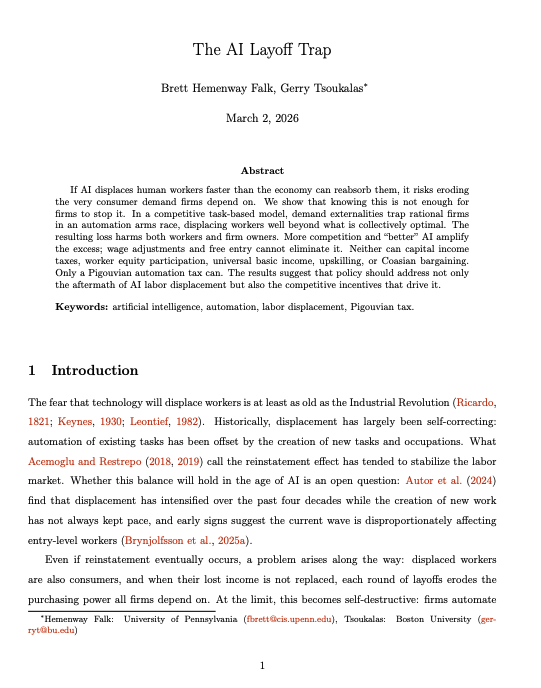
🚨BREAKING: Two researchers from UPenn and Boston University just published a paper that should be uncomfortable reading for every CEO automating their workforce right now.
The argument is straightforward. Every company replacing workers with AI is also eliminating its own future customers. Laid off workers stop spending. Enough of them stop spending and nobody can afford to buy anything. The companies that fired everyone end up selling into an economy with no purchasing power left.
Every executive can see this. The math is not complicated. But here is why nobody stops.
If you do not automate, your competitor does. They cut costs, lower prices, take your market share, and you collapse anyway. So every company automates knowing it is collectively destructive because the alternative is dying alone while everyone else survives. The researchers proved this is a Prisoner's Dilemma playing out in real time.
The numbers are already moving. Block cut nearly half its 10,000 employees this year. Jack Dorsey said AI made those roles unnecessary and that within the next year the majority of companies will reach the same conclusion. Salesforce replaced 4,000 customer support agents with AI. Goldman Sachs deployed a coding tool that lets one engineer do the work of five. Over 100,000 tech workers were laid off in 2025 and AI was cited as the primary driver in more than half those cases. 80% of US workers hold jobs with tasks susceptible to AI automation.
The researchers tested every proposed solution. Universal basic income does not change a single company's incentive to automate. Capital income taxes adjust profit levels but not the per-task decision to replace a human. Collective bargaining cannot hold because automating is always the dominant strategy.
They also identified what they call a Red Queen effect. Better AI does not solve the problem, it accelerates it. Every company chases faster automation to gain market share over rivals but at the end everyone has automated equally, the gains cancel out, and the only thing left is more destroyed demand.
The one thing the math says could work is a Pigouvian automation tax. A per-task charge that forces companies to account for the demand they destroy each time they replace a worker.
The conclusion is that this is not a transfer of wealth from workers to owners. Both sides lose. Workers lose income. Companies lose customers. It is a deadweight loss with no market mechanism to stop it on its own.
Link
https://t.co/H2jhabQDu3
12. Clickworker
Clickworker offers remote microtasks like data entry, AI training, writing, and surveys. It’s ideal for earning extra income with flexible, task-based work.
Experienced workers earn up to $10/hr.
🔗 https://t.co/xpQcjOrQ7E
An El Niño event is expected from mid-2026, impacting global temperature & rainfall patterns, according to WMO's global seasonal climate update. Models indicate that this may be a strong one!
More details 👉 https://t.co/zQDJ6uWGJE









![ahuja_priyank's tweet photo. 𝟕𝟎 𝐓𝐨𝐮𝐠𝐡𝐞𝐬𝐭 𝐈𝐧𝐭𝐞𝐫𝐯𝐢𝐞𝐰 𝐐𝐮𝐞𝐬𝐭𝐢𝐨𝐧𝐬
Mandatory Bookmark
► Thread [1/20] https://t.co/YeHb04gwTM](https://pbs.twimg.com/media/HHFGMAWbQAAuntb.jpg)


