Jevons paradox is happening in real time. Companies, especially outside of tech, are realizing that they can now afford to take on software projects that they wouldn’t have been able to tackle before because now AI lets them do so.
We’re going to start to use software for all new things in the economy because it’s incrementally cheaper to produce. Marketing teams at big companies will have engineers helping to automate workflows. Engineers in life sciences and healthcare will automate research. Small businesses will hire engineers for the first to build better digital experiences.
And as long as AI agents still require a human who understands what to prompt, how to review when an agent goes off the rails, how it guide back, how to maintain the system that was built, how to fix the ongoing bugs, and more, we will still have humans managing these agents.
This is why all the advice you get of not going into engineering is wrong. The world is going to increasingly be made up of software, and the people that understand it best will be in a strong economic position. This will happen in other roles as well where output goes up and demand increases.
New art project.
Train and inference GPT in 243 lines of pure, dependency-free Python. This is the *full* algorithmic content of what is needed. Everything else is just for efficiency. I cannot simplify this any further.
https://t.co/HmiRrQugnP
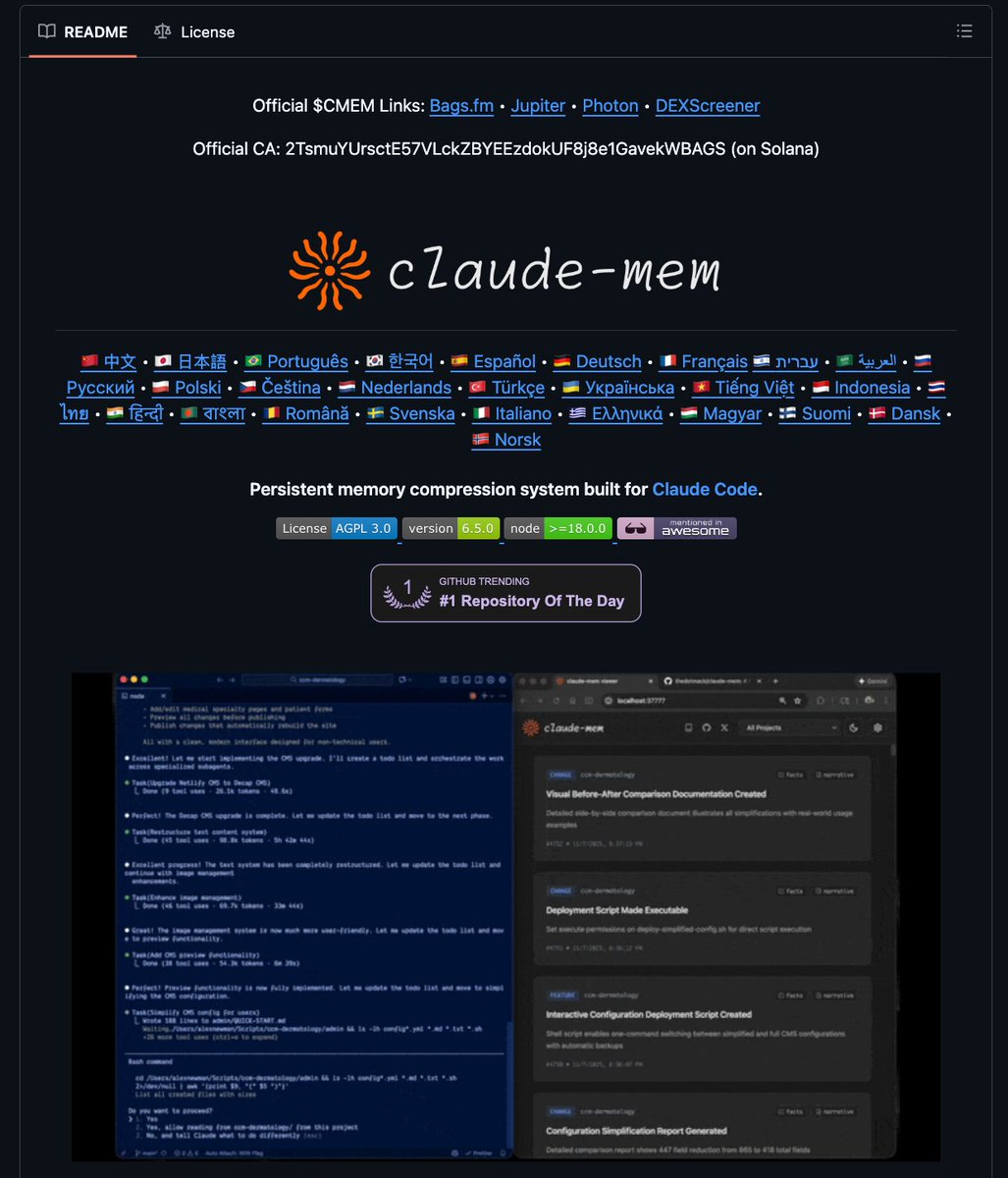
🚨BREAKING: Someone just solved Claude Code's biggest problem.
It's called Claude-Mem and it gives Claude persistent memory across sessions.
- You can use up to 95% fewer tokens each time.
- Make 20 times more tool calls before reaching limits.
100% Opensource.
"I don't have a GPU" is officially over.
VS Code now connects directly to Google Colab.
→ You get a free T4 GPU inside your editor.
→ Takes 2 minutes to set up. Their compute.
🚀 Boost Your AI Prompts with XML Tags!
Applications are now containerizing context in XML tags as it dramatically improves LLM accuracy by enhancing parsing & reducing ambiguity. For instance, Tagging-Augmented Generation (TAG) boosts long-context QA by up to 17% on 32K tokens. In math reasoning, XML-structured prompts hit 76.6% on GSM8K, outpacing vanilla methods
This paper from Google DeepMind, Meta, Amazon, and Yale University quietly explains why most “AI agents” feel smart in demos and dumb in real work.
The core idea is simple but uncomfortable: today’s LLMs don’t reason, they react. They generate fluent answers token by token, but they don’t explicitly plan, reflect, or decide when to stop and rethink. This paper argues that real progress comes from turning LLMs into agentic reasoners systems that can set goals, break them into subgoals, choose actions, evaluate outcomes, and revise their strategy mid-flight.
The authors formalize agentic reasoning as a loop, not a prompt:
observe → plan → act → reflect → update state → repeat.
Instead of one long chain-of-thought, the model maintains an internal task state. It decides what to think about next, not just how to finish the sentence.
This is why classic tricks like longer CoT plateau. You get more words, not better decisions.
One of the most important insights: reasoning quality collapses when control and reasoning are mixed. When the same prompt tries to plan, execute, critique, and finalize, errors compound silently. Agentic setups separate these roles.
Planning is explicit. Execution is scoped. Reflection is delayed and structured.
The paper shows that even strong frontier models improve dramatically when given:
• explicit intermediate goals
• checkpoints for self-evaluation
• the ability to abandon bad paths
• memory of past attempts
No new weights. No bigger models. Just better control over when and why the model reasons.
The takeaway is brutal for the industry: scaling tokens and parameters won’t give us reliable agents. Architecture will. Agentic reasoning isn’t a feature it’s the missing operating system for LLMs.
Most “autonomous agents” today are just fast typists with tools.
This paper explains what it actually takes to build thinkers.
Stanford just dropped a 457 page report on AI.
It's packed with data on: cost drops, efficiency, benchmarks, adoption.
This report is a cheat code for your career in 2026.
I pulled the most important charts + what they mean for your career: 🧵
2026 reality check: AI agents running on serverless (AWS Lambda, GCP Cloud Run, Azure Functions) are powering the explosion in consumer apps. We're already handing off the boring web stuff - shopping, bookings, research, even payments to autonomous agents that just handle it. No more endless tabs and clicking. The future is already here. 🤖
Happy New Year 🚀 2026 may be the year AI agents start feeling genuinely useful.
The shift isn’t just better models, but better context - memory, preferences, and real-time signals that help agents understand what we actually need.
We’re likely to see:
• Personal agents helping with daily planning
• Teams using AI agents for routine work and coordination
• AI that’s a bit more proactive and reliable
The challenge isn’t intelligence alone; it’s context.
If we get that right, agents become practical for everyday use.
Curious to see what gets built.
#AI2026 #AIAgents #ContextEngineering
The gap between a 5-person and a 500-person company just collapsed again. A small Texas bakery (Tiny Kitchen) tripled holiday orders (50 → 150+/week) and +40% revenue in 2 weeks using only ChatGPT for personalized posts & emails and Shopify AI for inventory & demand
Zero new hires. Zero tech skills. If you’re still doing everything manually in 2025, you’re choosing to fight with one hand tied.
#SmallBusiness #AI
AI advancements are supercharging small businesses! In 2025, adoption hits 55-60%, saving owners 20+ hours/month and $500-2K in costs. 82% report team growth, with AI automating tasks, boosting customer insights, and fueling innovation. Level the playing field now! #SmallBizAI #TechGrowth
👋 Meet the Nuqualis Email Assistant - Beta is here!
✨Reclaim your time! Our AI auto-responds to emails (customers, sales, events) using your docs. Focus on what matters. 🚀
Try the demo: 👇
https://t.co/40M0H0ANTh
#AI#BetaLaunch#Email#Automation#Nuqualis#SaveTime