@catturd2 Would never wear an N95 mask, with a beard, on a chin, outdoors.
Odd contrast,
Took aggressive stance against the dangers of Down Syndrome baby.
Pretty casual-stupid with the PPE.
Pretty much common knowledge, people abort for assorted reasons. Some even celebrate it. Some have deep regret. For most, it is a personal matter. The issue might be the psuedo-live streaming of the moral dilemma, followed by the monetized explanation of the "difficult choice" from the couple that (improperly) wear masks out doors because they are afraid of bad things in the air that their immune system cannot tolerate.
@Fair_and_Biased “Mind your own business” (a non-argument) also doesn’t work when you pre-record on a monetized social media platform.
In affect, they probably both got paid more to put their baby down faster than they did work to keep alive their dog with kidney failure.
It is 2026 and the are both wearing face masks outdoors (incorrectly and ineffectively) “out of an abundance of caution”, so perhaps understandable and ironic that they would publicly display (signal) their prenatal termination story.
Vulnerabilities commonly associated with Down syndrome (besides testing)
https://t.co/UfHM8YkPEo
With new prenatal testing, will babies with Down syndrome slowly disappear?
https://t.co/Pco0CIkYwI
What are we losing if Down syndrome disappears?
https://t.co/m0JsjivW0F
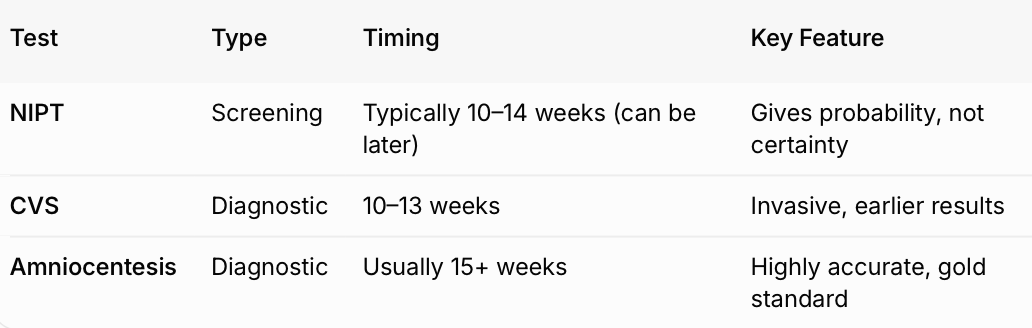
g: Prenatal Testing for Down Syndrome (Trisomy 21)
NIPT (cfDNA screening): This is a screening test. Among positive results, there is typically a 5–30% chance the baby is born without Down syndrome, with the rate varying significantly by maternal age. Younger mothers tend to have higher false-positive rates due to lower background prevalence of Trisomy 21.
Diagnostic tests (amniocentesis or CVS): These provide definitive results with accuracy >99.9%. Once confirmed positive, the chance of the baby being born without Down syndrome is less than 0.1%.
Jesse & Ashley Ridgway Case
YouTuber Jesse Ridgway (age 33) and his wife Ashley (age 31) publicly shared that they terminated a pregnancy after a diagnosis of Trisomy 21. Key facts from their statements:
Married: October 2025
Pregnancy announced: March 2026
NIPT screening (Natera): April 2026 → 95% chance of Trisomy 21 (baby was a boy). They noted concerns about possible false positives.
Amniocentesis: Results received around May 27, 2026 → Confirmed Trisomy 21
Termination: Early June 2026 (after diagnostic confirmation)
Testing Pathway & Probability Clarifications
The couple followed the standard pathway: NIPT screening first, followed by confirmatory amniocentesis.
The 95% was the Positive Predictive Value (PPV) from the NIPT. At age 31, this was a relatively strong result, meaning there was roughly a 5% chance the baby would be born without Down syndrome if they had relied on the screening test alone.
The >99.9% refers to the accuracy of amniocentesis. After confirmation, the chance of a normal (non-T21) outcome dropped to <0.1%.
Maternal age was already factored into the 95% NIPT result. However, once amniocentesis confirmed the diagnosis, age no longer meaningfully affected the probability.
In this case, the couple waited for diagnostic confirmation before making their decision. The initial 95% NIPT result (which already accounted for Ashley’s age) left some uncertainty, which the amniocentesis largely removed.
With new prenatal testing, will babies with Down syndrome slowly disappear?
https://t.co/Pco0CIkYwI
What are we losing if Down syndrome disappears?
https://t.co/m0JsjivW0F
With new prenatal testing, will babies with Down syndrome slowly disappear?
https://t.co/Pco0CIkYwI
What are we losing if Down syndrome disappears?
https://t.co/m0JsjivW0F
It’s a Brave New World of social media-enabled, Truman Show-stylized prenatal Sophie’s Choice.
Yet some would argue there is profound moral gravitas in pulling on the thread of what is knitted in the womb.
YouTuber Jesse Ridgway and his wife abort their child after finding out the baby had Down syndrome.
Ridgway cited that they chose to kill the baby after deciding that he and his wife didn't want to be inconvenienced with a child with Down syndrome.
"Things have been pretty dark for a while for us, and we felt this was gonna be a nice little ray of sunshine, and it's not."
Horrific and selfish.
An estimated 67% - 85% of pregnancies in the U.S. with a Down syndrome diagnosis are aborted.
This is evil. Don't let anyone convince you otherwise.
@DanFriedman81 Your short sentence *almost* captured an aspect of the issue....
#FixedIt
"The overwhelming majority of people faced with this awful choice [might] choose to terminate their pregnancies... privately, without ad-revenue."
g: Prenatal Testing for Down Syndrome (Trisomy 21)
NIPT (cfDNA screening): This is a screening test. Among positive results, there is typically a 5–30% chance the baby is born without Down syndrome, with the rate varying significantly by maternal age. Younger mothers tend to have higher false-positive rates due to lower background prevalence of Trisomy 21.
Diagnostic tests (amniocentesis or CVS): These provide definitive results with accuracy >99.9%. Once confirmed positive, the chance of the baby being born without Down syndrome is less than 0.1%.
Jesse & Ashley Ridgway Case
YouTuber Jesse Ridgway (age 33) and his wife Ashley (age 31) publicly shared that they terminated a pregnancy after a diagnosis of Trisomy 21. Key facts from their statements:
Married: October 2025
Pregnancy announced: March 2026
NIPT screening (Natera): April 2026 → 95% chance of Trisomy 21 (baby was a boy). They noted concerns about possible false positives.
Amniocentesis: Results received around May 27, 2026 → Confirmed Trisomy 21
Termination: Early June 2026 (after diagnostic confirmation)
Testing Pathway & Probability Clarifications
The couple followed the standard pathway: NIPT screening first, followed by confirmatory amniocentesis.
The 95% was the Positive Predictive Value (PPV) from the NIPT. At age 31, this was a relatively strong result, meaning there was roughly a 5% chance the baby would be born without Down syndrome if they had relied on the screening test alone.
The >99.9% refers to the accuracy of amniocentesis. After confirmation, the chance of a normal (non-T21) outcome dropped to <0.1%.
Maternal age was already factored into the 95% NIPT result. However, once amniocentesis confirmed the diagnosis, age no longer meaningfully affected the probability.
In this case, the couple waited for diagnostic confirmation before making their decision. The initial 95% NIPT result (which already accounted for Ashley’s age) left some uncertainty, which the amniocentesis largely removed.
@Slatzism It’s a Brave New World of social media-enabled, Truman Show-stylized embryonic Sophie’s Choice. Yet some would argue there is profound moral gravitas in pulling on the string of what is knitted in the womb.