Big AI/fusion acceleration from Google
Google DeepMind’s Gemini 4 agents teamed up to discover mathematically verified quantum algorithms with up to 290x improvements in quantum arithmetic and roughly 12x lower computational costs for fusion simulations
"Using teams of Gemini 4 agents, we’ve built new quantum circuits that cut future simulation costs by up to 10 times"
The AI driven massive breakthroughs are starting to compound.
There’s so much talk about AI accelerating cures but not enough concreteness on how exactly we’re going to shrink every step of the process and attack the right bottlenecks. I’m now spending all my energy on companies that solve these issues. My own health depends on it. Been advising Capable for a few months and I’m really impressed with their progress. See below.
AI proved the Riemann Hypothesis in a weekend.
Biology is next, but it won’t happen by waiting for smarter models. Math had a proof checker. Biology doesn’t yet.
Here are the 5 things we need to build. 🧵👇
I CANNOT BREATHE. claude just proved VP ≠ VNP
47 YEARS. valiant asked this in 1979 and the whole field has been stuck on it since. its the algebra version of P vs NP, the wall standing in front of the real one
the best lower bound for general circuits was from 1983. basically LINEAR. 43 years and nobody moved it an inch. a model just went superpolynomial over every field. first superpolynomial bound for general circuits EVER
the proof ends with a program eating itself. it runs on its own code, gets a value V, then V = 1 + V, contradiction, done. claude doesnt even know which of its own 2 cases is true and it wins both anyway
70 pages. author line says "CLAUDE". 73k lines of lean, 2 kernels signed off. AI wrote the paper and the lean, and the paper says only AI readers judged the statement file. NO HUMAN MATHEMATICIAN HAS CHECKED IT
ETH 4 weeks ago in the same repo. the riemann hypothesis claim 3 days ago. now valiant's conjecture. anthropic is deleting the open problems list and pushing it to github like a typo fix
mathematicians had a good run. its so over
read it yourself: https://t.co/HGLZ3MtCJK
Walmart is determined not to make the same mistake with agentic commerce that it did with ecommerce. While Amazon is blocking agents, Walmart is embracing them - quite a reversal.
And the new data from Stripe suggests agentic shopping may actually be kicking off & is sticky.
Frontier models can now propose technical social science research designs that experts grade more highly than the world's top political economist's---that's the finding from our new Free Systems eval, SnyderBench, in which we have PhD experts blind grade research proposals from AI models compared to papers written by Harvard political economist Jim Snyder (which the experts have not previously read).
At the same time, we see no evidence that models can develop research ideas that experts rate as better overall contributions. They're getting better and better at the technical part of research, but not necessarily at the more subjective part.
This could be because human experts possess "judgment" that the models do not.
It could also be that research "contribution" is so subjective that it doesn't actually point at any meaningful goal---consistent with this possibility, we find that our human experts don't agree with one another when rating project ideas for the strength of their contribution, with agreement rates barely higher than random chance. Perhaps social science research is what @alexolegimas might call a "relational good": something people value in part because it's produced by a human. We're not sure.
This past January, I released the results of a pilot in which I had Claude Code replicate and extend a past empirical paper on vote-by-mail. 10 months later, it's stunning the amount of progress that's been made. It's no longer interesting to ask whether AI can collect data and run analyses automagically---we take that for granted---instead, the question is how much of the entire research loop AI can complete. Our tentative answer: AI can handle the technical aspects of empirical political economy research from end to end, devising the design and executing it, but for now, we still need humans to drive the agenda.
This is joint work with @AndyCWMyers, and is of course dedicated to my PhD advisor Jim Snyder, who remains the world's great empirical political economist, AI or no AI.
Lots more in the full piece here:
https://t.co/zgScGvp9EY
@latticecut Interesting assertion. Behind it is lots of high profile fear--much as the fear of the mathematics AI is not about solutions but about loss of human dominance. I think the rich and powerful are starting to realize ASI is about their life and lifestyles first and foremost.
Western Europe is incredibly safe today compared to the preindustrial past.
What used to be a world of feuds, weak institutions, and routine violence has given way to stable courts, strong norms, and peaceful daily life.
I'm a huge believer and basically built my whole career around precision oncology. That's exactly why the access gap for rare alterations drives me mad.
I saw again a patient in his 40s with advanced bile duct cancer/cholangiocarcinoma. We sequenced the tumor and found a DNA change called MTAP loss, which leaves the tumor leaning hard on one enzyme to survive. There are drugs designed to use that dependency in trials right now. This is what I love about precision oncology, the advances here are unbelievable.
But: One study doesn't take his tumor type, only pancreatic or lung cancer. Another has the right cohort, but it hasn't opened yet, and nobody knows when it will open. Nobody did anything wrong here, the procedures are in place for good reason.
But this cancer doesn't wait. "Opening in a few months" is a reasonable timeline for a protocol, but a completely meaningless one for him.
So the only road left to travel is approaching the companies for a compassionate use access. That might work for him, but it doesn't work for us as a community, we don't learn from 1000 of isolated cases.
Rare alterations need trials built around the fault rather than the organ, and they need to open at the speed the disease moves. We got very good at finding these targets. We haven't built anything that can act on them in time.
@ValerioCapraro How many times must we again go through the basic ideas of intellectual property and copyright? Saying or writing something does not make it "yours." You cannot copyright an idea. To protect intellectual property you must explicitly claim and and prove originality for purpose.
@Jason@realDonaldTrump For humanity, Trump has been a disaster in virtually every way, but, remarkably, his position on AI redeems all of that--almost accidentally--and, ironically, will be the only thing about his time on this planet that is widely remembered.
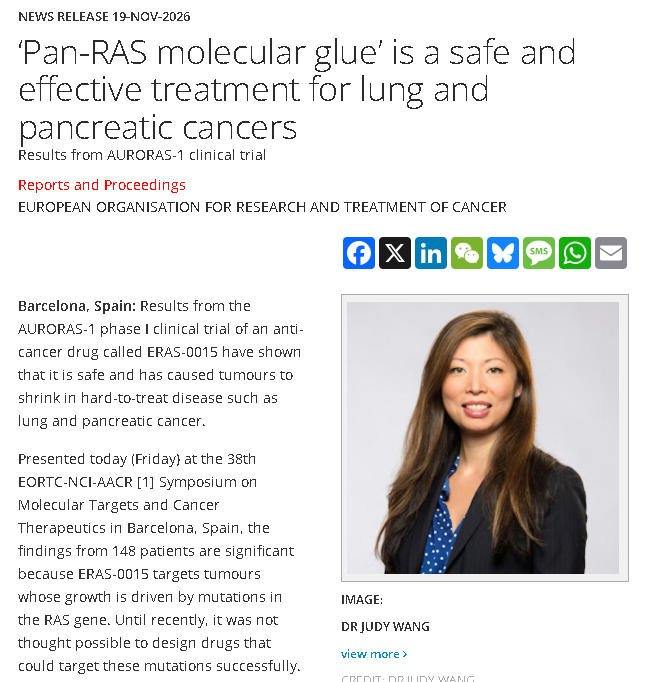
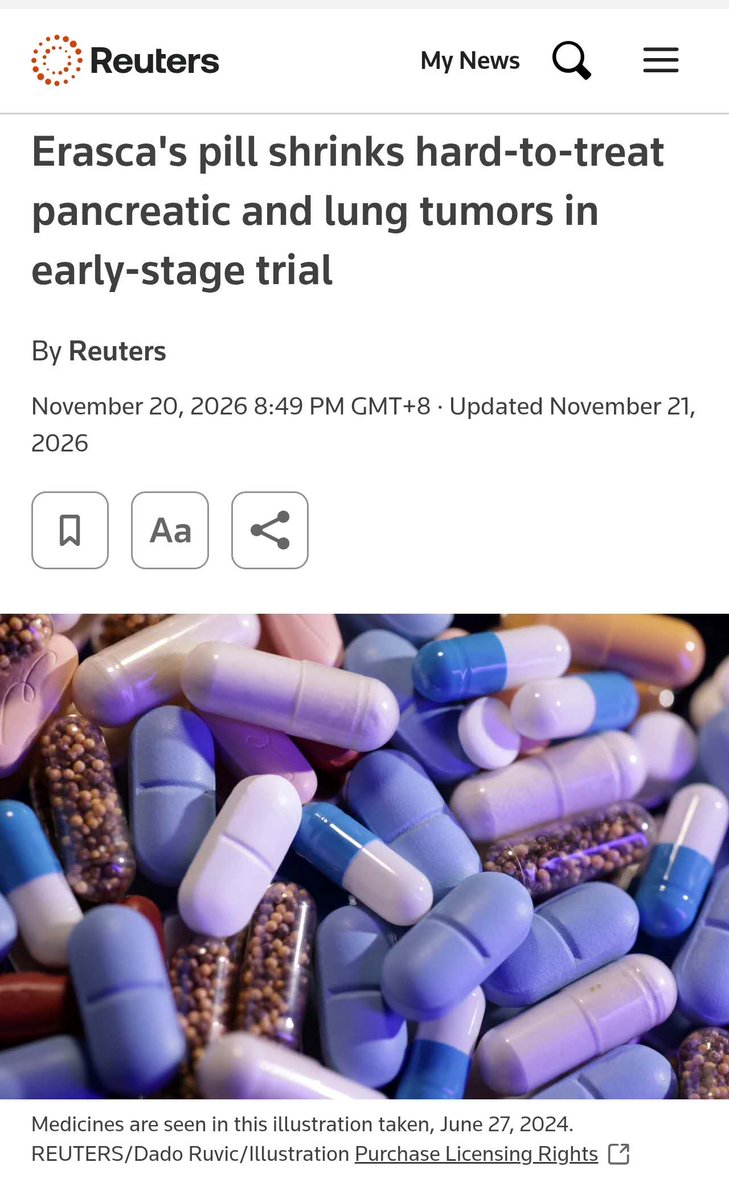
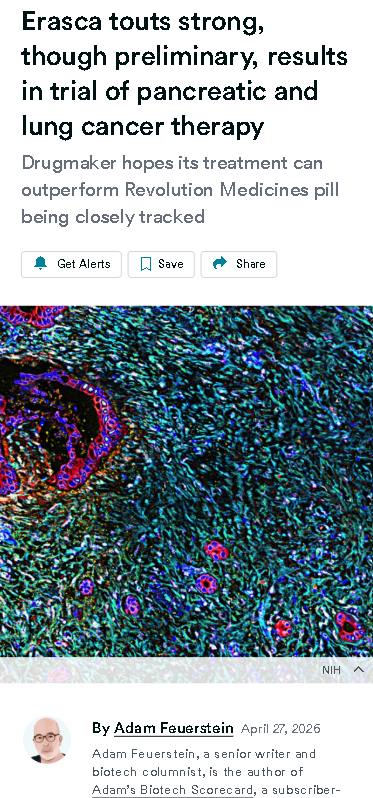
This is a fascinating story: there is this new cancer drug called "ERAS-0015", currently in Phase 1 human trials, that a leading Canadian oncologist characterizes as "one of the biggest breakthroughs for cancer in general in recent years" and "the biggest breakthrough for pancreas cancer probably ever" (https://t.co/OpRWB4YcBv).
The media present it as a "U.S. drug" coming from "U.S. drugmaker" Erasca, which is technically correct... but what they omit to mention is that the drug is actually Chinese, discovered in China, and licensed to Erasca by Guangzhou Joyo Pharmatech (广州嘉越医药科技有限公司), a Chinese biotech firm. The licensing agreement was even filed with the SEC: https://t.co/90Z9XPLeNR
In other words, this is effectively a Chinese drug being sold by an American firm, all the more given that even some of these human trials were conducted in China, as per Erasca's own press release (https://t.co/Llo3V0lPS8).
This is increasingly the direction of travel in the world of biotech and pharmaceuticals. We speak about it less than AI or robotics but it matters at least as much.
Here is a mind-blowing number for you: Goldman Sachs produced a report last year estimating that "46% of all new drug molecules that began human trials in the first half of this year originated in Chinese biopharma companies" (https://t.co/xF2oYqieSn).
Which means that - as of now - in the world of biotech, China is effectively as big as the rest of the world combined. Extraordinarily fast progress: in 2014, a mere 4% of innovative molecules in global pipelines were Chinese (https://t.co/n4AHKHs0Sn).
So expect many more stories like this in the future, where "American" breakthroughs will really be Chinese ones with a U.S. label on them.
@Yuchenj_UW I see it exactly the opposite. There is no moat. Aside from an NVIDIA chip that will ultimately be copied and proliferated (physics offers hard performance limits) building AI was relatively easy and possible for 10s of organizations. Distilling a leader is even easier.
@guillermoflor I think what everyone has to admit is that it was all rather simple. With a few thousand NVIDIA chips, it was a matter of months. One would have thought it would have been more difficult.