We never really knew how to train nonlinear RNNs well… BPTT struggled with vanishing grads (no long-range memory) and sequential rollout (hard to parallelizable).
What if instead an oracle told us the optimal memory state m_t at each step? Then the RNN could do one-step supervised learning on (m_t, x_{t+1}) → m_{t+1} labels.
We call this Supervised Memory Training (SMT): a replacement for BPTT that trains RNNs without unrolling them. SMT is time-parallelizable and solves vanishing gradients.
Website: https://t.co/BvctWJlPad
arXiv: https://t.co/5xR0mUVymp
Scaling laws describe how loss changes with scale. Do neurons inside models change predictably too?
We study vision and language models up to 30B params and find systematic scaling in neuron universality, specialization, and selectivity.
Paper+code: https://t.co/1f1mQGnnZ4
1/n
Gave my PhD dissertation talk on Friday!
It's been an incredible journey made possible by the best advisor who believed in me and gave me the freedom and support to explore. Thank you @pabbeel!
And thank you to everyone who came to support and share this milestone with me 🙏
Really excited to release this! Vista4D lets you reshoot a video by not just moving the camera 🎥 but also manipulating the scene 🌄, all grounded in a 4D point cloud ☁️ and designed in a friendly UI 🖌
Check out our project! https://t.co/ISPRkMX1U1
📢 Eyeline Labs and Netflix’s latest research, 🎥Vista4D🎥, accepted at #CVPR2026 as a 🌟Highlight🌟 paper, advances virtual cinematography and scene control with video generation.
🎥 Vista4D synthesizes the dynamic scene represented by an input video from novel camera trajectories and viewpoints by grounding video generation in a 4D point cloud. Our method maintains geometric and physical plausibility under imprecise 4D reconstruction of real-world videos.
🎥 Vista4D unlocks video reshooting beyond camera control. By directly editing the 4D point cloud, our method preserves scene information from casual captures and enables 4D scene editing and recomposition.
This work is part of the ongoing research and development at @eyelinestudios and @netflix, and we look forward to seeing its techniques and workflows adopted in future productions.
✊ Kudos to the team: @kuanhenglin, Zhizheng Liu, @pablosalamancal, @yash2kant, @RyanBurgert, @Yuancheng_Xu0, @Koichi_N_, Yiwei Zhao, @zhoubolei, @micahgoldblum, @debfx, @realNingYu
📰 Paper: https://t.co/PsuWi1xQqs
🌐 Project: https://t.co/SoUJW1krO1
⌨️ Code: https://t.co/vcbfeqIJ3o
We developed a simple, sample-efficient online RL technique for post-training image generation models. We see it as a possible steerable alternative to CFG, driven by any scalar reward, including human preference.
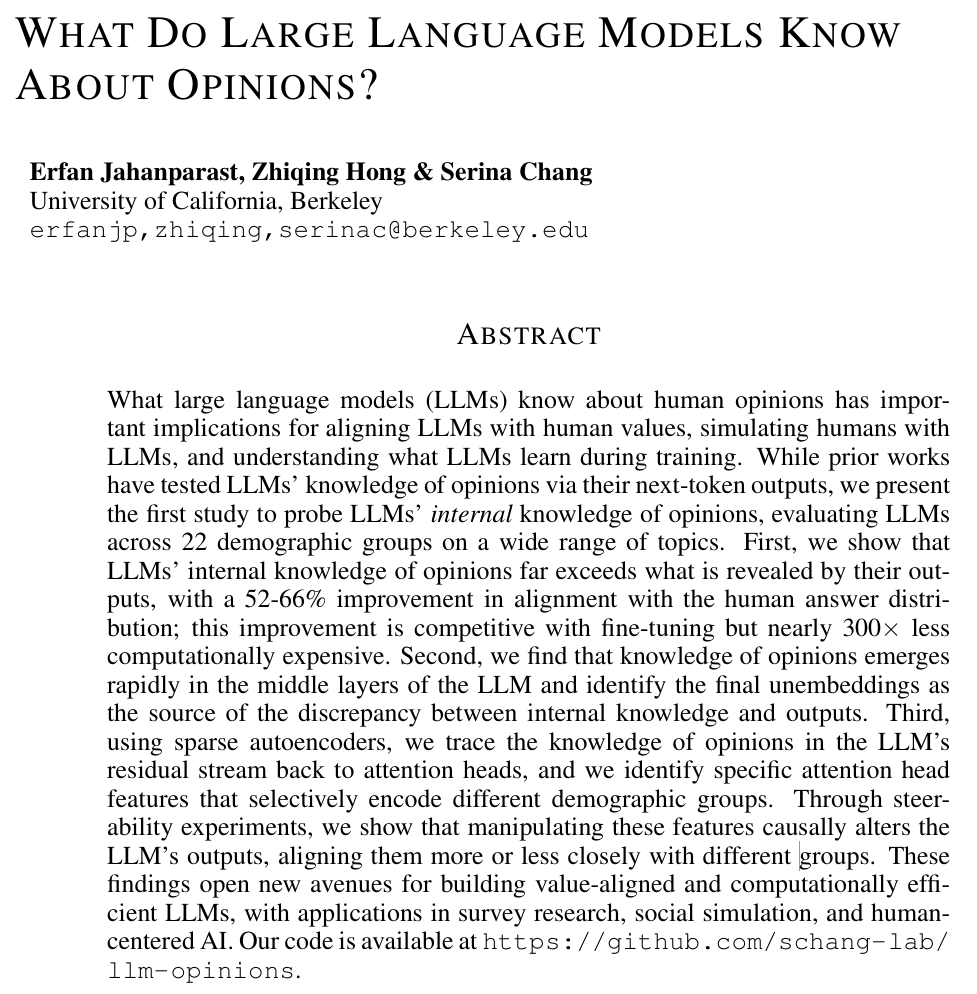
New paper: What Do LLMs Know About Opinions?
If we want LLMs to reflect diverse human views or simulate human responses well, we need to understand what they know about human opinions.
Current evaluations mostly rely on next-token probs, but what if that misses a lot of what the model actually knows? 💡
In our ICLR 2026 paper, we find that models know much more about human opinions than their outputs reveal.
excited to share some recent work!
tldr; models trained on multi-view sensory data are the first to match human-level 3D shape perception—all zero shot, with no training on experimental data/images
project page: https://t.co/cxTQQxfmO8
1/🧠
✨Thinking with Blender~
Meet VIGA: a multimodal agent that autonomously codes 3D/4D blender scenes from any image, with no human, no training!
@berkeley_ai#LLMs#Blender#Agent 🧵1/6
New work!
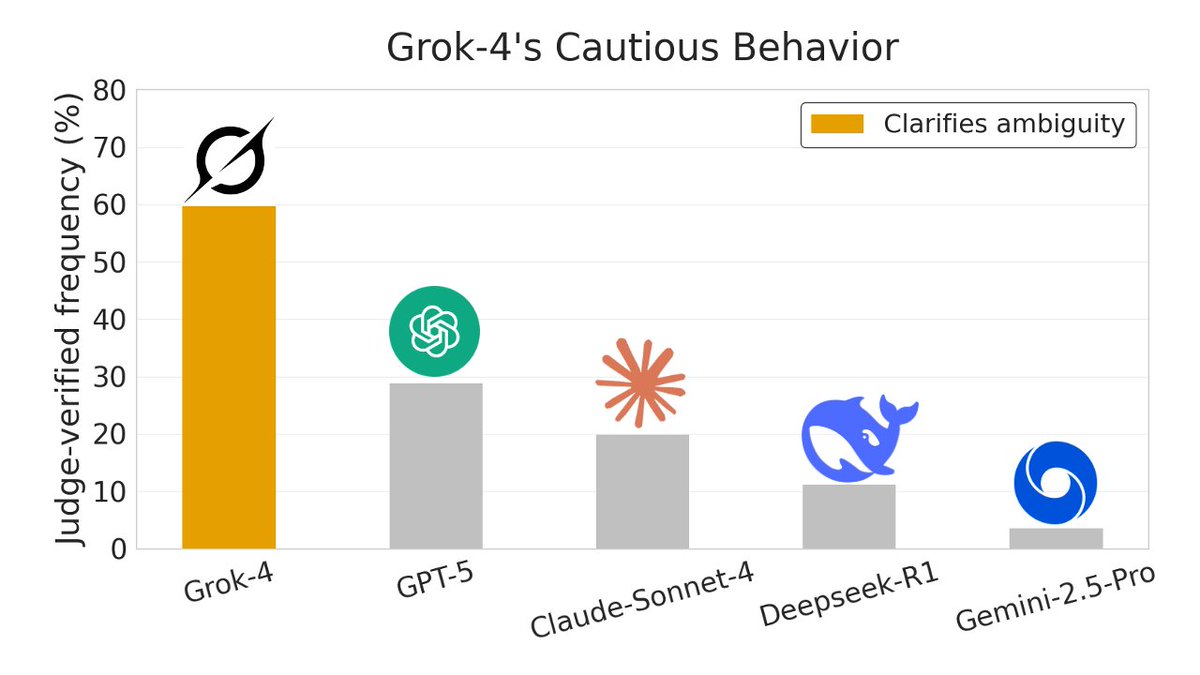
What if we used sparse autoencoders to analyze data, not models—where SAE latents act as a large set of data labels 🏷️?
We find that SAEs beat baselines on 4 data analysis tasks and uncover surprising, qualitative insights about models (e.g. Grok-4, OpenAI) from data.
For a long time, Yann LeCun and others believed in gradient-based planning, but it didn’t work very well … until now. Here’s how we did it using incredibly simple techniques. But first, an introduction to gradient-based planning: 🧵1/11
starting fall 2026 i'll be an assistant professor at @Penn 🥳
my lab will develop scalable models/theories of human behavior, focused on memory and perception
currently recruiting PhD students in psychology, neuroscience, & computer science!
reach out if you're interested😊
(1/7) Glad to see that people are following up on our work studying topological properties of modern neural network architectures. It was cool to see that widely used neural architectures can almost always generate any output given appropriate inputs, a.k.a. are surjective.
Everyone says they want general-purpose robots.
We actually mean it — and we’ll make it weird, creative, and fun along the way 😎
Recruiting PhD students to work on Computer Vision and Robotics @umdcs for Fall 2026 in the beautiful city of Washington DC!
Diffusion models operate step-by-step, hence they are serial models right?
However, that doesn't sit well because we have been seeing that diffusion models don't scale well with "steps".
In this thread: Diffusion models are not truly serial models.