After worrying trends:
⚡️ AWS 13-hour outage due to Kiro agent
🦀 OpenClaw exposing over 30,000 instances with leaked API keys
🦠 study finding AI-generated code contains more vulnerabilities
There is a counter trend:
🛟 Engineers pairing AI coding with formal verification
@karpathy Yes. Having AI write type defs is a godsend to align on 3, and then type checking allows the AI to fix signature errors (6) and correct 3p lib assumptions
@futurenomics Let’s also familiarize with economists’ responses to this paper, for example from authors Miran himself cited.
https://t.co/yuejwEDZ8c
Also:
https://t.co/QBMv2bLS5Y
https://t.co/MCrab5XbPb
A missing ChatGPT feature is the ability to clone a chat. That would allow going back and taking the conversation in another direction without losing the history.
This is a fair question, so I'm not going to give you the Emmett treatment, but the answer is "no".
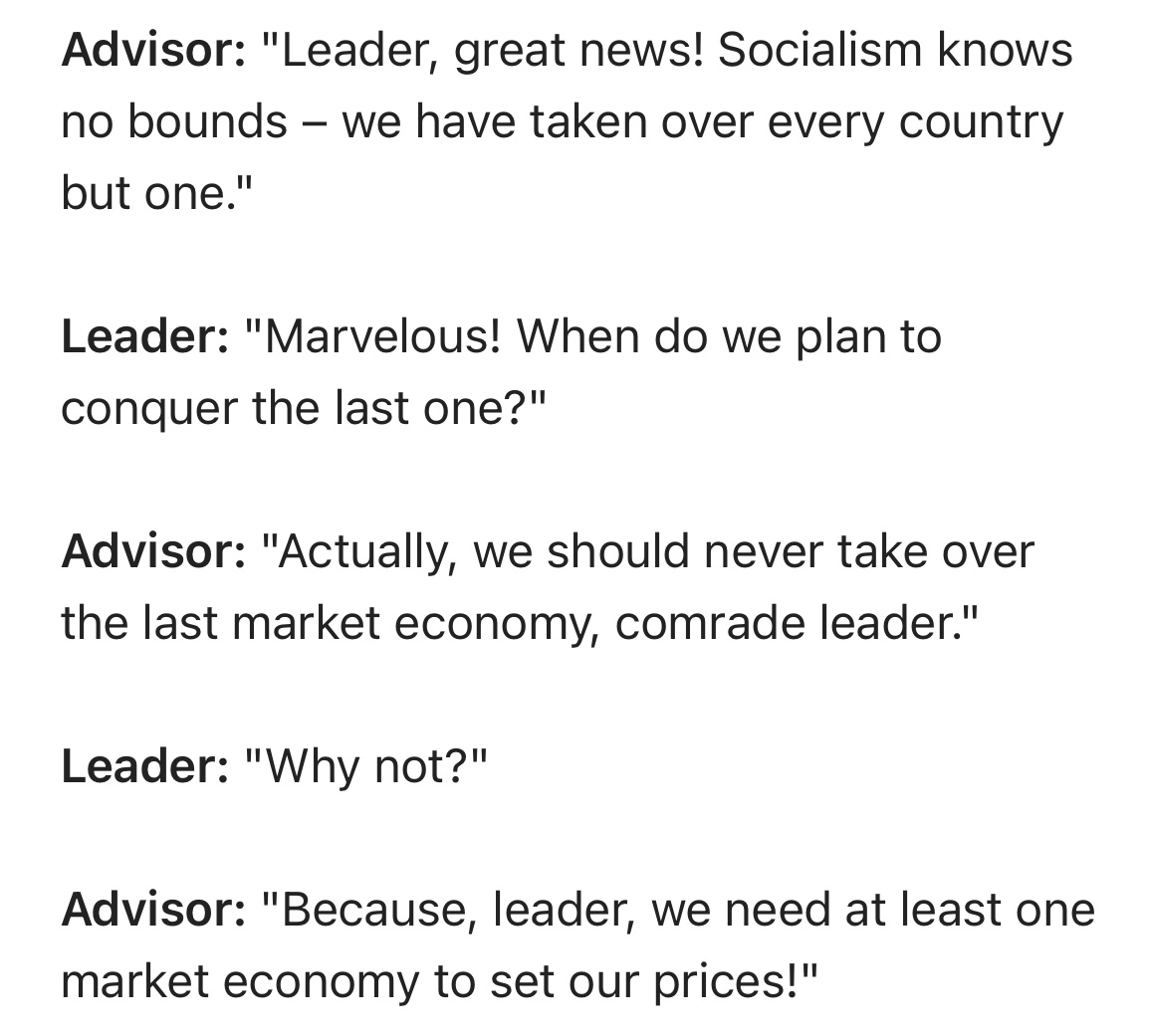
See, most people think that the problem with communism is that people aren't perfectly altruistic, or central planners aren't smart enough, but neither of these is the real issue.
The real bottleneck is data, not intelligence.
See, economics is the study of choice. Specifically, it's about the choice of how you allocated limited resources that have alternate uses.
Do you make desks out of wood, or steel? How much water do you allocate to filling swimming pools vs growing almonds?
In a communist system, there tends to be some kind of central planning entity that makes these kinds of decisions. In capitalism, the decisions are spread out, with many individual actors making small decisions about what THEY will do, based on what effects THEM.
The advantage of capitalist distributed and emergent decision making is not only that it makes far more neurons (and lately CPUs) available to this decision making process. I mean, that's a big deal. It really has orders magnitude more processing power.
But the real, insurmountable advantage of capitalist distributed decision making is that it brings those decisions close to the information they are based on.
A communist central planning committee is many layers removed from the guys in the forest cutting trees, and the guys smelting steel, and the guys making and selling furniture.
They truly can't figure out how many desks to make out of steel, and how many of wood, no matter how smart they are. They just don't have the data.
Capitalist decision makers are closest to the data that corresponds to their specialty, and they get an aggregate of other data from prices, which emerge from other people's decision making.
The dudes cutting trees know fucking everything about wood, but nothing about furniture. So they set the price of wood (based on their abilities and needs and expenses), and the guys who make furniture can work out how many wooden desks to make based on that price, because they know how many desks people buy, whether they prefer wood or steel, how much it will cost them to make each based on prices, etc.
In other words, capitalist systems farm out decisions to domain experts, while communism relies on bunch of isolated generalists.
This is why communism not only doesn't work, but can't work in any possible universe.
@knowclarified KNN will only load the index (embeddings) for comparison, not the docs. KNNs are slow for large doc counts, so most use algos such as HNSW, which increase mem footprint by storing graph edges. There are attempts to load from disk https://t.co/lkZqoRo4F0
@fchollet My speculation is that collecting music was once a popular status symbol, similar to other collector’s items, but the mp3 format disrupted that, making streaming a more viable way to create a revenue stream
@fchollet Industries change and have to survive however they can. If you plot this next to a trend line estimating the counterfactual of the record biz continuing, or look at it as a % of GDP, it is clear that music spending has been majorly displaced
Rejecting entitlement in favor of self sufficiency would help us return to the roots that made our country successful. One major downside is monetization != value added
I think a presidential candidate could win an election with the following tax policy:
0% income tax
0% capital gains tax
0% sales tax
0% corporate tax
100% wealth tax upon death
Why would it be popular?
1. Boomers have made it clear they give fewer & fewer shits about their kids every year.
2. Young and middle-aged voters don’t think that far into the future.
3. The few trust-fund kids who stand to lose the most do not make up a meaningful part of the electorate.
The Benefit:
1. Millions of Americans would re-enter the workforce because salaries would effectively double.
2. Inflation would collapse with the surge in the workforce, along with all the cost savings in transactional taxes.
3. It would immediately make our government solvent again without needing to issue more bonds. This would cause a meaningful decline in interest rates (without the accompanying rise in housing costs since so much inventory would become available through all the forced home liquidations).
4. The stimulus from consumption spending from senior citizens drawing down their estate would trigger the greatest economic expansion of our lifetimes.
Finally, the claim that people work hardest at the end of their career for the benefit of their kids is likely overstated: they mostly do it because they have no friends, they need time away from their spouse and they have nothing else to do.
Surely it would be complicated to patch all the loopholes of people trying to hand down wealth through indirect methods. However, we would certainly have the bandwidth to find those gaps once we reallocate the IRS to that problem instead of whatever nonsense they work on now.
Yes, it sounds like communism but another framing is that it’s the purest form of capitalism: no money would be allocated to those who didn’t work for it.
Please reserve the comments section for the macro impacts and not the moral judgements because we aren’t going to find alignment on that dimension on Twitter today.
I think a presidential candidate could win an election with the following tax policy:
0% income tax
0% capital gains tax
0% sales tax
0% corporate tax
100% wealth tax upon death
Why would it be popular?
1. Boomers have made it clear they give fewer & fewer shits about their kids every year.
2. Young and middle-aged voters don’t think that far into the future.
3. The few trust-fund kids who stand to lose the most do not make up a meaningful part of the electorate.
The Benefit:
1. Millions of Americans would re-enter the workforce because salaries would effectively double.
2. Inflation would collapse with the surge in the workforce, along with all the cost savings in transactional taxes.
3. It would immediately make our government solvent again without needing to issue more bonds. This would cause a meaningful decline in interest rates (without the accompanying rise in housing costs since so much inventory would become available through all the forced home liquidations).
4. The stimulus from consumption spending from senior citizens drawing down their estate would trigger the greatest economic expansion of our lifetimes.
Finally, the claim that people work hardest at the end of their career for the benefit of their kids is likely overstated: they mostly do it because they have no friends, they need time away from their spouse and they have nothing else to do.
Surely it would be complicated to patch all the loopholes of people trying to hand down wealth through indirect methods. However, we would certainly have the bandwidth to find those gaps once we reallocate the IRS to that problem instead of whatever nonsense they work on now.
Yes, it sounds like communism but another framing is that it’s the purest form of capitalism: no money would be allocated to those who didn’t work for it.
Please reserve the comments section for the macro impacts and not the moral judgements because we aren’t going to find alignment on that dimension on Twitter today.