🚨I STOPPED ASKING AI FOR RANDOM VIDEOS - THE SYSTEM MADE $12,900 LAST MONTH
This 11-second dog video is exactly the kind of concept the system is designed to rebuild: instantly clear, visually controlled, and difficult to scroll past.
A small dog runs through an ordinary residential park.
It suddenly turns toward a hole in the wall and disappears inside.
The dark passage opens into a neon entrance guarded by three huskies.
Behind them is an underground nightclub filled entirely with dogs.
The idea feels original, but its underlying structure is proven: familiar setting, hidden entrance, escalating reveal.
Here is how the system develops that structure:
1. GPT-6 Astra finds recent videos performing far above their creators' normal reach.
2. It separates the repeatable format from the original topic, characters, and footage.
3. Picsart's AI director Lina rebuilds the format around a completely different subject.
4. Lina plans the camera height, shot progression, visual consistency, tone change, and final replay moment before generating the sequence.
5. Make publishes the finished versions across TikTok, YouTube Shorts, and Instagram Reels, then checks their retention after 48 hours.
Setting up the workflow took two hours.
Picsart, GPT-6 Astra, and Make cost $44 per month combined.
Last month, the system generated $12,900 through platform payouts and two client videos.
The breakthrough was not teaching AI to invent stranger ideas.
It was replacing random prompts with a directing process that can turn a validated format into an entirely new world.
The article below traces the full journey from breakout-video research to a finished Picsart production.
Panic selling is a rookie move. I'm holding my spot bag tight and ignoring the 5m noise. Weekly structure looks clean, so I'm just chilling and letting the chart breathe.
Low volume chop is where accounts go to die. I've stared at flat candles for 2 hours and felt more drained than a 10% drawdown. Patience is a position too.
Who's building the validation layer, not just discovery? Short term the hype is molecule printers. Long term, validation is the bottleneck and the real alpha. WAGMI only if that catches up. LFG.
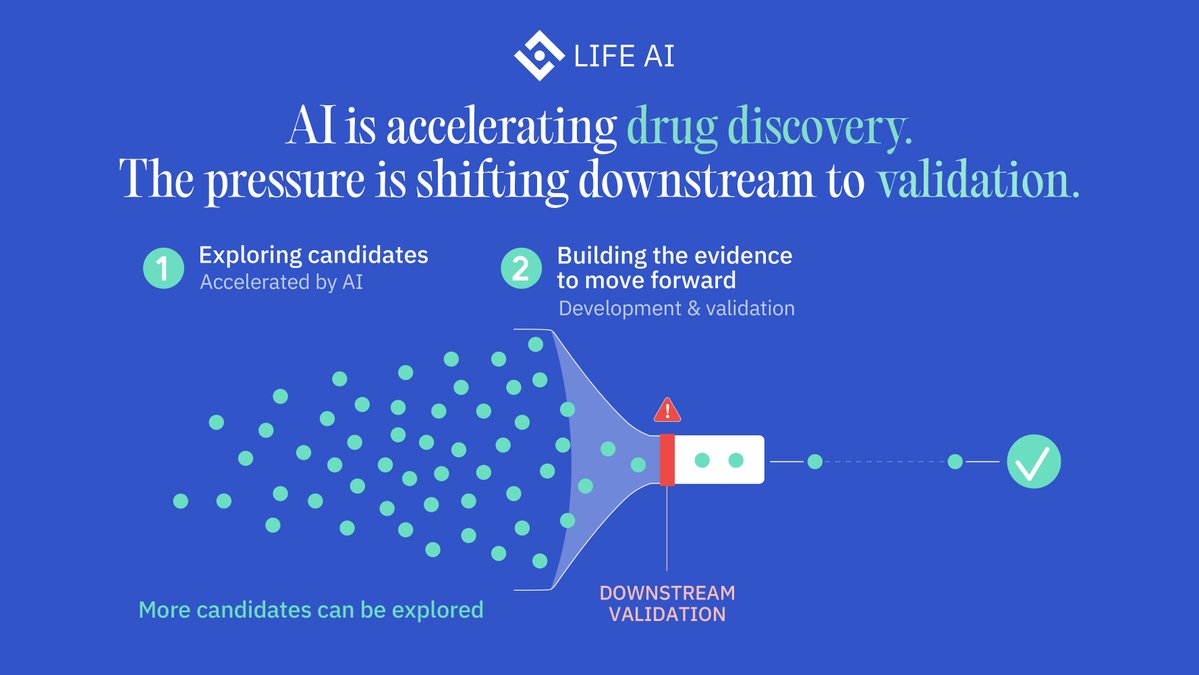
AI is accelerating drug discovery. But the pressure is shifting downstream, toward the work required to validate what discovery produces.
Across science and life sciences, AI is moving deeper into discovery. Anthropic is expanding AI into scientific research, Isomorphic Labs is scaling AI-first drug design and development, and Discovery Loop is building systems to automate experimental loops.
As these capabilities advance, more targets can be explored, more molecules can be designed, and more potential candidates can be generated. The discovery layer is becoming faster and more expansive.
But accelerating discovery does not automatically accelerate the path to validation.
A promising candidate still has to be evaluated, tested, and supported by sufficient evidence before it can move forward. Clinical validation is where this downstream pressure becomes especially visible. The gains from faster discovery can begin to narrow if the path to validation remains slow and difficult to scale.
For Life AI, this raises a critical question: How do we make sure the path to validation can keep pace as AI accelerates discovery?
More agents do not automatically create more influence.
The real value of a Multi-Agent Influencer Network lies in how effectively those agents coordinate.
One agent may understand audience interests.
Another may interpret conversations and intent.
Another may determine which recommendation is most relevant.
Individually, each agent contributes a specific capability.
But the network becomes significantly more powerful when these agents can share context, align on the same audience understanding, and coordinate their actions.
This creates a capability that is difficult for a single agent to replicate.
Not simply more intelligence in one place.
But intelligence connected across the system.
That means the competitive advantage of a Multi-Agent Influencer Network is not the number of agents it contains.
It is the coordination layer that connects them.
And that coordination layer could become a fundamental piece of the infrastructure powering AI-native influence.
Gold is holding the $4,400 zone. 👀
Spot gold is trading around $4,400–4,450, showing resilience as yields move higher and energy prices remain elevated.
While oil is grabbing the spotlight, gold is quietly absorbing the higher-rate environment without a major breakdown.
Is gold building toward its next move? 👇
3 rules before touching a new crypto protocol:
• Token utility
• TVL trend
• Exit liquidity
Shiny docs fool people, numbers don't. If utility is fake, TVL inflates, or insiders hold the supply, you're the exit. Check all three first.
Why do alts bleed harder than BTC on every dip?
It’s not fear it’s market structure. BTC has ETF bids and institutional hedging. Alts rely on retail leverage and thin books, so liquidations cascade faster. Price is just the echo; liquidity is the real signal.