I have no doubts you’ve thought about this much longer and deeper than i have or ever will. So consider any of these opinions strong opinions held loosely. One thing about this industry that excites me the most is anyone has the ability to contribute and create new financial products / infrastructure. So what you’re doing with metalex is one of the most unique and important experiments our industry can offer today. All that said let’s, maybe regretfully, poke the bear:
“if blockchain state and DTCC state disagree, which one has legal effect? If the answer is DTC's official books, the public chain has not replaced the incumbent ledger; it is carrying messages for it. Carrying messages is honorable work, and real-time collateral mobility, programmability, interoperability, better securities lending workflows and improved DVP are all useful, for intermediaries. What the program is not is disintermediation. It is an upgraded ultra-intermediary”
This is a feature, not a bug for the current situation. Right now we should be asking ourselves how do we realistically mesh the tradfi world in with this world. Every fmi and incumbent isn’t just going to drop everything they’ve built over the past decade(s) to switch to this new shiny, largely untested, space. There needs to be certain guarantees around this and the dtcc is willing to take a time tested setup and allow bridging into this space with the same guarantees and trust their clients need in the traditional system. I’ve heard many times from Nadine chakar that the dtcc may not be needed at all in the future or will be completely automated away. For now a hybrid system is needed.
I think you’re spot on for your argument for “recognition power” but we made our bed the moment we made liquidity deepest among “slightly permissioned assets” like USDT / USDC which have the ability to go against social concensus. This becomes even more important when you consider national economic defense and being able to recover “state” (both offchain and onchain) in a way that won’t blow up the global economy. For me this is one of the most important arguments against alternatives. It will be really interesting to see how the first hack get reconciled when these permissioned assets are apart of it. Realistically LP’s will take the hit and onchain ownership will just get rolled back but who knows.
After seeing this space get pillaged and extracted time and time again I’ve sort of accepted the immediate need for trusted parties. At least as we scale and prove “what works”. The dtcc’s solution allows their current participants to immediately start interacting with this space and even has the ability to transfer these assets to a new issuance format. In theory some projects can vampire attack this setup if the market finds there’s a more compelling way to tokenize assets
In short, it’s my belief they’re completely necessary right now for any sort of mass migration to a tokenized version. I also believe this space offers the capacity to experiment and find ways to do things better. So the work you’re doing can and will either influence their future or eat into their market share.
This read was awesome btw
@lex_node@nullpackets@VitalikButerin@decentrek This is sort of the tradeoff Solana has decided to make with apenglow and firedancer
1m tps might be a mistake but it’s probably worth someone trying, even if it means pulling the decentralized lever lower than it already is over there
The first call hapened back in april with recent early adoption from @ZenithProtocols as the current primary user powering their XLM perps feed
looks like @GMX_IO may have done a test in September for a GMX stream
For now adoption is limited with only 1k calls made in total
NEW: Chainlink oracle infrastructure is now live on @StellarOrg, bringing Data Feeds and Data Streams to Stellar network’s $4B+ RWA ecosystem.
Devs gain verifiable market data powering lending, stablecoins, tokenized equities, & more.
Through the Chainlink Scale program, Stellar is making a substantial capital commitment to give its builders cost-efficient access to high-quality, institutional-grade oracle infra.
CLS settles the majority of global FX at scales much bigger than what blockchains can offer. The DTCC/euroclear does so with just about everything else.
I really don’t think our industry offers scaling benefits. I think most the benefits come from lowering friction and automating an enormous amount of middlemen services (and transparency benefits).
On capital efficiency and making illiquid things somehow liquid, I think we also become extremely competitive
@chrischang43@0xTaker Yea sorry, I should have said binance.
I tried doing this a bit ago and the drift from recreating state between the REST heart beats was way too big to use the WS data lol
This is awesome 🍻
On Oct 9th, chainlink load tested hundreds of CRE workflows talking to AWS using the Key Value Store (AWS S3) workflow. It relies on SigV4 so the DON can read and update S3 objects without putting AWS keys onchain
This is how you build the universal golden record at scale
https://t.co/zpU3IhoELw
I'm fairly confident this highlights a gap in historical project coverage + changing chain economics rather than this extreme of a sector trend.
Many large revenue generating projects have came and went during that time (think Synthetix, MUX, Vertex, Lodestar, Gamma, dydx, Rysk, Frax, trader joe, woo, etc) . I'd imagine almost none of the STIP/OP Grants recipients are covered under this as most have disappeared and are no longer relevant but had large incentive programs that drove *real* (incentivized) revenues during that time for instance. Couple that with changing economics around eth and you start to really paint this chart.
This data is geared to more recent projects and lacks a lot of historical coverage and context.
@ADLXBT@The_DTCC These are not transacting real value. My hunch is they need to run a series of tests before they can open anything to their clients and this is part of reliability testing
Currently every hour @The_DTCC runs a live production test of fulcrum on sepolia. What's happening is tokenized MSFT gets locked -> 10k tUSD gets borrowed -> repaid in ~30 seconds unlocking the MSFT collateral
Regulated defi is here
https://t.co/TF7OTfxH09
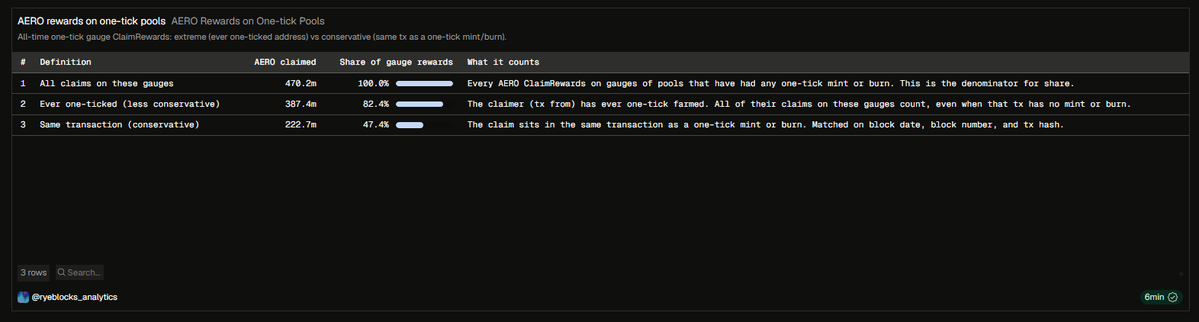
82% of rewards emitted from @aeroxyz gauges may have been one tick farmed at increased rewards compared to "real" LP's
- 470.2m AERO claimed (~$454.1m)
- 387.4m AERO claimed by addresses who have ever one ticked (82.4%, ~$374.1m)
- 222.7m AERO claimed on same tx as a one tick mint/burn (47.4%, ~$215.1m)
https://t.co/st6AYdoSs1
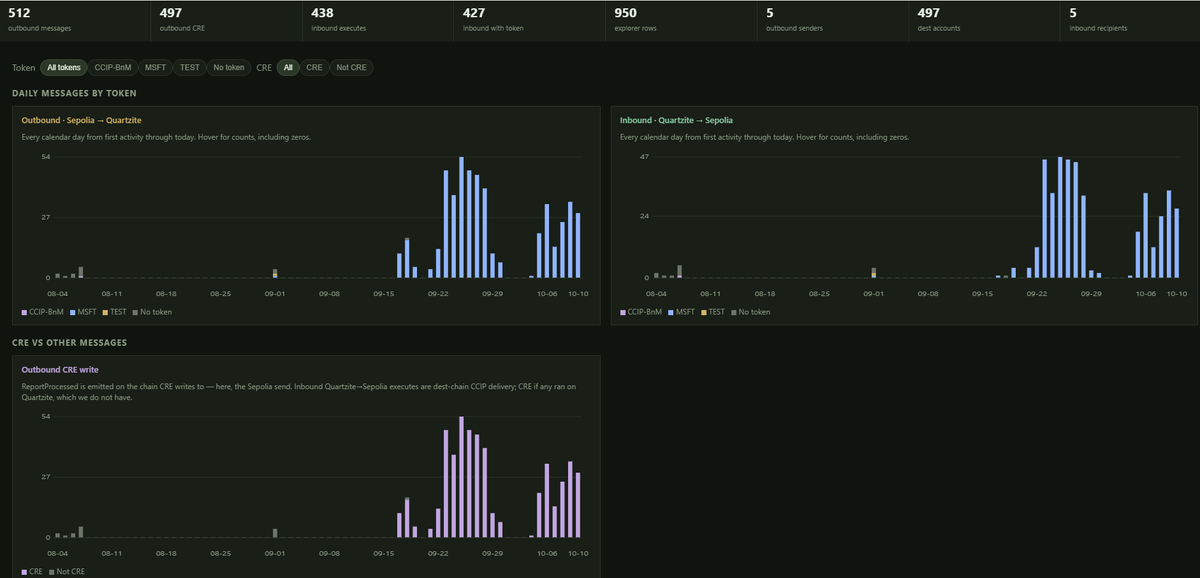
On Sept 1st the DTCC ran its first test with real value, transferring 1 share of MSFT across CCIP between their private testnet -> Ethereum sepolia
16 days later they attached CRE workflows to the CCIP transfer
~1000 messages in the last 30 days
Hyperchainlinkization
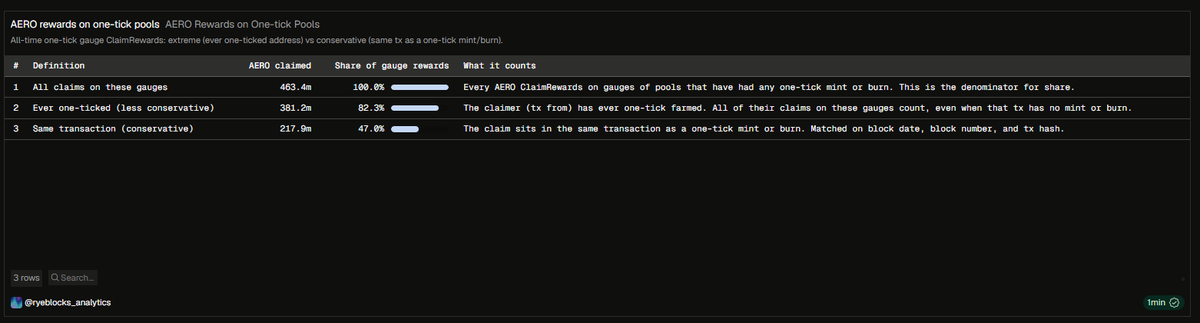
82% of rewards emitted from aerodrome gauges may have been one tick farmed at increased rewards compared to "real" LP's
To continue this saga, lets dive into these farmers a bit
On gauges of pools that have ever one-ticked:
- 463.4m AERO claimed (~$310.5m)
- 381.2m AERO claimed by addresses who have ever one ticked: 381.2m (82.3%, ~$255m)
- 217.9m AERO claimed on same tx as a one tick mint/burn (47%, ~$146m)
Follow the data here:
https://t.co/st6AYdoSs1