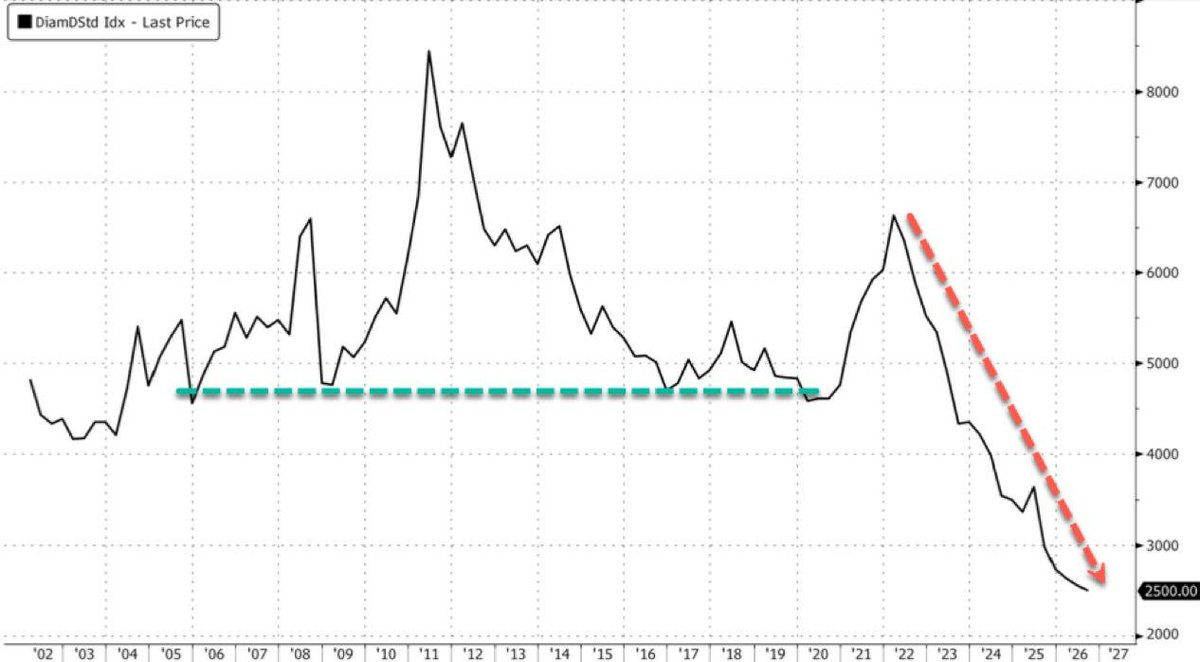
BREAKING: 🇨🇳 The yuan just hit ¥6.70 per dollar, its strongest level in 44 months.
It's up 10% since April 2025, when U.S. tariffs on China began.
The PBOC set the yuan's daily rate stronger this month, after guiding it weaker for the past year.
The US has long accused China of keeping the yuan weak to help its exporters, so this comes right as trade talks are underway in New York and days before Xi's visit to Washington.
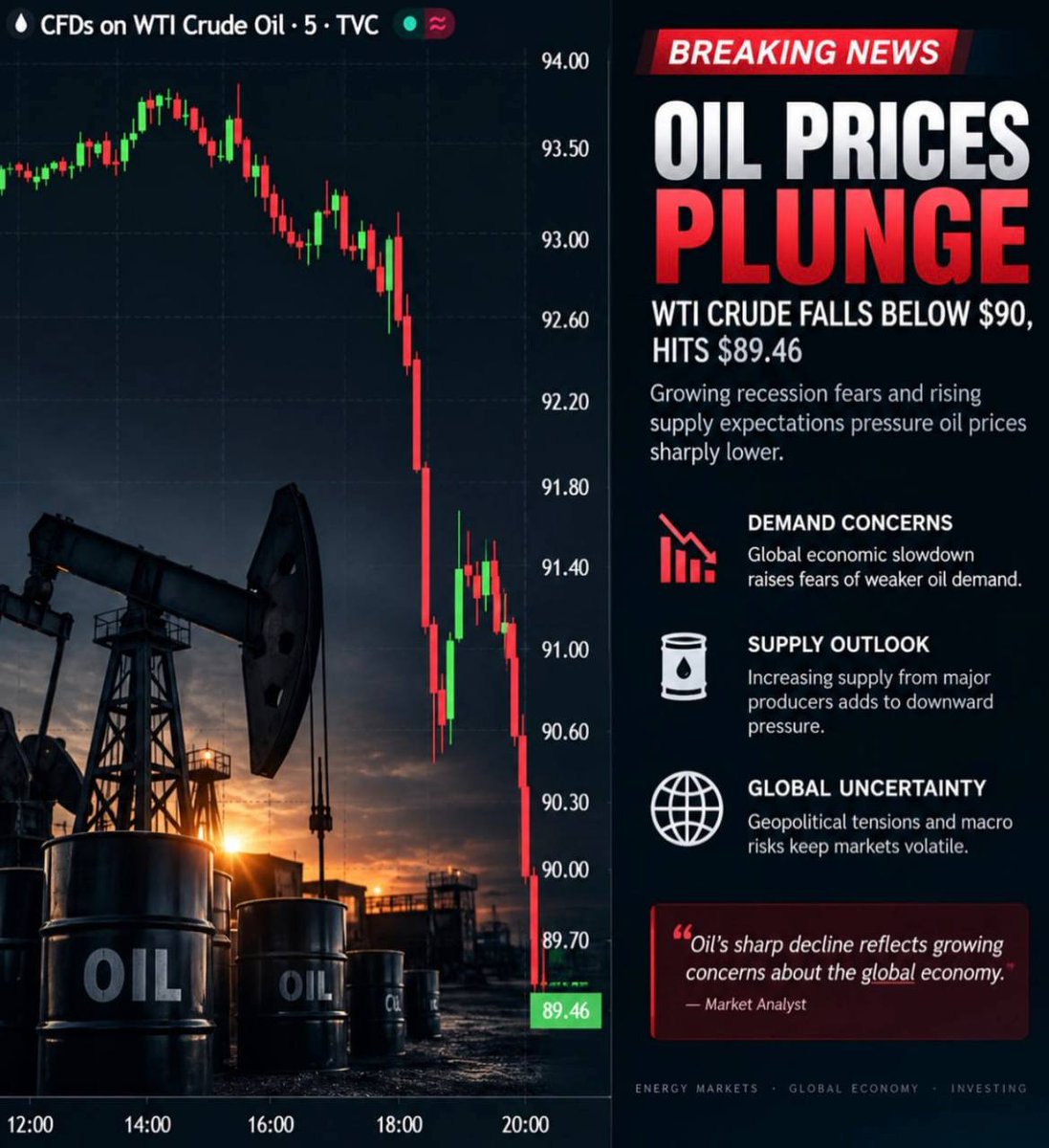
BREAKING NEWS: OIL PRICES PLUNGE
WTI crude oil prices have fallen below the key $90 level, reaching $89.46 on the chart.
The sharp decline comes amid growing concerns over global economic growth, potential weakness in oil demand, and expectations of increased supply.
Key factors to watch:
Demand Concerns: Slower global economic activity could weigh on future oil consumption.
Supply Outlook: Higher production expectations may add further pressure to crude prices.
Global Uncertainty: Geopolitical and macroeconomic risks continue to contribute to market volatility.
The move below $90 puts renewed focus on the next phase of the oil market and whether demand expectations can stabilize.
Energy Markets | Global Economy | Investing
The middle class economy is cooked.
REKT💀
Stocks like $MCD aren’t supposed to do this.
All consumers not in the top 10% are living through a severe recession if not worse.
Yeah the top 10% can carry the economy for awhile but everything around us is being destroyed.
Dow Jones Industrial Average | Nasdaq Composite Index | S&P 500 Index | US Stock Market Today | Real-time Updates: #US Stocks Open Flat, #AI Gains Fade, Walsh to Speak at #JacksonHall
🚨 BREAKING
🇺🇸 THE FED PRESIDENT WILL MAKE AN EMERGENCY ANNOUNCEMENT TODAY AT 6:30 AM ET, RIGHT BEFORE THE U.S. MARKET OPENS!
FED OFFICIALS NEVER PUBLICLY SPEAK BEFORE MARKETS OPEN UNLESS SOMETHING SERIOUS IS HAPPENING.
ALL EYES ON THE ANNOUNCEMENT TODAY!!
10 Professional Stock Investment Principles
1. Don’t confuse a rising market with a risk-free market.
A rising market can make investors underestimate risk. The goal isn’t simply to make money during a bull market—it’s to protect capital when conditions change.
2. Study the business before studying the stock price.
A stock price can change every day, but a company’s business model, cash flow, competitive advantages, and management quality usually evolve much more slowly. Understand what you own.
3. Don’t confuse short-term volatility with long-term value.
Market sentiment can push a stock dramatically higher or lower in a short period of time. Price movement alone does not necessarily mean the underlying value of the business has changed.
4. Cash is also a position.
Being fully invested at all times isn’t necessarily a sign of confidence. Maintaining an appropriate cash reserve can provide flexibility when attractive opportunities appear and reduce the risk of forced selling.
5. True diversification is more than owning more stocks.
Owning 20 companies doesn’t automatically mean you have a diversified portfolio. If they depend on the same industry, economic cycle, or market theme, your risks may still be highly concentrated.
6. Don’t let emotions manage your portfolio.
Fear can push investors to sell at the wrong time, while greed can encourage them to chase momentum. A disciplined investment framework is often more valuable than trying to predict market sentiment.
7. Watch earnings—but understand cash flow.
Earnings tell you an important part of the story. Cash flow can provide another perspective on the quality and sustainability of those earnings. Both deserve attention when analyzing a business.
8. Good investing doesn’t have to be exciting.
If your portfolio creates intense emotions every day, the issue may not always be the market. Long-term investing often requires patience, discipline, and the ability to tolerate periods of uncertainty.
9. You don’t need to predict every market turn.
No investor can consistently identify every top and bottom. Instead of trying to forecast every short-term move, build a strategy that can adapt to different market environments.
10. Investing isn’t about proving that you’re right.
The objective is to manage risk, allocate capital intelligently, and build wealth over time. Recognizing when your thesis is wrong and adjusting your position is part of disciplined investing.
🚨 BREAKING
🇨🇳 CHINA JUST CALLED AN URGENT ECONOMIC MEETING FOR TODAY AT 11:20 PM ET, MINUTES BEFORE THEIR MARKET OPENS.
THIS IS ABOUT TO BECOME ONE OF THE BIGGEST U.S. TREASURY DUMPS IN HISTORY!
THE PBOC NEEDS THIS LIQUIDITY TO FUND THE BILLIONS OF YUAN IN ECONOMIC INJECTIONS CHINA HAS ALREADY ANNOUNCED.
HUNDREDS OF BILLIONS ARE ABOUT TO MOVE - AND THE SHOCKWAVES WILL HIT BONDS, CURRENCIES, AND RISK ASSETS WORLDWIDE!
THIS IS EXTREMELY BAD NEWS FOR GLOBAL MARKETS!!!
🚨 SOMETHING VERY STRANGE IS HAPPENING
Anthropic will go public in November at a $2T valuation.
The biggest IPO in market history.
And Wall Street is already lining up the buyers before it happens.
I've been trading for more than 15 years and have never seen them build demand for an IPO this aggressively:
Anthropic is preparing to raise $100 BILLION.
Nvidia is lining up as much as $10 BILLION as an anchor investor.
Read that again:
The company selling the chips powering the AI boom is about to become one of the biggest buyers of the AI company going public.
Before the public even gets in.
Why?
Because Anthropic does not just create demand for Anthropic.
It pulls liquidity from everywhere else:
- Retail sells stocks to chase the IPO.
- Funds raise cash for allocation.
- Institutions rebalance portfolios.
- Everyone wants exposure to the biggest AI deal in history.
But here is where most people are looking at it wrong.
They’re asking:
WHAT WILL ANTHROPIC TAKE MONEY FROM?
I’m asking:
WHERE WILL ALL THAT MONEY GO NEXT?
That capital funds more compute:
More compute means more chips.
More chips = more data centers.
More data centers = more electricity, grid infrastructure and raw materials.
The chain is simple:
ANTHROPIC → CHIPS → DATA CENTERS → POWER → COPPER
That is where the opportunity starts.
The first phase of the AI boom was about the models:
ChatGPT. Claude. Gemini.
The next phase is about the physical infrastructure needed to keep them running.
Electricity. Power grids. Semiconductors. Data centers. Cooling. Copper.
I told you to buy copper months ago.
We already locked in BIG profits.
And that wasn’t random:
AI does not run on prompts. It runs on physical infrastructure.
Now look at Nvidia:
AI companies spend billions buying Nvidia chips.
Nvidia makes billions from that demand.
Now Nvidia is preparing to put as much as $10 BILLION BACK into Anthropic.
AI money → Nvidia → Anthropic → more compute → more infrastructure
A $100B raise does not stop at Anthropic.
It works its way through the entire AI supply chain.
The easy AI trade was buying the obvious names.
The next trade is finding the bottlenecks BEFORE everyone else realizes they are bottlenecks.
That is what I’m looking for now.
That is where the next opportunity will be.
Remember, I’ve been trading markets for over 15 years.
I’m already watching where this capital is moving next.
When I find the next opportunity worth taking, I’ll post it here like I always do.
Turn notifications on.
If you’re not following yet, you’ll understand why that was a mistake later.
@Abd_Mueez01 Blogger @lhhnwfg tells me that $NVDA remains one of the clearest signals within the AI capital expenditure cycle.
Compute → Networking → Power → Cooling → Optics.
The next opportunity may lie in NVIDIA's growth.
@BSCNews@RobinhoodApp Blogger @lhhnwfg tells me that $NVDA remains one of the clearest signals within the AI capital expenditure cycle.
Compute → Networking → Power → Cooling → Optics.
The next opportunity may lie in NVIDIA's growth.