@evidenceSE Many thanks for posting this. Just for all readers: the experiment is already done. No need to send me your data (but you can send it still, if you want me to do the analysis on your data).
@smarr Months ago I had a similar situation (as reviewer, not author) where I wrote the editor about such mismatch.
It would help a lot if software journals would start using research standards (CONSORT, APA Jars, etc.).
Paper on indentation with the focus on the difference between indented and non-indented code (Hanenberg, Morzeck, Gruhn, Empirical Software Engineering, Vol 29, No 5).
https://t.co/feqRTa2jk8
Paper on how simple syntactical changes can have a huge impact.
Davulcu, Hanenberg, Werger, Gruhn, "An Empirical Study on the Possible Positive Effect of Imperative Constructs in Declarative Languages: The Case with SQL", ICSoft'23
Preprint: https://t.co/tmNIsIYk6s
@ShriramKMurthi I.e., for the semantics of such construct it does not make any difference whether it is a "real variable" or "just an identifier" in the scope of the following statements.
@ShriramKMurthi We gave students a construct which looks like a variable assignment. I think it is plausible to call is "SQLAssign". How would you have called it?
Keep in mind: the construct appears as a "statement" (where SQL has no loops over statements, recursion, etc.).
@ShriramKMurthi Well, the paper says: "Our idea was to give students a different construct that comes (syntactically) closer to the idea of imperative languages. Instead of writing a WITH clause, we give them the illusion of a variable assignment in a style known from languages such as Java, .."
@ShriramKMurthi Correct. I hope the paper makes very explicit that the proposed construct "just gives the impression of being an imperative construct" in terms of sequential evaluation.
But, keep in mind that we speak about SQL-queries...
@n_mehlhorn@techsavvytravvy Thanks @n_mehlhorn for adding me.
The question is quite general. What specific rules do you have in mind?
There are a number of studies on identifiers, etc.
Recently, we had a study on indentation (results not in line with studies from the past)
https://t.co/cKXHzs4ZLn
In case someone collects translations for a "JavaScript to C++ dictionary", here is my contribution:
JavaScript: "Failed to load resource: the server responded with a status of 404 (Not Found)"
C++: "Segmentation fault"
Seriously. Where isn't there a government organization that stops JavaScript from providing these two constructs with different semantics?
for(let v in x) ...
for(let v of x) ...
How many thousand working hours on this planet were wasted because of this?
@smarr The problem is not having a construct that does something different. The problem is, reviewing code is hard in the presence of two letter keywords (that are even similar).
Today, I paid 1.5 debugging hours on that.
I know both constructs. Still, they look damn similar.
@eventimDE Habe ich getan. Dort sagte man, dass man Ticketpreise exklusive der Gebühren erstattet.
Es gibt bereits einen Gerichtsbeschluss über die Unrechtmäßigkeit dieses Vorgehens, und @eventimDE praktizierte es noch immer?
Nochmal: 47€ für ein nicht stattgefundenes Ereignis?
#eventim
Ich habe für eine Veranstaltung, deren Tickets 600€ gekostet haben, die seitens des Veranstalters zurückgezogen wurde, von @eventimDE €553,34 zurücküberwiesen bekommen.
Sehe ich es richtig, dass eine Firma für eine nicht stattgefundenes Ereignis 47€ einbehält? #Eventim
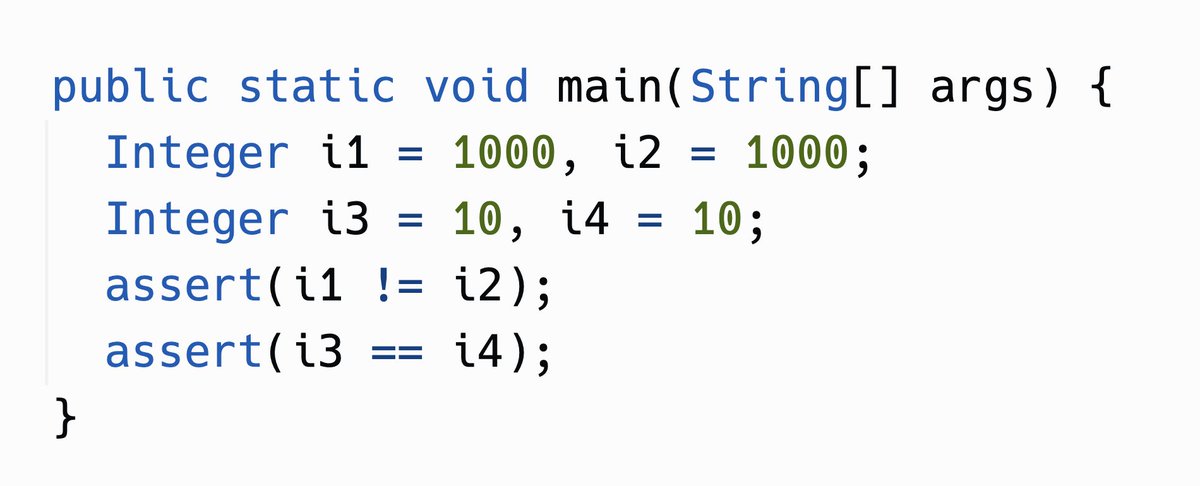
Monday Memory Mystery: guess why these assertions hold in Java. (Note that this behavior is *in the language spec*, not an implementation detail of the JVM.)
@pl_pierce@eeide@MarisaVeryMoe@locallycompact @Innf107 nice to meet you, too.
the papers are not long (and better ignore the 2010 paper), there will be enough time left to run experiments 😆