Brain activity doesn't wander randomly through high-D space. It travels along well-worn routes, forming a low-D structures or neural manifold. Using T-PHATE, which we developed previously (https://t.co/2J0qbRm5Qx), we learned each individual's manifold prior to BCI training.
As neuro-ai shifts toward brain foundation models, the need for a good, standardized benchmark has never been greater
NeuralBench is finally here! Grateful to have helped on this massive effort by @hubertjbanville and the team! Can’t wait to see where the community takes it!
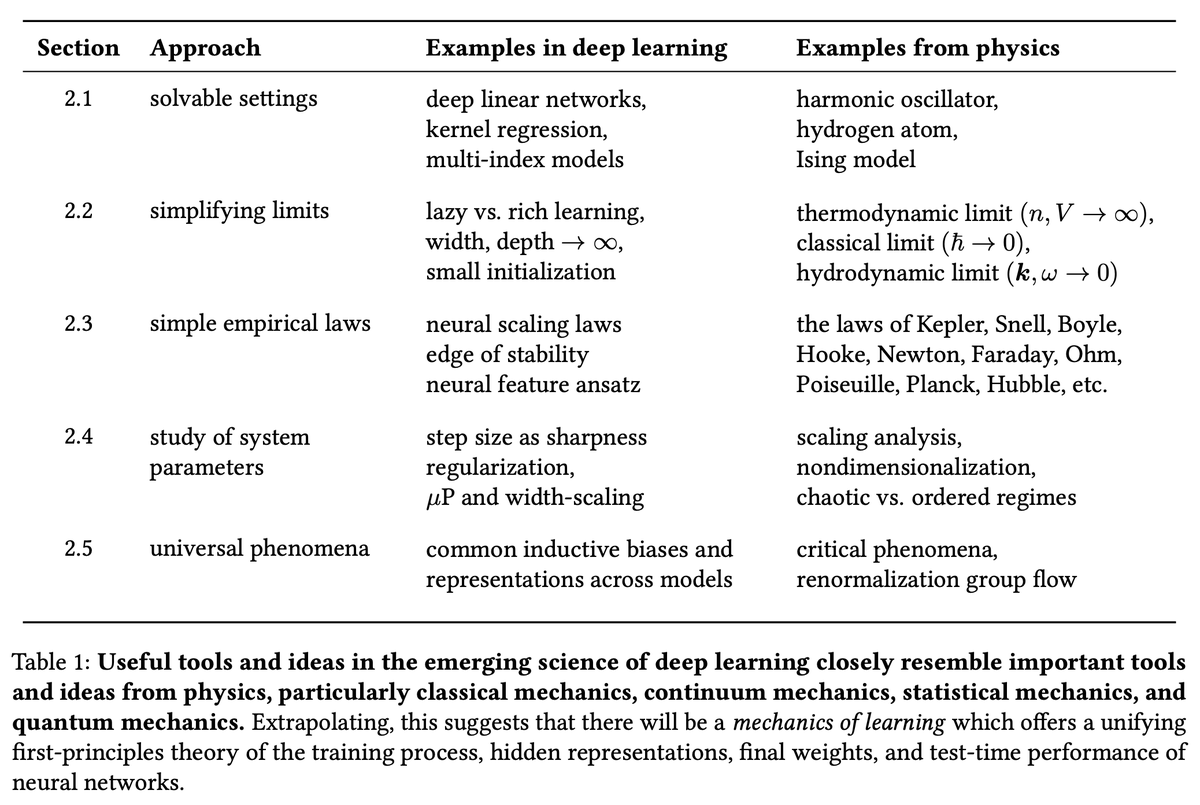
1/ Deep learning is going to have a scientific theory. We can see the pieces starting to come together, and it's looking a lot like physics!
We're releasing a paper pulling together these emerging threads and giving them a name: learning mechanics.
🔨 https://t.co/92nSIHameW 🔧
Congrats to the team on an incredible release!! Dealing with data harmonization across modalities and temporal scales is a massive bottleneck in comp neuro — no longer!
very jealous of incoming PhD students who get to start with neuralset from day one!
New package release from our amazing team 🎉🎉🎉
Using NeuralSet, you can go from a directory of downloaded data files to analysis-ready / AI-ready tensors with only a couple of lines of code
Time to power up 💪
Interpretability has not kept up with scaling LLMs at all, especially for *knowledge*. But here's a wild idea:
using cross-lingual knowledge inconsistency (typically seen as a "bug") as a tool for dissecting where knowledge lives
🧵1/4 https://t.co/9iLZ3DExOH @GoogleResearch
I've used em-dashes my whole life — they add rhythm and grace to writing. But now they're an AI tell.
Can we get a grandfather clause for those of us who were fluent in em-dashes before ChatGPT launched in November 2022?
Excited to see our work in AJHG! Thank you to our amazing co-authors, UCLA Institute for Precision Health, UCLA CTSI, and our collaborators for the support with this work. Above all, we are grateful to the patients and ATLAS biobank participants at @UCLAHealth.
New preprint! We mapped thalamocortical dynamics in human focal epilepsy using SEEG. We found distinct spectral and connectivity based signature that could be direct targets for neurostimulation.
With @UCLAMCH and @uclamii
https://t.co/MG7Lr7TAnm