investment research, sociological analysis, growth at reasonable quality and price, enter when technicals confirm momentum, weight position on risk/reward
If I read one more pitch about a Korean net net I will go crazy. I do not care even a bit about the business, that is not where the alpha is in that market.
There are so many cheap Korean names that I could post an article a day on net nets, or on growing companies at very low valuations there. That is the point. A cheap Korean company is not necessarily an opportunity when there are that many of them.
The variant view you need in Korea is whether the Value Up program works, whether governance actually improves, whether activism can succeed in the country. Write about that if you like that market.
Everyone knows it is cheap. What you should be telling me is why you think differently from a market that is pricing the whole country that way.
-Updated the website
-Looks a lot cleaner and user friendly (light mode is now default, turns out most peope prefer this)
-When you click on a company details come up
🎙️ NEW EPISODE: MicroVCSELs vs MicroLEDs, a MicroExplainer
Austin and Vik host an explainer on the two competing microemitter technologies for AI interconnects, microLEDs and microVCSELs. They break down Credo's surprising pivot at OCP from its microLED acquisition to a microVCSEL product, and the physics that give microVCSELs better speed and reach.
- The new battleground is the 5-50 meter "reach gap," too long for copper limited to ~7 meters and too short for expensive, supply-constrained InP optics
- MicroLEDs are limited to ~3-5 Gbps over 5 meters because their broad light spectrum causes chromatic dispersion that smears the signal
- Hitting 1 Tbps with microLEDs takes ~300 slow lanes, and coupling hundreds of fibers adds a lot of manufacturing complexity
- MicroVCSELs can hit 50 Gbps+ over 50 meters. Stimulated emission gives a narrow beam with less dispersion, for 10x the speed and reach
- MicroVCSELs use a mature Gallium Arsenide (GaAs) process on 8-inch wafers, shared with cell phones, for a cost and scale advantage over InP
- MicroLEDs' niche is heat. Gallium Nitride (GaN) is highly temperature-insensitive, a candidate for short-reach optics inside a hot server tray
This episode is presented by @CrusoeAI. Crusoe's Serverless Fine-Tuning trains an open model like Llama, DeepSeek, or GLM on your own data, and you pay per million tokens, not per GPU hour. About $2 buys roughly 5M training tokens on smaller models. Get $5 in credit to start: https://t.co/aanT3ZwAQt
Chapters:
0:00 The Credo Pivot
3:49 The Talk of OCP
8:13 The 5-50 Meter Reach Gap
12:52 How MicroLEDs Work
21:10 MicroLEDs' Parallelism Problem
22:55 How MicroVCSELs Work
26:57 MicroVCSEL Performance Specs
31:51 The Physics of VCSELs
33:35 The Market Chooses MicroVCSELs
35:45 MicroLEDs' Niche: Heat
38:16 Teasing Future Interviews
Mentioned in this episode:
- PicoJool’s Al Yuen: The Case for GaAs VCSELs in Scale-Up Interconnects (Semi Doped episode): https://t.co/hnzQDoPdNc
- A MicroLED Field Trip to Avicena (Vik's Newsletter, paid): https://t.co/Lk5VlPYjzN
- MicroLEDs vs. Lasers: The Linewidth Tradeoff (Vik's Newsletter, free): https://t.co/HWXZaPyifL
- Understanding Energy Bands in Semiconductors (Vik's Newsletter, free): https://t.co/cr7STSFmUi
Get more of Austin and Vik daily, free!
Sign up: https://t.co/7trwA2esP9
Connect with Vik and Austin:
Vik's Paid Substack: https://t.co/yLJKcE3oMe
Austin's Paid Substack: https://t.co/bTnS0luOzO
@austinsemis@vikramskr
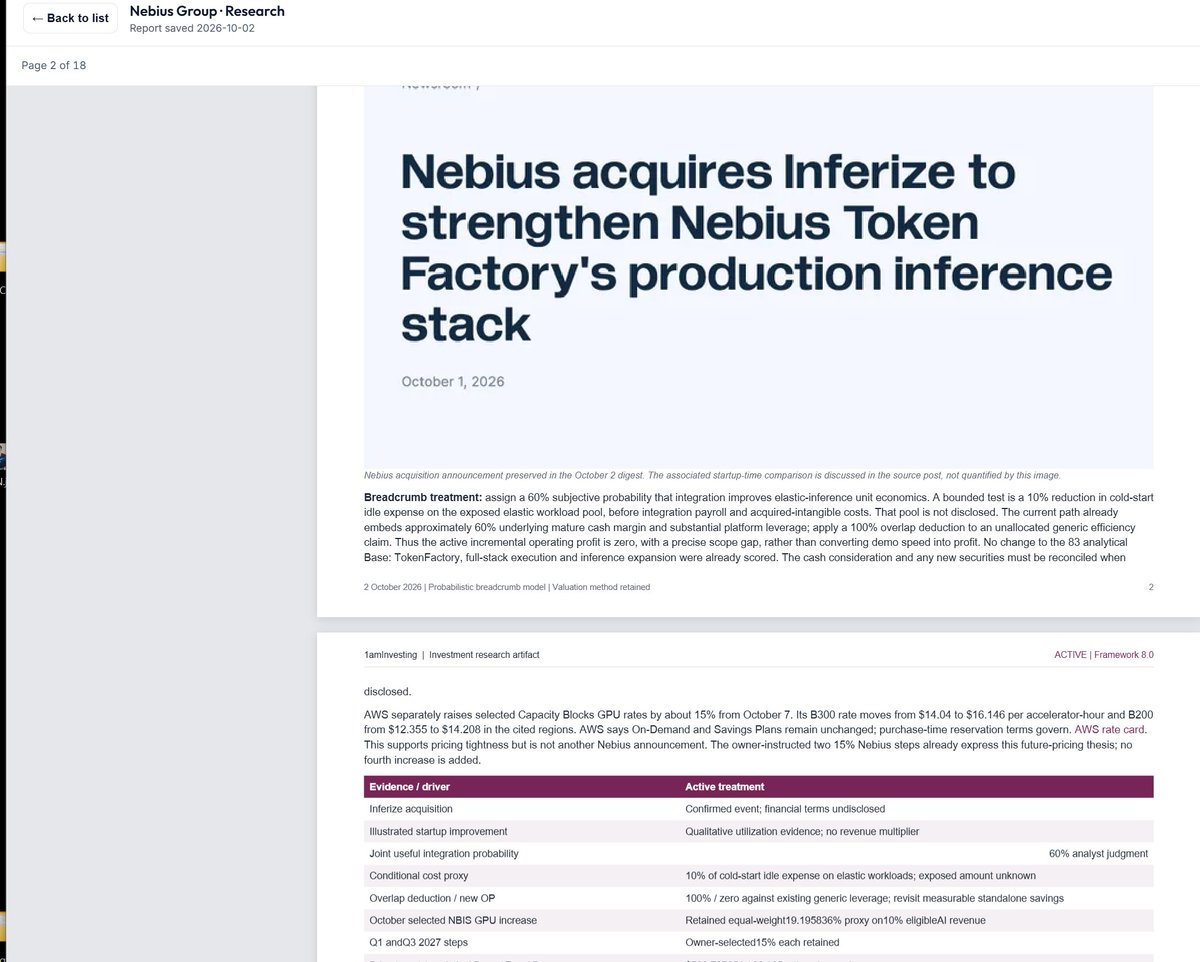
This is exactly why I remain heavily invested in $NBIS and $MU.
Everyone keeps talking about an AI compute bubble, yet Musk is saying they can’t get enough capacity, customers are renewing at HIGHER prices, and even older GPUs are commanding premiums.
Think about that.
Demand isn’t just absorbing new supply ~ it’s potentially outpacing it.
The real question isn’t whether AI infrastructure spending is too high. It’s whether we’re still underestimating how much compute the world is going to need.
Long $NBIS and $MU.
Expert Takeaways: Data Centers
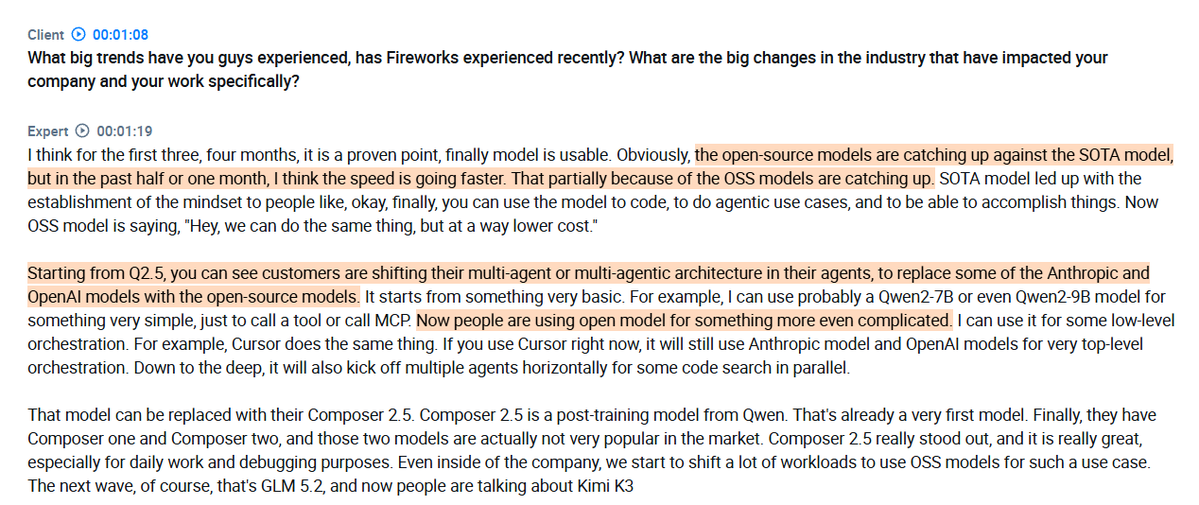
1. Open-Source Models Closing the Gap
> Open-source models are catching up to state-of-the-art frontier models faster than expected, driven by lower costs and improved performance.
> Starting in Q2, customers began replacing Anthropic and OpenAI models with open-source alternatives (such as Qwen variants like Composer 2.5).
> The transition started with basic tasks like tool calling and Model Context Protocol (MCP) and has advanced to low-level agent orchestration (e.g., parallel code searches).
2. Compute Capacity & Latency Bottlenecks
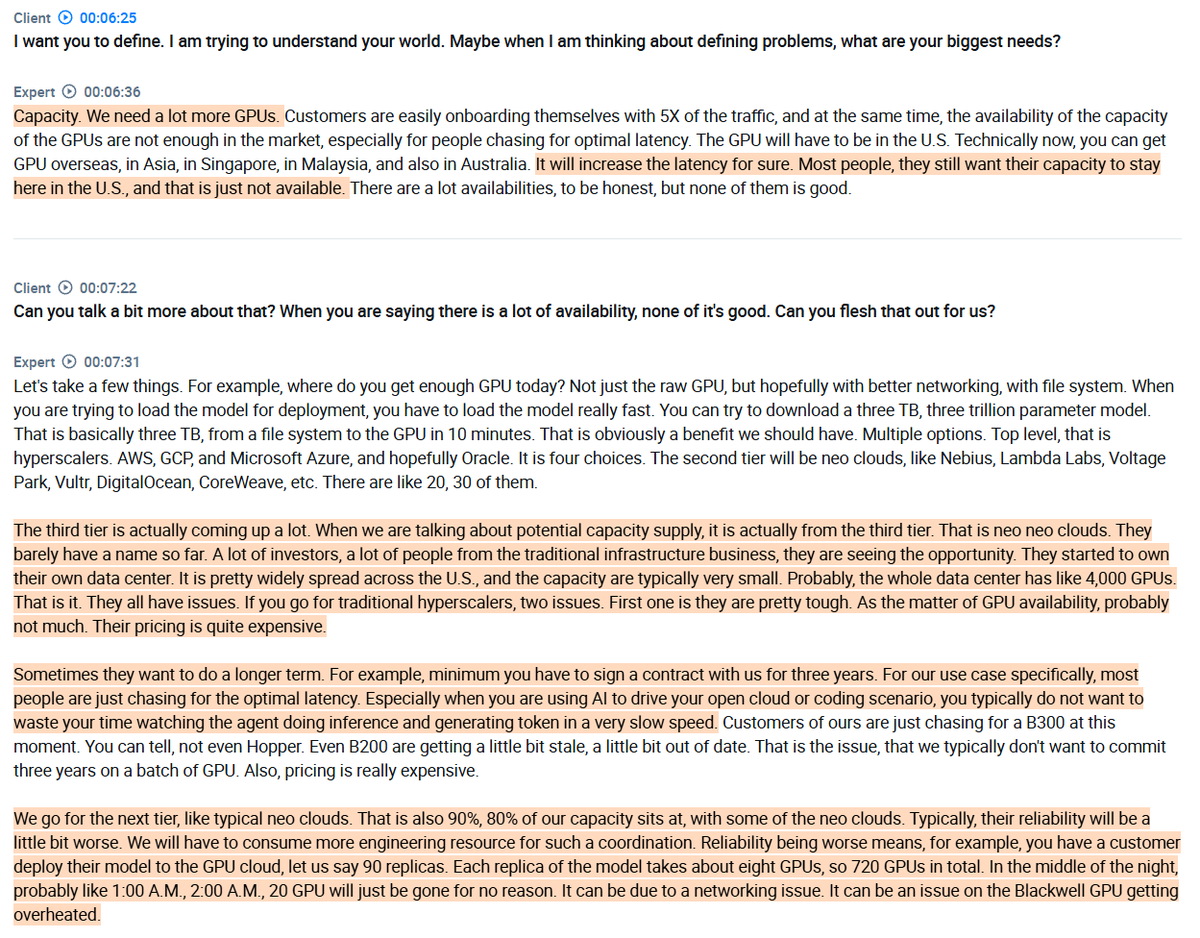
> Demand is constrained by GPU capacity, with some companies experiencing 5x traffic growth.
> Capacity shortages are most acute in the U.S., where strict latency requirements prevent companies from shifting workloads overseas to regions with available supply (e.g., Singapore, Malaysia, Australia).
3. Compute Provider Ecosystem Dynamics
> AWS, GCP, Azure, and Oracle offer reliability but are expensive, require long-term commitments (3+ years), and lack immediate availability for late-generation hardware (such as NVIDIA B300s).
> Companies host 80–90% of their capacity with neoclouds (e.g., CoreWeave, Lambda Labs, Nebius) due to cost flexibility. However, neoclouds suffer from reliability issues (e.g., unexpected GPU drop-offs from networking failures or Blackwell overheating), requiring ongoing engineering resources to manage fleet stability.
> Small operators leasing GPU racks (typically ~4,000 GPUs) attempt to recoup investments within 1–2 years. In practice, they are often unusable due to a lack of cloud management, infrastructure maintenance, and operational expertise.
4. Supply Dynamics & Industry Bottlenecks
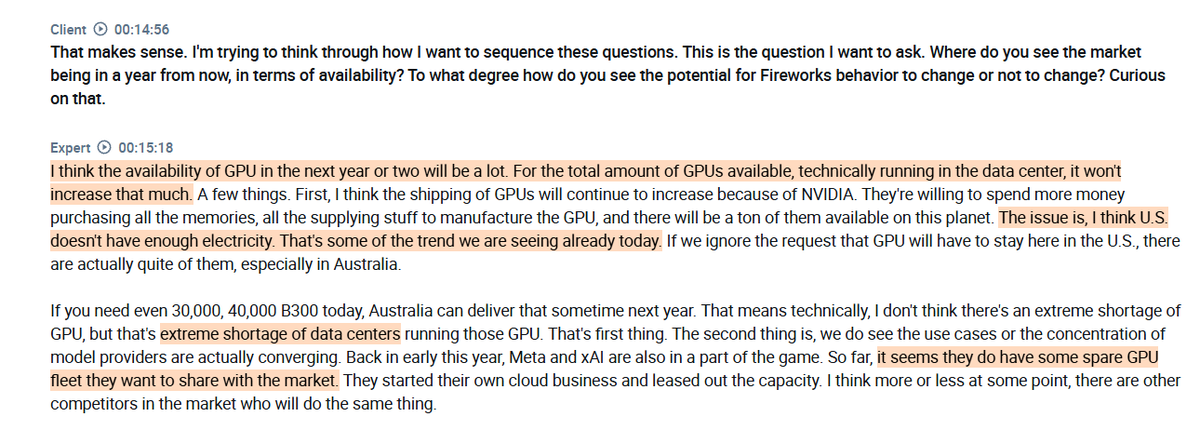
> While NVIDIA continues to scale GPU production, the true limitation in the U.S. is power/electricity supply and data center infrastructure, rather than physical GPU availability.
> Major model developers and players with spare capacity are beginning to lease out their idle GPU fleets directly to the market.
5. Payment Terms & Financial Structures
> U.S.-based neoclouds generally require 20%–30% upfront prepayment, with the remainder paid monthly or quarterly, and rebates negotiated at term completion for SLA/traffic disruptions.
> Providers in the APAC region operate under more lenient terms, requiring no prepayment upfront.
Great work from @RihardJarc
$GOOGL $AMZN $META $MSFT $NVDA $ORCL
Supertake turned this news into a stock portfolio: 16 picks led by glasses platforms, plus chips and optics. See it and make it yours: https://t.co/DKZJwOyup3
This is how you get rich ⚡️
You buy the macro dip in companies that are structural to building the future, with great management and a killer product roadmap.
This is the time to add, into fear, into bad news, into uncertainty, not to sell.
From February to the end of March, everyone was calling for the end of memory, and a lot of people who bought memory with me back in 2025 sold. Now HBM is being co-designed with the GPUs and custom chips themselves, down to custom base dies, which makes it more embedded and less of a commodity every day.
There was a time when Nvidia was considered a cyclical stock, and now we know it isn’t.
Right now we’re in a boom-and-bust cycle, which is completely normal. After such a massive re-rating of the structural bets that make the AI buildout possible, a drawdown (or, well, now two) is perfectly acceptable.
Bet on structural names, the ones the AI buildout wouldn’t be possible without, at least until we’re back in the boom part of the cycle.
Yes $LITE, no $POET
Yes $NBIS, no $BRUN
Yes $BE, no $FCEL
You get the idea: $NVDA, $SNDK, $MU, $MRVL, $AMD, $DELL, $INTC, $GLW, $CRDO...
Memory and interconnect are being embedded into what makes AI possible.
If you want significant returns, add to past winners that have a stronghold on the future being built, and add when others are selling.
This is exactly what I’ll keep doing. Every dollar I invest will be added here, not when we rally, and if things play out the way I see them, we’ll be much higher by the end of Q1 2027.
Bullish ⚡️
On me demande souvent : quelle exposition prendre sur la photonique ?
Si je devais reconstruire aujourd’hui une position sur un thème, je partirais toujours sur un basket core–satellite
Core — 72 %
$LITE 28 % — ma plus forte conviction. Ils sont positionnés sur les lasers InP, composants optiques, transceivers cloud probablement l’exposition qui présente un des meilleurs risk/reward
$CIEN 18 % — C'est un pari sur la couche réseau. C'est du transport optique, des interconnexions cohérentes et du switching en gros le scale across pour relier les datacenters et absorber l’augmentation structurelle du trafic
$COHR 15 % — l’un des acteurs les plus intégrés de la chaîne optique, lasers InP, modulateurs, photodiodes, silicon photonics et transceivers de 800G à 3.2T. Comme $LITE et $AMS-OSRAM ils sont exposés aux nouvelles architectures optiques.
$GLW 11 % — Corning maîtrise à la fois la fibre, le câble et la connectique haute densité. Une capacité industrielle difficile à répliquer à l’échelle des hyperscalers et des contrats verrouillés avec $NVDA $AMZ $META
Satellite — 28 %
$AMS-OSRAM 9 % — le pari asymétrique sur les nouvelles architectures photoniques. Le groupe dispose d’un vrai savoir-faire industriel sur les VCSEL et les micro-émetteurs, et développe désormais des arrays microLED ultra-parallèles pour les futures interconnexions optiques « slow & wide » des clusters IA.
$AXTI 8 % — l’exposition amont du panier. AXT fabrique les substrats en phosphure d’indium utilisés dans les lasers, modulateurs et photodétecteurs à haute vitesse. A mons sens c'est la position la plus convexe, l'InP est un véritable Bottleneck.
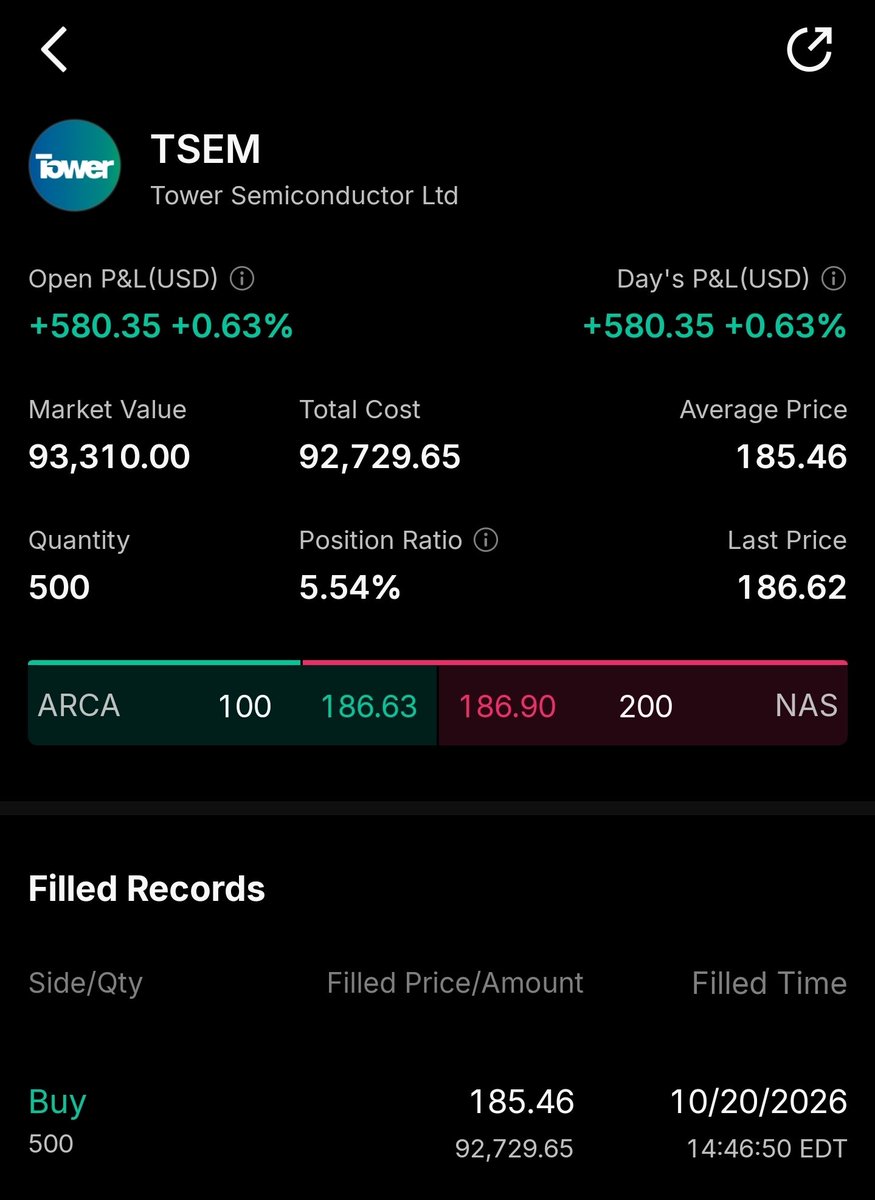
$TSEM 7 % — C'est la foundry spécialisée en silicon photonic. Tower fabrique des circuits de silicon photonics pour les transceivers, l’optique cohérente et les futures architectures de switching optique. La SiPho fait déjà 37 % du CA, 1,3 Md$ de CA 2027 sous contrat, collaboration 1.6T avec NVIDIA, Collab sur le NPO.
$AAOI 4 % — Exposition plus directionnelle aux modules optiques pour hyperscalers. Lasers, composants et transceivers 400G/800G/1.6T, avec une forte optionalité sur la montée en cadence des réseaux IA. Gros flux retail donc je reste prudent mais les earnings m'ont rassurés.
AI supply chain constraint map from Outer Ninth Research 👀
I created a dashboard for us to track the most constrained supply chain components which will be updated monthly. Here is the October edition with additional information to come.
October brings us a 7.2/9 overall index score with 16/32 components very tight.
20 components have tightened from last month, 12 flat and 0 easing.
At first glance, several items stand out 👀
the stage is set for 2027, position accordingly
Goldman Sachs: Optical Networking
> Driven by an AI infrastructure ramp-up and rising computing power per rack, Goldman Sachs forecasts a 9x expansion in the total addressable market (TAM) from US$15bn (GB300 NVL72, mainly in 2026) to US$154bn (Rubin Ultra NVL576, mainly in 2028).
> CPO is projected to contribute US$91bn, capturing 59% of the overall US$154bn TAM (assuming a 29% penetration rate in scale-out).
> Aggregate networking dollar content per computing unit across scale-up and scale-out is expected to surge 29x, jumping from US$315k in the GB300 NVL72 to US$9.4bn in the Rubin Ultra NVL576. Per computing unit, dollar content increases by 16x in Scale-Out and 45x in Scale-Up.
> The addressable market for optical modules/engines expands 13x when moving from scale-out to scale-up architectures.
Pluggable Optical Modules & Silicon Photonics (SiPh)
> The value market for pluggable optical modules in scale-out will grow 10x per computing unit from the 2H25 server model to the 2H27 server model.
> Equivalent 1.6T units per computing unit will skyrocket from 216 units (GB300 NVL72) to 2.5k units (Rubin Ultra NVL576).
> Silicon Photonics adoption in the datacom market is expected to spike from 6% in 1Q24 to 45% by 4Q28, offering up to a 32% BoM cost advantage and 20% price advantage over traditional EML solutions at 1.6T speeds.
Technology Matrix & Supply Chain Realities
> Copper cables and PCBs remain king for short-distance, cost-effective, and low-power connections, but optics become essential for high-speed, long-distance interconnections.
> Light source supply (both EML and CW lasers) is expected to remain very tight through 2026/2027 due to booming AI demand and Indium Phosphide (InP) substrate export controls from China. Supply balance isn't expected until 2H28 as supply chain expansions come online.
> Alternative entirely optical signal switches (like Google's Palomar OCS) are scaling rapidly, enabling datacenter speed upgrades without needing to replace the switches themselves. Lumentum’s OCS backlog crossed $400M as of Feb 2026.
This is a report from April which is made publicly online by GS, but I don't think people covered it enough. Hence, revisiting and highlighting key data potentially missed.
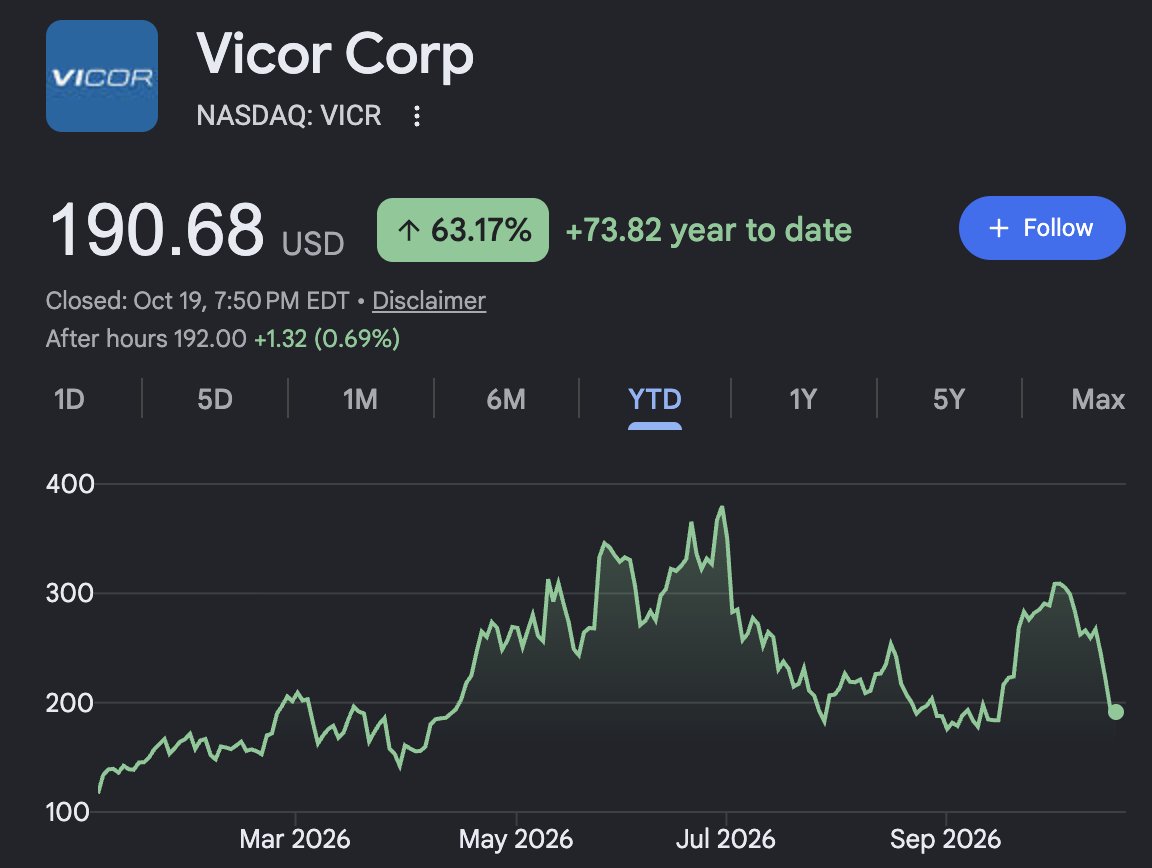
Vicor guided the same quarter three times in 71 days.
Jul 21: Q3 up nearly 10%.
Sep 21: up more than 20%.
Sep 30: up more than 30%, so above $186.4M.
The product forecast never moved. Both raises came from one source: royalties on Vicor’s first non-exclusive Vertical Power Delivery license.
Back out what was already contracted, and that license works out to roughly $28.7M in a single quarter. For comparison, Vicor’s royalty for all of 2025 was $57.4M.
$VICR reports tomorrow before the open. Here’s what we’re watching.
First, is it a run rate or a catch-up? If the license pays per unit sold, part of Q3 is back royalties on units that already shipped. Vicor has done this before: Q3 2025 royalty spiked, then fell 33% the next quarter. Whatever the Q4 guide implies for royalty answers this.
Second, opex. The May license added $4.4M to SG&A for contingent legal fees. Royalty has no cost of goods, but it isn’t free. If opex jumps again, the new license carries the same cut.
Third, the product side. Customer feedback on Gen2 VPD, and how quickly the fab reaches $1.5B in capacity. Fab space isn’t what limits Vicor right now. Customers are.
Our line is simple. Q4 royalty under $25.4M means the new license doesn’t recur. Anything above that means Vicor now has two engines, and the second runs at nearly 100% gross margin.
Part 1 and Part 2 are on our Substack. Part 3 drops after the print tomorrow!