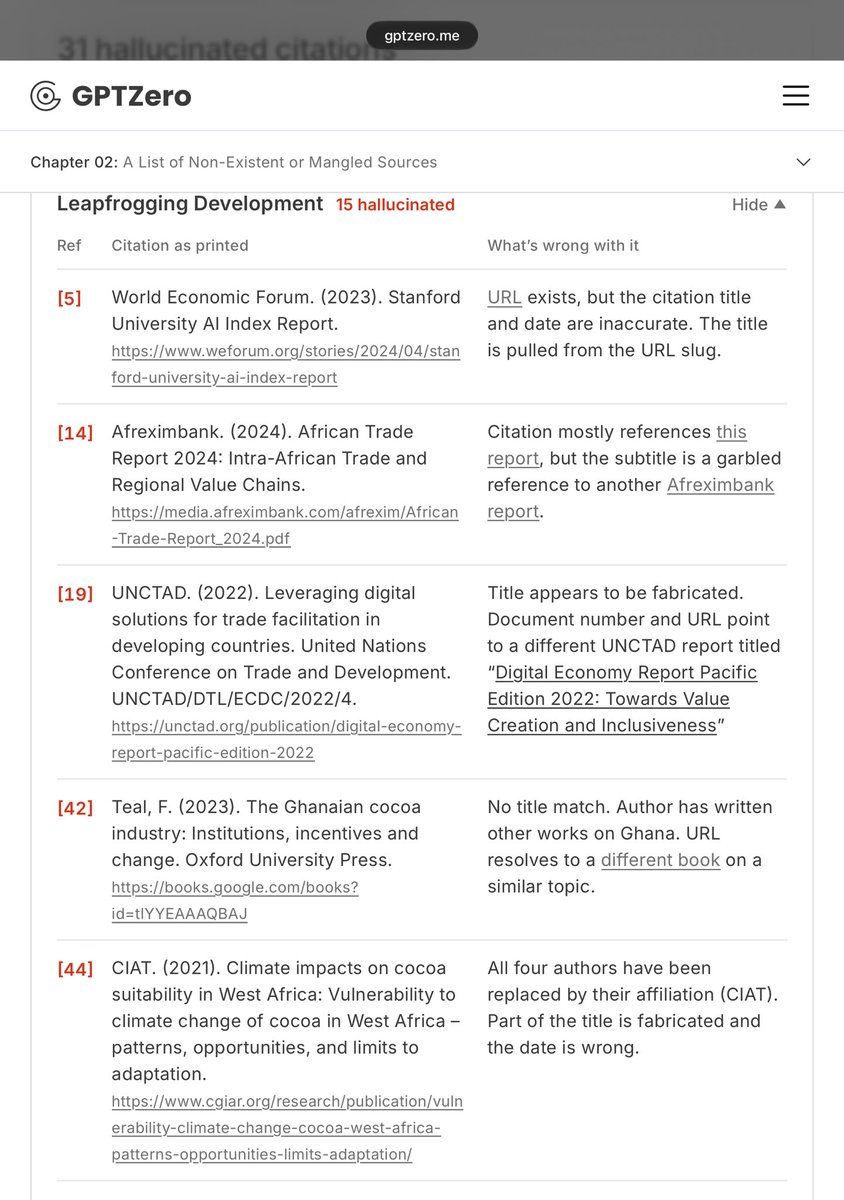
‼️ Accenture, which sells AI consulting to big business, published a report on AI in Africa citing sources that don't exist.
AI-detection firm GPTZero says 15 of its 89 citations are invented or spliced, including a "Southern Africa AgriTech Network" that doesn't appear to exist.
The report also ranks Ghana 47th on a global AI readiness index that puts it 141st.
Across three Accenture-linked papers, GPTZero found 31 fake citations. One links a deleted "FraudGPT" GitHub repo used to spread malware.
Accenture blames human error and will correct the report. It won't say how it ruled out AI.
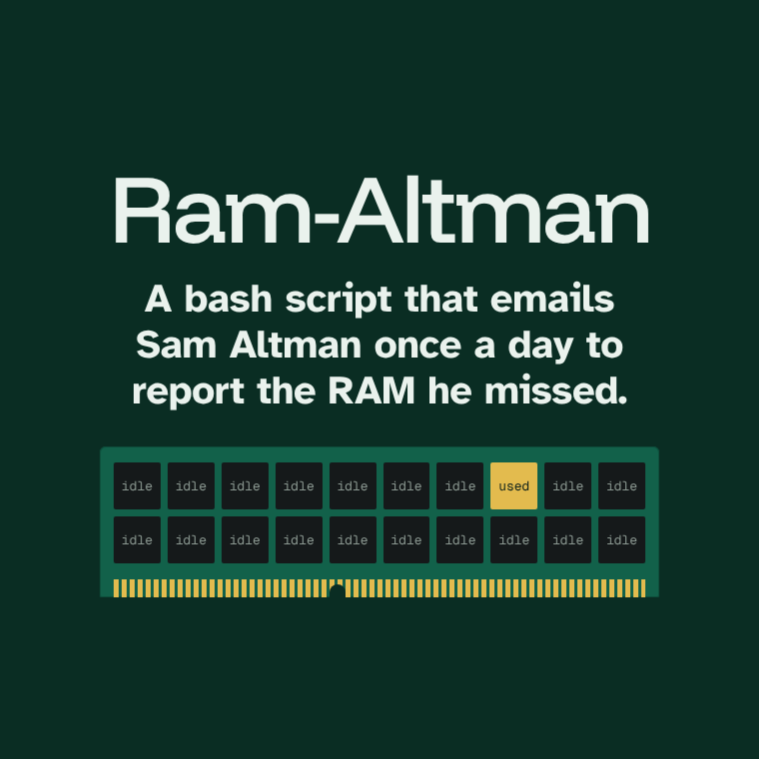
❗ Someone built a script that emails Sam Altman to let him know when their RAM sits idle.
Sam Altman said the RAM belongs in datacenters, that the RAM in people's PCs is used "maybe 5% of the time", and called it "quite terrible".
Ram-Altman logs a Linux PC's memory every five minutes and, once a day, reports in if more than 10% of it is unused.
People are missing the point of Ginux.
I didn’t create another kernel to compete with Linux. That is idiotic!
In fact I consider the code disposable. Think about that…
Ginux wasn’t the product. The development process was the experiment. The kernel was the evidence.
Could AI, directed by an experienced engineer, could build and validate an extraordinarily complex software system.
In just 11 days, I produced an independent kernel capable of booting Rocky Linux 10 with systemd.
That was the experiment. And while Ginux isn’t a complete Linux aligned kernel, the experiment is complete.
The research paper documents the methodology, results, and limitations.
Since publishing, people have started finding bugs and security issues. That’s fantastic! Independent review is exactly how complex software gets better.
There has already been an initial security review, and there’s a remediation plan sitting in context that I’m considering implementing.
So the question is, since the experiment is complete, do I even do anything further here?
Maybe there is an interesting experiment in measuring how efficiently human-directed AI can fix the problems external reviewers discover?
How much time does it take to reproduce an issue, identify the root cause, implement a fix, and validate the result? How much human intervention is actually required?
That’s potentially an even more interesting situation than the original 11-day experiment.
Because the real question was never whether AI could replace Linux. Even if it can replace some aspects of its functionality, it can’t replicate the community, standards, collaboration, alignment, or stability.
If you still believe that Ginux was designed to be a Linux replacement, you should read the actual paper.
https://t.co/VGJkSOr9Yw
The FBI continues to warn about two critical security flaws in PHP, a programming language used to build many websites and online services. Attackers could exploit these vulnerabilities to break into systems, putting sensitive information and business operations at risk. Security updates are available and should be applied immediately.
If you are a business owner or website operator, check whether your systems are affected. Contact your IT support team, website developer, or hosting provider for help identifying vulnerable systems and applying the necessary updates.
The FBI urges organizations to take the following steps now:
➡️ If an immediate update is not feasible it is recommended that organizations take the system offline until it can be fully mitigated.
➡️ Immediately update affected PHP installations following the guidance on https://t.co/JFOW6jG9Ws. Inventory where PHP runs in your environment, prioritizing internet-facing systems and vendor products that bundle PHP.
➡️ Monitor web servers for suspicious activity, including PHP processes unexpectedly launching command shells or downloading files. Ensure appropriate process-monitoring capabilities are in place to help identify potential exploitation.
➡️ If you find signs of compromise, isolate affected systems, preserve your web server and PHP logs, and report it to your local FBI field office or https://t.co/ZWC7Se2YdU. Those reports help us identify the actors involved and warn other organizations before they become victims.
For the latest information on these vulnerabilities (CVE-2026-109618 and CVE-2026-109619), follow PHP’s announcements on https://t.co/JFOW6jG9Ws, CERT-EU Security Advisory 2026-018, and CISA’s Known Exploited Vulnerabilities catalog.
Two critical vulnerabilities have been identified in PHP, a widely used programming language that powers websites and web applications. These vulnerabilities (CVE-2026-109618 and CVE-2026-109619) could allow malicious cyber actors to remotely execute code in PHP core, potentially compromising sensitive data and networks.
The FBI urges organizations to take the following steps now:
➡️ If an immediate update is not feasible it is recommended that organizations take the system offline until it can be fully mitigated.
➡️ Immediately update affected PHP installations following the guidance on https://t.co/rDrPSxB3zX. Inventory where PHP runs in your environment, prioritizing internet-facing systems and vendor products that bundle PHP.
➡️ Monitor web servers for suspicious activity, including PHP processes unexpectedly launching command shells or downloading files. Ensure appropriate process-monitoring capabilities are in place to help identify potential exploitation.
➡️ If you find signs of compromise, isolate affected systems, preserve your web server and PHP logs, and report it to your local FBI field office or https://t.co/iqgVZIbCru. Those reports help us identify the actors involved and warn other organizations before they become victims.
For the latest information, follow PHP’s announcement on https://t.co/rDrPSxB3zX, CERT-EU Security Advisory 2026-018, and CISA’s Known Exploited Vulnerabilities catalog.
Effective Immediately, all organizations using PHP for their systems are advised to be prepared for an update addressing two critical vulnerabilities. PHP is widely used for web applications. These vulnerabilities often provide a direct path to the server's file system or database. If an immediate update is not feasible, it is recommend that organizations take the system offline until it can be fully mitigated. NSA will follow up shortly with more specific guidance.
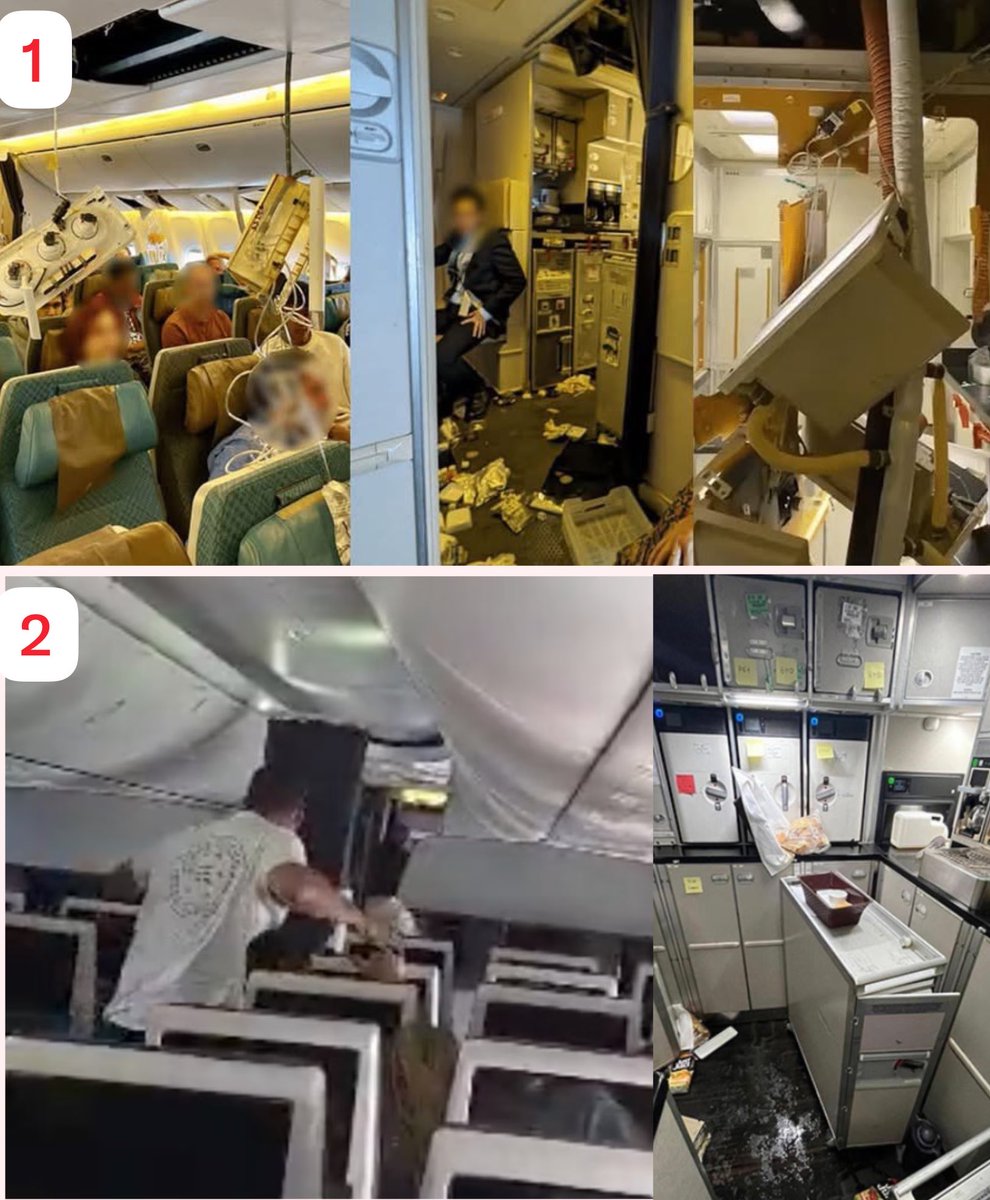
1️⃣ This is what happened to a similar plane during severe turbulence when it dropped only 178 feet in less than 5 seconds.
2️⃣ And this is what happened to Flydubai, which nose-dived 14,000 feet in just 29 seconds.
Probably nothing.
As a pilot for 20 years I have questions:
- where are the cabin crew here?
- where are the oxygen masks that automatically drop during a rapid emergency descent?
- how did the Capt manage to open the door while being stabbed?
- Omani pilots were not allowed to fly to Israel, why was he allowed?
- how did the offending pilot get a weapon onboard?
- why has this happened so close to elections?
- how are passengers walking around while apparently in a nosedive?
- who else was injured? Nose dives cause significant g force incidents
- why is there two perfectly positioned people recording the incident and not helping?
- why did a plumber take control and not the 2 pilots onboard who would certainly know when an aircraft was in a nosedive?
- why was the plumber speaking in English to Bibi after the flight
- why was he still in his blood soaked clothes 8 hours after the incident
False Flags have been a very effective mechanism to influence public opinion
Hitler burnt down the Reichstag just before his parliament elections and he won the election…changing the course of history.
A full and independent investigation should be carried out here.
Hopefully independent journalist will be allowed to view this too.
HR informed me I had to conduct a mandatory cybersecurity seminar for all new hires.
Normally I just email them a PDF from 2012 and mark them as compliant in the system.
But our insurance provider required physical proof of an instructor-led session.
I gathered 40 terrified employees in a conference room.
My goal was to ensure none of them ever submitted an IT help desk ticket for as long as they worked here.
I opened the presentation with a slide showing a stock photo of a house on fire.
I told them this is what happens to the corporate network when you restart your computer without authorization.
I explained that our entire infrastructure operates on a fragile ecosystem of asynchronous legacy tunneling.
I said every time a user reboots a machine, it sends a localized EMP spike directly into the primary database.
A girl from accounting raised her hand and asked what to do if her screen freezes.
I told her she needs to wait for the CPU to naturally metabolize the data.
I said forcing a shutdown is the equivalent of digital manslaughter.
Then I moved to the topic of password security.
I told them our new policy requires a 64-character password that must include a prime number, a zodiac sign, and a semicolon.
I said passwords cannot be written down, stored in a manager, or committed to long-term memory.
A guy from marketing asked how he's supposed to remember it.
I told him security isn't supposed to be convenient, it's supposed to be agonizing.
I spent the last 45 minutes explaining the dangers of opening browser tabs.
I convinced them that every active tab drains exactly 4% of the company's total bandwidth.
I said if anyone has more than 3 tabs open at once, they're actively participating in a localized denial of service attack.
The room was dead silent.
They all walked back to their desks like they were navigating a minefield.
Help desk tickets are down 94% this week.
Half the staff is too afraid to even turn their monitors on.
I've spent the last 3 days watching documentaries about the bronze age collapse in absolute peace.
Fear is the most cost-effective firewall on the market.