Bitcoiner, Do Not Make These 10 Mistakes!
First Five of a series of 10 Videos About
Mistakes To Be Avoided At All Costs!
Mistake Number 1: Overconfidence
https://t.co/zjUL6AtZUn
Mistake Number 2: All Eggs In One Basket
https://t.co/Op9xiJ0atJ
continue…
@sesi_the_man@JoeNakamoto@omg21btc I’m not an engineer, just an ordinary user. I figured out SeedSigner without any issues. Driving a car is harder. This guy explains everything here. If you’re willing, it’s not difficult at all.
@ColeTU
https://t.co/2kly9OWqr2
@HODL_Bob@BTCAaron My experience is that once your Bitcoin is stolen, apart from scammers offering their "services," nobody really helps you track down the thieves. It's a sad reality in the Bitcoin space. If you're not well-known or connected to influencers, nobody truly cares about your loss.
Technical Hypothesis
Now let's get to the key question...
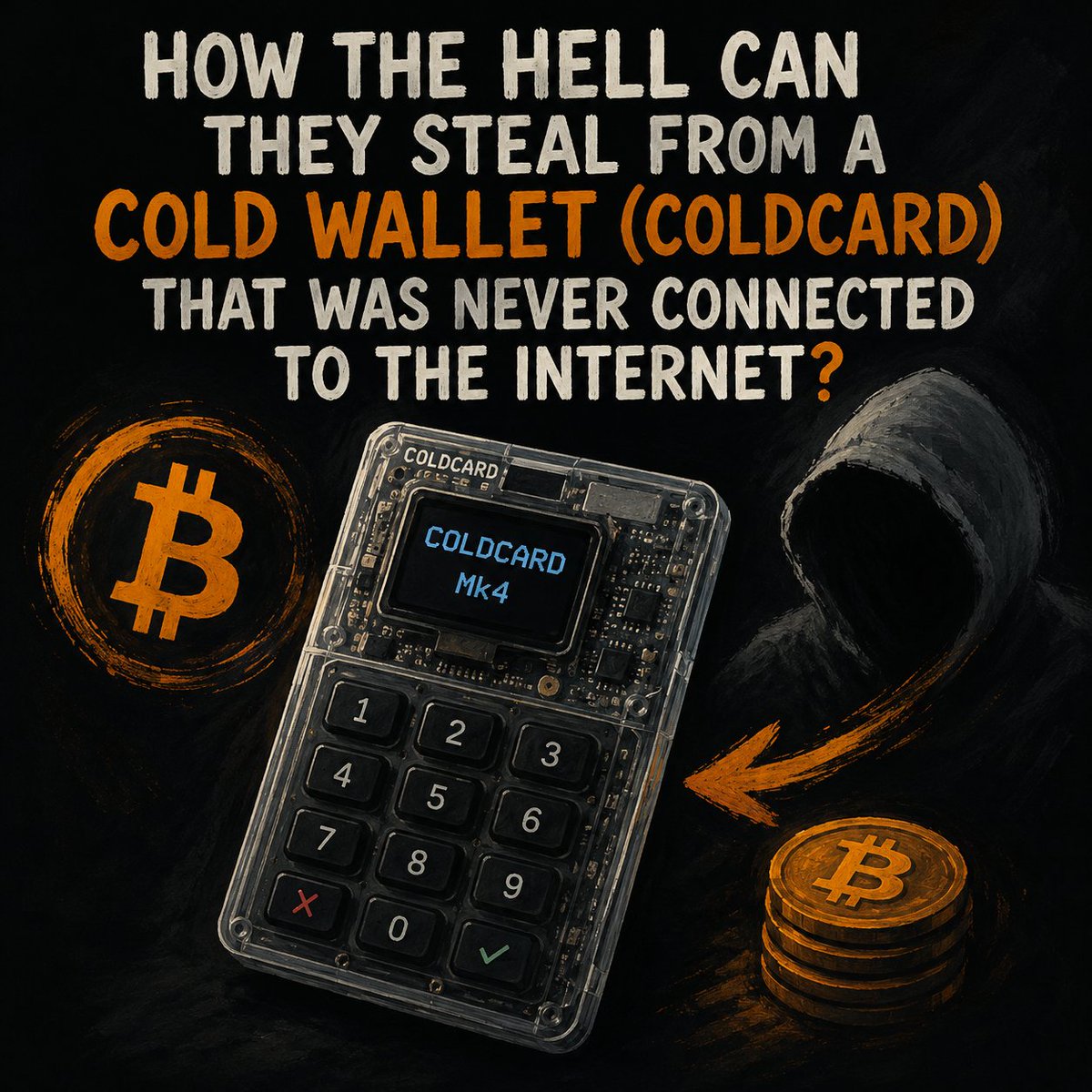
How could someone steal funds without ever touching the Coldcard?
Based on the information currently available, the strongest technical hypothesis is the following.
1. The attacker reconstructs the flawed algorithm.
Because the firmware is public, it can be analyzed to determine:
• Which pseudo-random number generator (PRNG) was used.
• What initial data seeded it.
• How its internal state evolved.
• How those values were ultimately converted into a BIP-39 seed.
If the random number generator was sufficiently predictable, the problem stops being cryptographic and becomes computational.
2. The attacker generates millions or even trillions of candidate seeds.
The attacker is not trying to guess every possible BIP-39 seed.
Instead, they only reproduce the seeds that the flawed firmware could have generated.
That difference is enormous.
Think of it like searching for a key.
A properly generated seed is like searching for a key in an almost infinite universe.
A weak seed is like searching for a key inside a relatively small box.
3. The attacker derives Bitcoin addresses.
Each candidate seed produces:
Candidate Seed
↓
BIP-32 Master Key
↓
BIP-84 Derivation Path
↓
bc1q... Bitcoin Addresses
All of this can be done completely offline.
There is no need to contact the Coldcard.
4. The attacker compares those addresses against the blockchain.
The blockchain is public.
Recent findings from the ongoing investigation suggest that the attacker used a commercial blockchain-services provider to automate address lookups during the sweeps.
Conceptually, the workflow is straightforward:
"Does any of these addresses contain UTXOs?"
If the answer is no...
The seed is discarded.
If the answer is yes...
The correct seed has very likely been found.
5. The attacker signs the transaction.
This is the part that most people misunderstand.
A Coldcard does not physically store your bitcoin.
Your bitcoin always remain on the blockchain.
The Coldcard only stores the private key required to produce a valid signature.
If someone else reconstructs that exact same private key, they can generate signatures that are mathematically indistinguishable from yours.
To Bitcoin, both signatures are equally valid.
The network has no way of knowing whether the signature came from your Coldcard or from an attacker.
That is why a hardware wallet can remain:
• Powered off.
• Completely offline.
• Locked inside a safe.
• Without ever revealing the seed phrase.
And still lose its funds.
Not because the device itself was hacked.
But because someone reconstructed the exact same private key.
That completely changes the perspective.
This would not be an attack against Bitcoin.
Nor would it be a flaw in BIP-39.
It would instead be a failure in the quality of the entropy used to generate the seed.
The observed theft appears to have been highly automated.
Approximately 594.5 BTC were swept from around 500 single-signature addresses within just a few consecutive blocks.
It has not yet been officially confirmed that every one of those cases resulted from the same Coldcard vulnerability.
However, the observed on-chain pattern, Coinkite's official advisory, independent technical analyses, and the recently disclosed evidence regarding automated blockchain-service queries all point in the same direction.
While the complete forensic report has not yet been published, every new piece of public evidence released so far has reinforced this hypothesis rather than contradicted it.
At this stage, this remains the most technically consistent explanation for what appears to have happened.
Our lead developer @KeithMukai has actually been dipping into his own bitcoin savings to continue work on SeedSigner, and our lead maintainer @newtonick works on the project pro bono as well. If you get value from @SeedSigner consider sending them a few sats via:
https://t.co/SmYdCCZFB6
(Note: I am intentionally not included in the donation workflow)
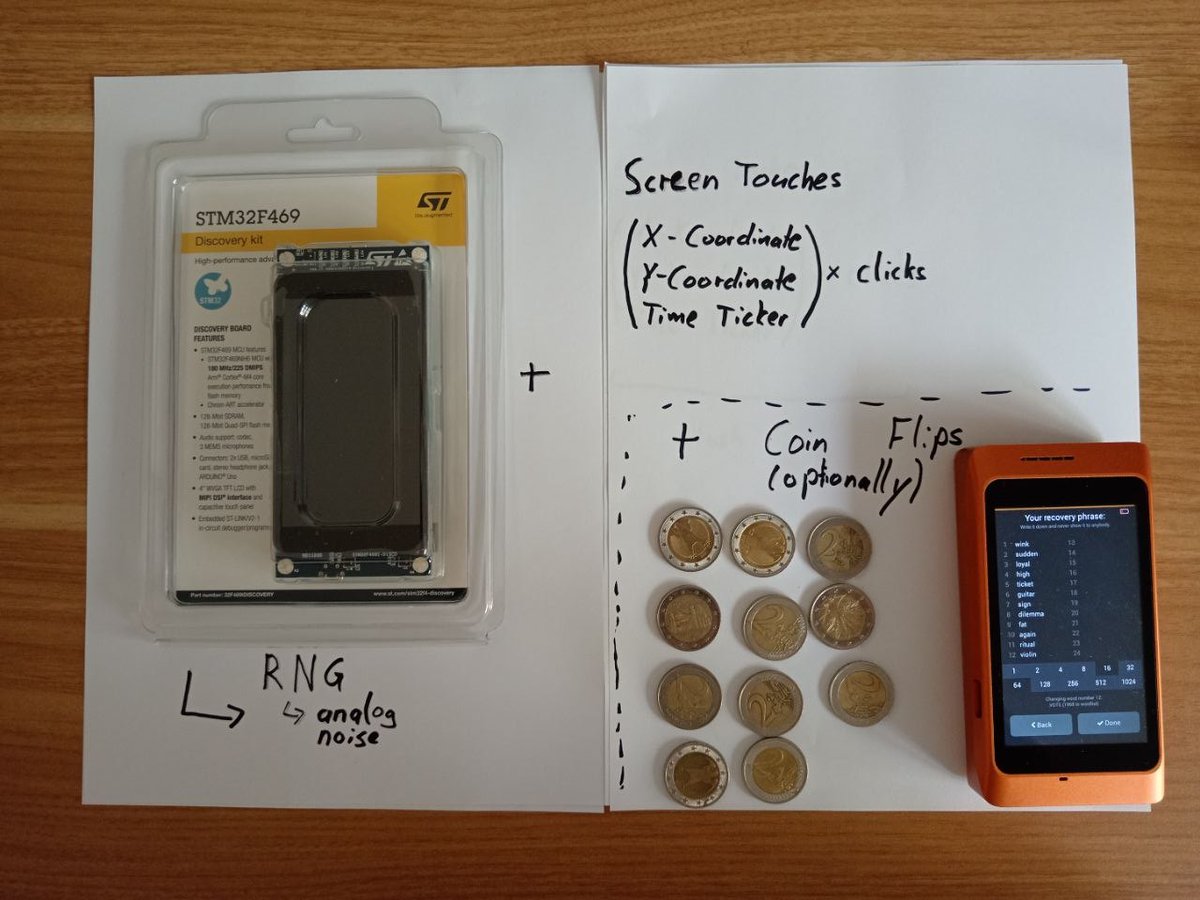
1/19 COLDCARD is currently facing problems with secure seed-phrase generation.
So we want to show transparently how Specter DIY generates randomness, combines multiple sources, and lets users control the decisive entropy themselves.
Quite a few people suggesting/using dice to mitigate the Coldcard vulnerability.
Note that common dice are not designed to be cryptographically secure.
If you are going to do this, you probably should buy precision casino dice. And even then, have another source of entropy.
@notgrubles@VandelayBTC@grubles Watch my video. Bitcoin thieves are the worst kind of people. They never return our Bitcoin's. I lost 2.62 BTC in 2017. Still didn't stop trying to track the Polish scammer. It is not easy. By the way,the other scammers contacting us offering "help" is hilarious.
The beauty of @SeedSigner is not just the device , it’s the philosophy behind it.
Teach people, don’t capture them. Give them the tools to become sovereign.
Massive respect for the transparency, humility, and commitment to putting users before profit. This is exactly why open-source Bitcoin projects matter.
Seedsigner is an incredible project that has been under supported and shaded out in the past, and continues through grit and passion for FOSS.
Learn about it, try it, buy it, fork it, try to break it, fund it.
Great video by @ColeTU on the current ColdCard situation.
If you hold ANY ColdCard device, there are steps you NEED to take to ensure your Bitcoin is safe.
If you’ve noted my recent posts, you can tell that I’m traveling in Europe with my family right now. I stayed up for a while last night but forced myself to go to bed around midnight, before the specifics of the CC entropy vulnerability had been widely discovered. My heart hurts for any bitcoiner who was affected by the UTXO sweeps, we all work very hard and make sacrifices to save as much bitcoin as we can, because we deeply believe in the possibilities and the larger mission. There will be plenty of time to post mortem and debate best practices, but please remember that at a certain level we’re all basically on the same team and want bitcoin to win. I’m going to continue to consciously try to focus on family over these last couple days of our trip, but may still comment here and there as questions arise. Just please try to remember there are real people who are on the other side of the keyboard, and real people who have lost savings and are hurting. Appreciate you all. 🧡
Bottom line: if you have provisioned keys (no dice rolls) with a Coinkite (Coldcard, Q) device that you bought in or after 2021, you should be moving your funds expeditiously. Today if possible.
There's an ongoing investigation about the current state of the firmware.