Been dogfooding Sai with Claude Code lately and the part that's actually stuck for us isn't just the responsiveness. It's that you can get work done on your phone. We have teammates improving our app from iMessage daily now.
This all started last week, when a teammate spotted a UI bug (black text on a black button). Normally that's a ticket → repro doc → Slack thread → fix-tomorrow situation. Instead Sai reproduced the bug, took screenshots, and handed it to Claude Code. Put up a PR before someone even read the bug report.
Whole thing started on our teammate's phone. On the go, laptop never opened, all in our VMs.
In preview now. Try it at https://t.co/WLHgZN9UJG with invite code: SAI_CLAUDECODE
Many people don’t realize the risk of coding agents is way beyond human control. However, it is overlooked that GUI is the actual interface designed for humans, restricting agents to operate on GUI can ensure more effective controllability.
Proud to be featured in the launch of Windows 365 for Agents!
@sai_borg now can scale enterprise workflows with the help of Windows 365 for Agents
Across browsers, desktops, and legacy systems.
[@SimularAI x @Microsoft] 🤝
Windows 365 for Agents went GA at Build 2026 - and @sai_borg is one of the launch partners.
The “where do AI agents actually run in production?” question has stalled enterprise pilots for two years. Microsoft just shipped the answer.
The Sai demo Microsoft published:
→ Reads scanned insurance claims
→ Extracts fields
→ Verifies coverage
→ Enters results through the UI
→ No APIs, no integrations
Watch: https://t.co/EVvE3JnE51
What unlocks: enterprise work locked behind UIs without APIs - insurance, healthcare, finance, legacy ERPs. Now deployable inside the Microsoft stack companies already pay for.
The humans won on the AI panel. 🙂
We had one big question: What's the role of humans in the AI age?
Last night answered it: in-person connection, human trust, serendipitous conversations with strangers in the room.
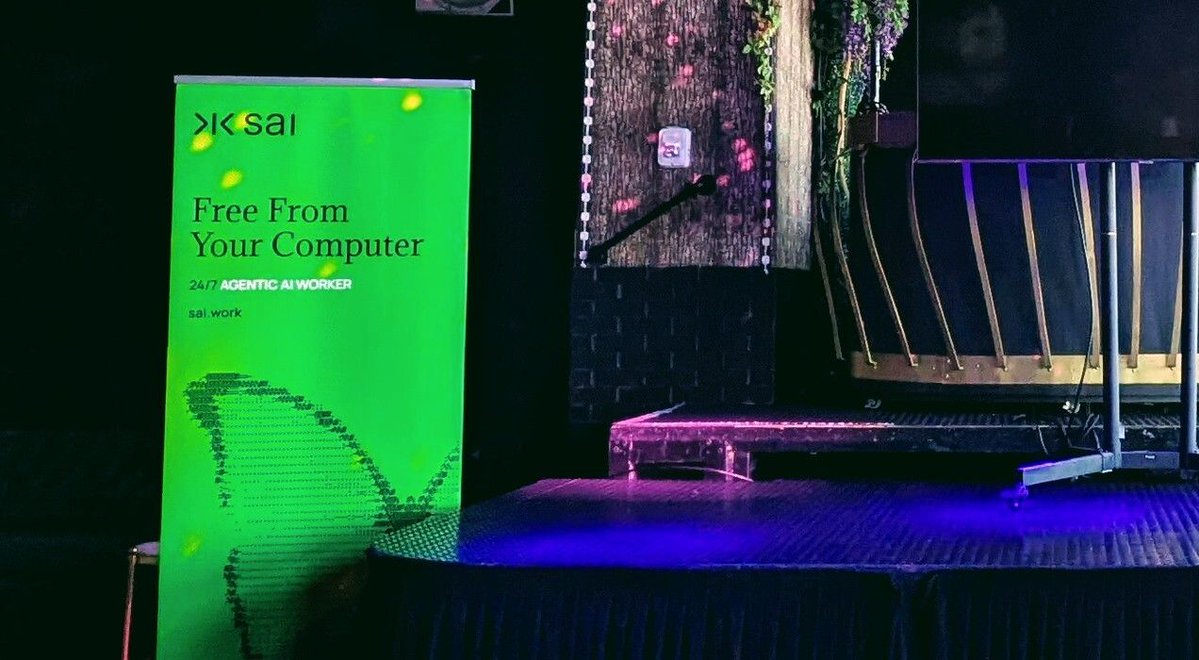
300+ packed into Somewhere Nowhere to kick off NYC Tech Week and our first event in the city.
Thanks to everyone who showed up and to our guests @matthewridenour@ChristopherFong@AgrawalArian. Recap coming soon!
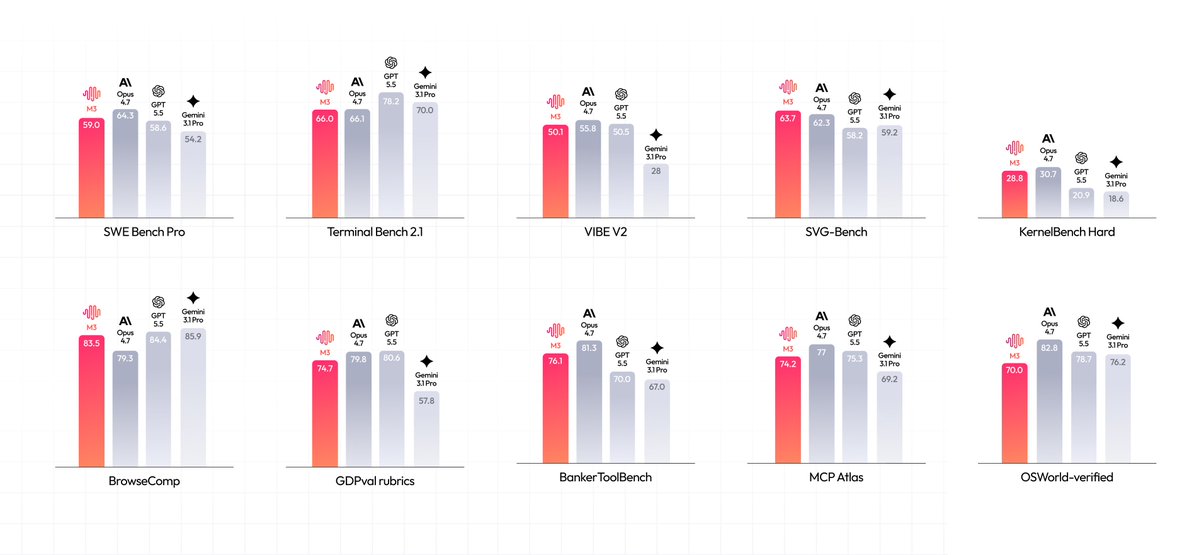
Today @MiniMax_AI ships M3 — the first frontier model purpose-built for computer-use agents. Natively multimodal. One model, almost every real-world task.
And today, @sai_borg runs it.
Our users are the first to use M3 the way it was designed to be used — on a real desktop, doing real work.
This is what model-and-agent alignment looks like.
→ Try it: https://t.co/skPjzLZoyi
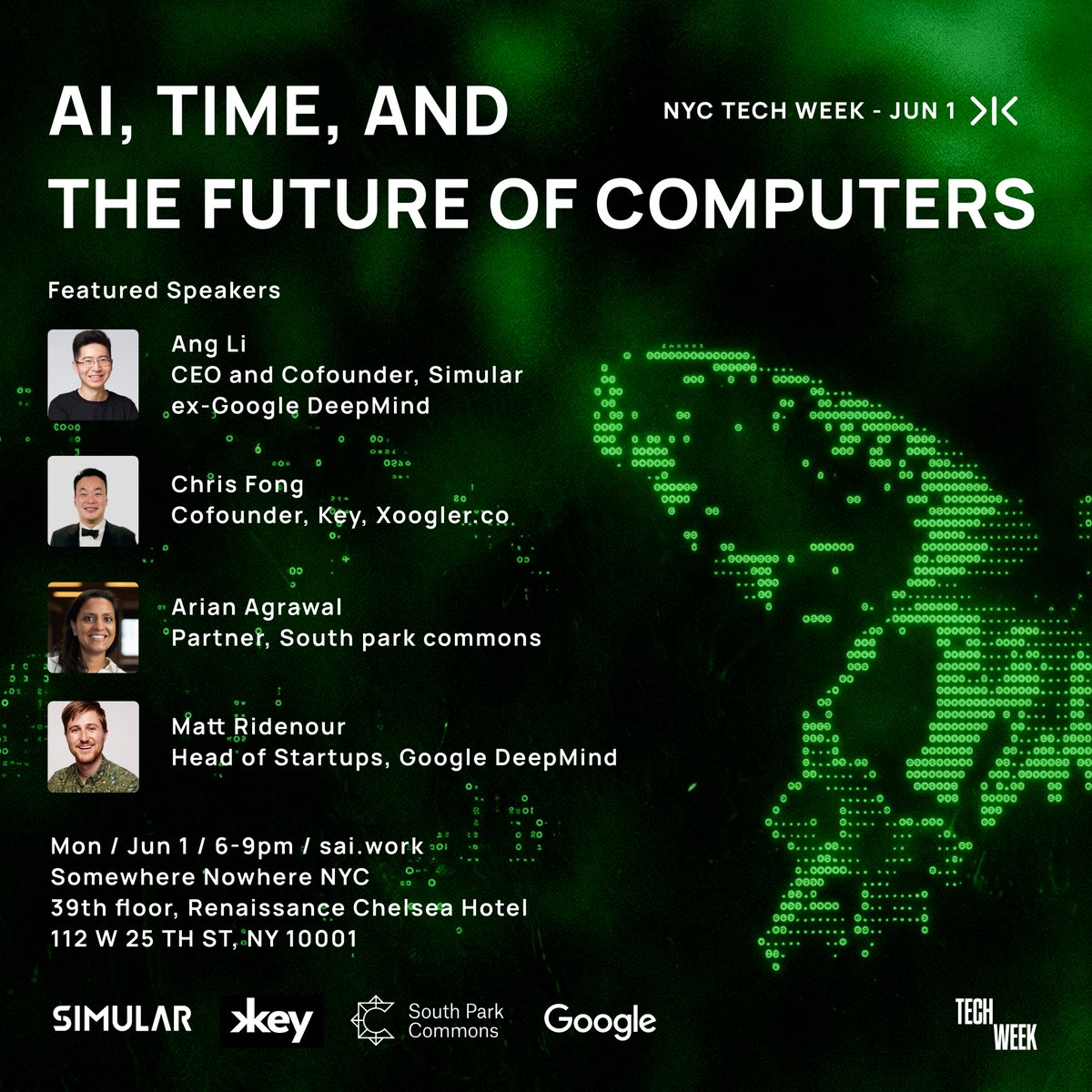
Next Monday I'm hosting one of my favorite kinds of conversations in NYC: what happens to computer work when computers start doing the work themselves.
We're calling it 𝐀𝐈, 𝐓𝐢𝐦𝐞, 𝐚𝐧𝐝 𝐭𝐡𝐞 𝐅𝐮𝐭𝐮𝐫𝐞 𝐨𝐟 𝐂𝐨𝐦𝐩𝐮𝐭𝐞𝐫𝐬, our flagship NYC Tech Week event.
I'll kick things off with live demos of what @sai_borg can do today. Then I'll join the panel with three people I deeply respect:
• @ChristopherFong Chris Fong, Cofounder of Key and https://t.co/aAq88cLbQP
• @AgrawalArian Arian Agrawal, Partner at @southpkcommons
• @matthewridenour Matt Ridenour, Head of Startups at @GoogleDeepMind
We'll dig into the questions I've been sitting with at @SimularAI: if agents can use any app, what does software look like in five years? What gets cheaper, what gets scarcer, and where do the next great companies get built?
📅 Monday, June 1, 6 to 9 PM
📍 Somewhere Nowhere NYC, 39th floor, Renaissance Chelsea Hotel, 112 W 25th St
If you're a founder, builder, researcher, or just curious about where this all goes, come hang out. I'd love to meet you in person.
RSVP at https://t.co/cBod33Mcnx
Big thanks to Key, @southpkcommons , @GoogleStartups, @GoogleDeepMind , and @Techweek_ for partnering with us.
@t_blom (@ycombinator) on building a self-improving company with AI. I watched this video so you don't have to.
5 takeaways 🧵👇
1/ Companies today = Roman legions. Hierarchies exist because humans are the bottleneck for information flow. AI removes the bottleneck. The org chart should follow.
2/ Don't bolt AI onto old workflows. Reimagine the company as recursive loops: Sensors → Policy → Tools → Quality Gate → Learning. Each loop improves itself.
3/ The "aha" isn't AI making humans 20% faster. It's an agent watching other agents fail, writing the fix, opening a PR, merging it, and shipping overnight.
4/ Burn tokens, not headcount. YC's latest batch is hitting Demo Day with ~5x revenue per employee vs. 18 months ago.
5/ Middle management is the most exposed layer. Most of that work is information routing — loops do it better.
Full summary 👇 (made with @sai_borg)
In a recent batch talk, YC General Partner @t_blom broke down how to build a self-improving, AI-native company.
He walks through how to create recursive, self-improving AI loops, and why founders who get this right will run companies that improve while they sleep.
00:00 — Companies Are Roman Legions
00:54 — Copilots Are the Wrong Mental Model
01:55 — Extract the Domain Knowledge
02:24 — The Recursive Self-Improving Loop
04:12 — The Holy Shit Moment at YC
05:50 — Self-Optimizing Product and Support Loops
06:29 — Burn Tokens, Not Headcount
07:23 — Middle Management Is Over
08:05 — Make Everything Legible to AI
09:40 — Regenerating the YC User Manual
11:19 — Software Is Ephemeral, Context Is Valuable
12:18 — Where Humans Still Matter
LinkedIn hates bots. Good thing Sai isn't one.
The only 'bot' that LinkedIn can't stop is the one that doesn't act like one.
Try it today: https://t.co/OYiaUCn8WU