Why is crypto not going up while everything is?
Because a large majority of you cunts spent the last cycle promoting garbage negative sum meme coins to newcomers
Now those people hate crypto and your meme coin is worth zero regardless while some scamming cunt drives a new lambo
@LoganJastremski@alive_ Decentralization ≈ Security ≈ The product works the way I expect
so now tell me which product would you be okay with not working the way you expect?
We identified and contained a compromise affecting our off-chain merkle rewards distribution infrastructure.
Importantly:
• The core protocol remains fully secure and is governed by governance and the 7/14 team multisig.
• All protocol smart contracts are safe and unaffected.
• User funds are not at risk from this incident.
The impacted contract is not part of the core protocol infrastructure and was used solely for rewards distribution with minimal funds in its balance.
Our team is actively investigating the incident. We will share a detailed post-mortem as soon as possible.
We appreciate the community’s patience and support as we work through this.
VCs trying to say that $ETH is overvalued because fees today are low
While saying that their corpo-L1 should be valued high because TAM is huge and is going to continue to increase
Make it make sense
@austincampbell@FigoETH because expectation of future growth (and fees) is large
which chain is actually best suited to host every countries assets?
just look at it like a growth play ffs, it's not an established bank with value based on current revenue
@austincampbell let's assume that L1s should be valued like companies (as you say) and REV is the correct metric:
Why are you valuing L1s off current revenues like a value stock? e.g. an established bank.
Why not value it like a growth stock? e.g. SpaceX, OpenAI, etc.
@CloutedMind History has shown that risk is too high to use anything other than established protocols
Hopefully we can fix this in the next 12-24 months with lower cost of audits and formal verification
The chart unfortunately paints a much different picture than the caption.
That chart depicts a steady decline in onchain activity ($ wise) since 2021, supported by alt metrics like google trends which also show a decline in crypto interest over that same timeframe.
If you look closely, Ethereum’s share of activity was in a down trend until 2025, but since then has stabilized and is now regaining dominance, albeit at snail’s pace.
Hyperliquid fees shouldn’t be conflated with general purpose onchain activity as all of their revenue comes from perps trading.
I bet if we had better insight into bybit, or binance, or bitmex, or any other CEX we’d see that it’s their revenue being cannibalized rather general purposes block space.
Look I get it.
ETH has been underperforming BTC quite a bit.
I don’t like it. You don’t like it. Vitalik doesn’t like it. The EF doesn’t like it.
I think the reason Ethereum is the target of these hit pieces is that it has a large and active community and poking at it sparks engagement.
(The very same chart illustrates an even steeper decline in Solana market share over a shorter timeframe, but makes no mention of that)
I also think VCs and funds are incentivized to poke at Ethereum because they see blockchains as inevitable, and think that there’s enormous upside in capturing capital rotations out of ETH and into their bags.
This gives even more fuel for hit pieces in Eth.
What they miss is that Ethereum development has not been losing market share.
Alt L1s are not a new phenomenon, they’ve been around since before ETH. And even in 2021, there was no shortage of them.
What these VCs and hit pieces don’t understand by spinning narratives is that activity as a whole has been declining.
Painting Eth in a negative light is just a red herring for the fact that most of the industry is struggling.
Bitcoin is seeing supply centralization and mining consolidation in a way that is completely unprecedented in its short history.
Solana engineered a social narrative that lead to massive amounts of extraction from retail to its own and the rest of the industry’s detriment.
Binance/BNB has and continues to engage in some of the most manipulative and corrupt practices in crypto, and these hit pieces actually credit them for their wash-trading sourced revenue!
Tron is widely known to have onchain activity of questionable provenance, and largely serves as a sandbox for Tether.
Hyperliquid is the new shiny thing that’s making holders money so all its sins are washed, but everyone is forgetting that the chain is literally closed source.
I’m not telling you to buy ETH. You can invest how you want.
But ETH’s price action is probably the strongest signal of genuine crypto interest.
Its decline means that interest in crypto more broadly is in decline.
The chart below illustrates that fact more than anything else.
And spinning anti-ETH narratives is just a projection that crypto simply isn’t capturing mind share or capital flows the way it did.
“Ethereum losing to competitors” isn’t the story here.
The story is that capital is largely expensive as result of high glob interest rates, and what liquidity is available is being funnelled into Sam Altman’s and Dario’s quests to build god.
But there are exceptions.
It’s not all doom and gloom.
Prediction markets are an exception. Equity/commodity perps are an exception.
And amazingly, in a massive breath of fresh air, onchain privacy solutions are an exception.
Interestingly, the top prediction market, the top perp-DEX, and almost all of the privacy solutions are either built on Ethereum, built adjacent to Ethereum, or adopt Ethereum tech.
But we don’t see that in any of the headlines do we?
Some of my perspective on where the @ethereumfndn is going.
First of all, this is only my own view. The board is not just me, and I have no extra special powers on the board that the other board members do not. @aerugoettinea is the one executing much of this transition. My input has been largely on technical questions. The board is in the process of expanding, and my own power within the org will continue to decrease, which is honestly what I want.
The 2025 era brought many important improvements to EF and its ability to execute. Many issues were resolved, and EF continues to benefit from its improved efficiency and greater focus on concrete goals to this day. And so with those problems resolved, early this year, the largest remaining hole that I perceived was something different nagging at me: I would regularly spot people saying things like "vitalik says these beautiful things about ethereum needing to be decentralized, and have privacy, and be a sanctuary technology, but why do the EF's actions not reflect that?"
Now, you may have been hearing something different. You may not have been sensing a feeling of crisis at all, and maybe were hearing people saying that finally we were taking execution and BD seriously and the main task for us is to keep going that way and be even better and faster. Then probably there is genuine difference between you and me, in what kinds of criticism I take most seriously, and what kinds of critics through their criticism are most able to make me feel pain.
As an analogy, let's briefly switch over to a different domain.
One belief you can have about Google is that it is a success story, and has brought a lot of good to humanity in organizing the world's information. Another belief you can have about Google is that they had a beautiful idealistic beginning, but at some point the corruption of mainstream corporate attitudes seeped in, and they slowly bit by bit completely abandoned the "don't be evil" slogan.
My belief on Google specifically is probably somewhere between the two. BUT, if you had taken me back in time to ~2008, and offered me a button to press to make Google one or two standard deviations more "dogmatic", eg. give Richard Stallman permanent veto power over some key policies, I would immediately press it.
Why? Because a choice for one company is not a choice for the world, or even one country. Google existed and exists in the context of a technology industry generally drifting away from early idealistic don't-be-evil roots and toward greed for financial gain, totalizing visions of accelerated superintelligence, infiltration by sociopaths, and craven capitulation to (or worse, active participation in) government pressure for ideological control, surveillance and war. And so *one company* doing something different, positioning itself to be what George Bernard Shaw calls the Unreasonable Man, resisting the trend of the times, would have been better for freedom, balance of power and stability of society as a whole, than *all* large companies bending to dominant trends. This is a part of my version of pluralism.
This line of thinking is not just mine, but I also is not too far off from what Aya and others had in mind with the Mandate.
Now how does this all get to the role of the EF?
EF is not a "center of Ethereum", rather EF is "one node, with a defined purpose, alongside other nodes". We've always said that the EF should be the latter, but many in the Ethereum ecosystem (and even within the EF) wanted us to be the former. Now, we are taking action to ensure that we will be the latter.
This is particularly important because EF is a limited organization, with limited resources and limited organizational capacity. The EF has only ~0.16% of all ETH (less than many other individual ETH holders), whereas among other blockchains it's common for "the central foundation" to have 10-50%. Fiscally, the EF was originally designed to fulfill a limited work scope defined in the token sale docs and other pre-launch materials (building the chain software; getting through Frontier, Homestead, Metropolis, Serenity), which was fully completed in 2022; it was not designed to be an eternal steward.
And so today, the EF is choosing to use its remaining resources to pursue longevity over breadth (yes, this means we sell less ETH). The EF focuses *specifically* on those activities critical to the success of ethereum as a censorship/capture-resistant, open, private and secure system, that would not happen otherwise. This means making hard choices, and in some cases even activities that we highly approve of and people that we highly respect becoming outside of the EF. People of great technical talent, public respect and even alignment with the mission and CROPS being outside of the EF is in fact necessary if we want important tasks to be able to attract outside capital. This also means the EF taking opinionated stands culturally.
This is all intended in cooperation with all other parts of ethereum. We recognize that many other parts of the ethereum world highly respect CROPS and related values. But highly respecting is not the same as choosing to specialize and totally dedicate to a domain (Compare in a different domain: I think reducing animal cruelty is important, and I like vegan food, but am not full unconditional vegan myself)
EF is still in a transition period, and we expect its new long-term form to stabilize over the next few months. What are the guiding principles of this new form? Again, I am only one person, but I can give my answer from a technical perspective (there are also critical non-technical aspects).
At the core, *Ethereum must be impressive*. We are living in an age of highly intelligent AI and all kinds of other technological acceleration. "Status quo EVM, with a hard fork or two a year to optimize for short-term needs of users" is not interesting.
To some, "impressive" means: 250ms latency and 1M TPS. I think Ethereum trying to go that route is a mistake. Being as fast and as scalable as possible, and only a small epsilon more decentralized than the others, is a route to mediocrity, and if we try it we will lose.
I think Ethereum should scale. But I think Ethereum should strive the hardest to be deeply impressive in a different dimension: the CROPS dimension. This means things like:
* Provably bug-free Ethereum. This is a goal that all cybersecurity researchers would have thought is absurd and impossible, up until roughly 6 months ago. Now, it's on the cusp of being possible, thanks to AI-assisted formal verification. So we should be frontrunners in doing this.
* Available chain consensus. Ethereum is, and with lean consensus will cotninue to be, the ONLY chain that has both (i) traditional-BFT style properties that it's safe under asynchrony up to a high level of fault tolerance, and (ii) the bitcoin PoW-style property that under synchrony it's safe up to 49% attackers. As far as I can tell, literally no other chain has this or is planning for it; bitcoin goes for (ii) only and most other chains go for (i) only. Some will remember I fought hard for this, Unreasonably insisting that it is not OK for ethereum to rely on social consensus and hard forks to rescue ethereum from 34% of nodes going offline. It's OK for chains like hyperledger, bnb, solana, tempo, etc. It's not OK for bitcoin or ethereum or eg. zcash.
* Intermediary minimization. The fact that smart contract wallets, protocols like railgun, etc have to send transactions through intermediaries to get included onchain is honestly embarrassing, and it's a constant point of fragility. Hence the work on FOCIL and EIP-8141 (and 7701 and years of work before) to make transaction sending intermediary-minimized with public mempool and strong inclusion properties, in a truly general-purpose way, that covers not just eg. secp256r1, but also privacy protocols and much more. Kohaku is pushing intermediary minimization at the user layer, pulling Ethereum away from the dystopian status quo world where our wallets don't even verify the chain, send our private data out to a dozen third-party servers, and toward a brighter CROPS future.
Some of these goals are Unreasonable - maybe Ethereum would be "fine" getting only 50% of the way - what if we depend on intermediaries, but make it easy to switch? But going 50% of the way would not make Ethereum Deeply Impressive in the CROPS way. So we push for 100%.
Fortunately all these goals are compatible with high TPS, this is a major focus of research (esp. on scaling the state). Well-designed L2s can also help, especially L2s optimized for specific applications (eg. high-volume trading, privacy...). These goals are even compatible with significantly lower slot times, thanks to Raul's work on erasure-coded P2P, and many other optimizations.
The most high-value "product" of the ethereum blockchain, financially speaking, is ETH the asset. Ethereum secures $250 billion of ETH. The types of properties of Ethereum that I mentioned above are very good for ETH the asset. Nearly 90% of my net worth is in ETH, and most of the remainder is ~$40m of onchain fiat of which every dollar has already been allocated for some open-source biotech or software or hardware initiative. That said, there are aspects of supporting ETH the asset - *necessary* aspects even - that are outside the scope of the EF. This is where we need other heroes (some of whom hold more ETH than the EF does) to step in and help. EF has been recently thinking more about how it will relate to other such organizations, and give them needed initial support.
EF will be a smaller ship than in previous years, a more opinionated one - in some cases more opinionated in ways that might be difficult to comprehend - but a longer-lasting one, and one suited to making sure that ethereum brings something meaningful to the world. We are grateful to all those inside and outside the EF who are helping to make this happen.
ethereum isn't a fucking company and you don't "fix" it by building a $1b command center with a board & a mandate to pump eth. the moment you route staking or fee revenue into a central org "aligned with price", you've built a capture machine and called it accountability. that's _not_ alignment, that's governance gravity - power concentrates, others defer, and it slowly becomes the system's real control layer. cypherpunk systems don't win by optimising some retarded balance sheet, they win by resisting control, staying permissionless, and never creating a single point of pressure, bribery, or capture. period.
ethereum got flooded by fucking mercenaries pretending to be revolutionaries. everyone talks about decentralisation until there's money on the table, then suddenly compliance, surveillance, business opportunities, and extraction become pragmatic. most of this ecosystem does not give a shit about freedom. they care about pumps, fees, and turning users into fucking exit liquidity. cypherpunk was never about making founders rich. it was about making tyranny obsolete. the grifters will cash out. the cowards will comply. cypherpunks will outlast all of them. principles compound harder than capital. you don't have to believe me. you won't. because you'll be gone while i'm still here.
VCs threw money into centralized systems from 2022-2025 because they’re faster and have better UX.
But they thought that because they misunderstood the decentralization thesis.
The arbitrum DAO legal issue is helping people finally understand why decentralization is better than centralized systems.
Will the right people end up eventually getting those “frozen” funds? Almost certainly. There isn’t any actual risk of those funds going to some long-past DPRK victims.
But will the legal system and courts slow down that process? Absolutely.
Does KYC slow down the UX of an app? Absolutely.
Does checking every tx against OFAC slow down a relay? Absolutely.
Does budging for legal expenses increase the costs passed on to users? Absolutely.
Does having all of the users’ funds vulnerable to attack via a single compromised key (centralized) pose more risk than a fully decentralized system? Absolutely.
Decentralized systems are faster, cheaper, safer, and offer better UX than centralized systems because they can bypass the regulatory and legal speed bumps that make companies slower, more expensive, riskier, and with a worse UX.
The crypto VC narrative of “but users don’t care about decentralization” had a very short lived truth. In reality, most crypto VCs have just never worked in TradFi (or similarly regulated industries) and therefore did not understand just how much of an advantage a fully decentralized system would have… but their naivety wasn’t punished because regulators and lawyers didn’t go after the centralized crypto systems because of how new they were.
That’s changing.
Unfortunately, that “centralized > decentralized” thesis from the first half of the 2020s led to many solid decentralized products not getting funded, and to many centralized products getting funded. As an industry, we’re way more centralized than we should be due to the relative inexperience that crypto VCs have with regulatory friction.
Most users don’t care about decentralization as a concept. But they care about not getting hacked. They care about not having to KYC every six months. They care about not having higher fees. They care about uptime.
Decentralization isn’t better than centralized systems for some abstract reason. As our industry continues to mature, the advantages will become more apparent to everyone. We should start to see more decentralized products getting funded as the capital allocators in crypto gain more real world experience with the friction of dealing with regulations. That’s a good thing.
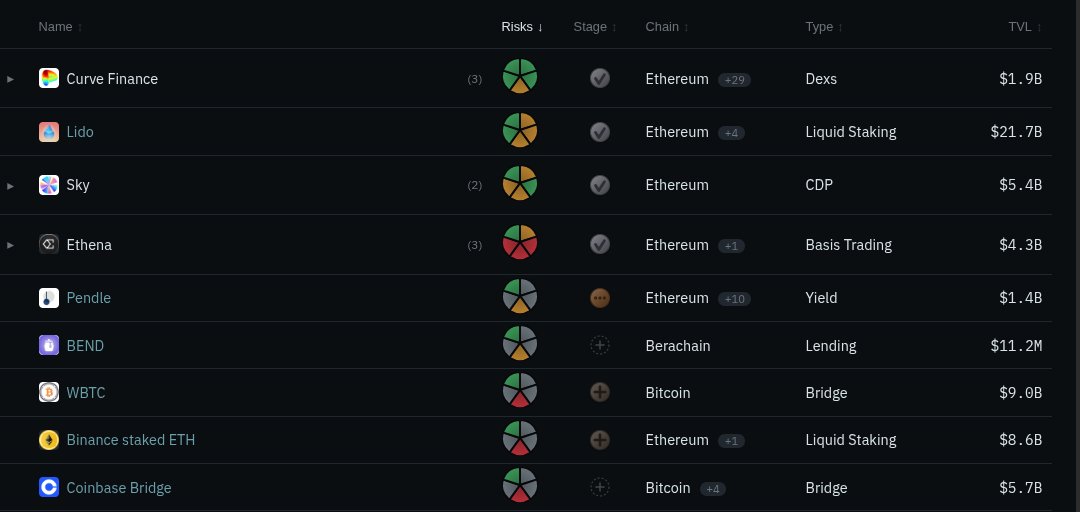
A new DeFi risk website appears: https://t.co/Pi0UVUyLbK
Currently @CurveFinance has the top score👀
Anyone can copy prompts and submit risk reports for any protocol, very cool
BIG DeFi, small DeFi.
Maintained, abandoned.
Growing, stagnant.
Raising, folding.
Resilient, fragile.
Token go up, down.
Most important factor: does it pass the walkaway test or not?
I've been working on a L2BEAT for DeFi to track that, it's live: https://t.co/xIBR8fsHx0