Exited to share our most resent research paper! Thanks to Shengrui Feng, @decarvalho_lab and the co-authors for the great collaboration.
https://t.co/CYIWnhCOkx
Sharing a paper below in @CellGenomics that took us literally 10 years+ (!) to write on the topics of 👇👇👇
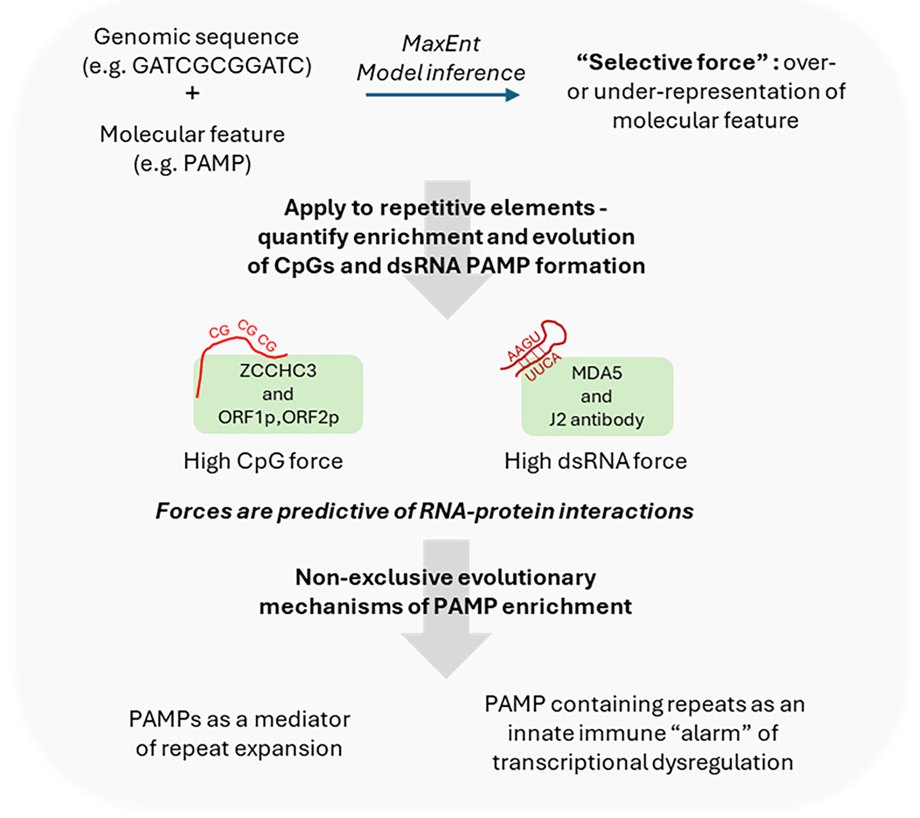
* How, exactly, do we quantify viral mimicry - the expression of molecular features usually associated with nonself viruses by our own "self" cells?
* Why do we see mimicry in so many disease settings such as cancer?
* How broad a phenomena is this?
* How do we think about selection in this evolutionary context?
Trying to answer these questions required a theoretical framework at the intersection of physics, machine learning and evolutionary dynamics that our lab most enjoys - led by @petr_sulc, long-time collaborators at Ecole normale supérieure, and our lab at @MSKCancerCenter (Alexander Solovyov/ @stephen_martis / @sunsiyu1). It also required an amazing set of deep collaborations: @decarvalho_lab (whose work motivated a lot of our thinking) and John Lacava, who went all in for this work with their great labs and colleagues.
I would usually write a summary but I will defer to the text this time and just express thanks for the interactions and experiences this work generated. Its been a gateway into a lot of great science that we are still unpacking 👇 👇👇
https://t.co/Kq7ug8IlZr
Excited to have this paper out today!
Repeats mimic pathogen-associated patterns across a vast evolutionary landscape."
It was a fun and productive collaboration with Benjamin Greenbaum, John LaCava, Simona Cocco, Petr Šulc and many others! https://t.co/GPTxfoW6mh
Scientists at UHN's @pmcancercentre have found that certain repetitive elements in DNA contribute to cancer initiation by evading immune defences.🧬
These findings could lead to more effective treatment and interception strategies.
Read more: https://t.co/hPYqXpwRNJ
New Links: Cancer and Immune Evasion🧬
Recent study found that cancer cells without the tumour suppressor protein p53 become more resistant to the body's immune response. A study led by @decarvalho_lab at @UHN’s @pmcancercentre.
https://t.co/COkgq1UuxM; https://t.co/nLSoS26Agn
Scientists @PMResearch_UHN have uncovered how cancer can evade immune defenses after losing a key tumour-suppressing gene. These findings implicate repetitive elements in DNA and may unlock new targets for cancer interception.
Read more ➡️ https://t.co/zrjThGpQBz
Thank you to @decarvalho_lab and @SajidMarhon for their leadership on this study, and all team members who made this study possible! This study represents an exciting new direction towards understanding how dsRNAs promote tumorigenesis. We're excited to expand further!
Cancer cells in viral disguise🦠
In certain childhood cancers affecting the brain and spinal cord, a novel treatment can amplify virus-like features in tumour cells, triggering immune responses to control the cancer. Discovery by @decarvalho_lab@UHN.
https://t.co/o30Y2oYnlR
Our latest paper is out: "Inhibiting EZH2 targets atypical teratoid rhabdoid tumor by triggering viral mimicry via both RNA and DNA sensing pathways" https://t.co/vFXKDZk4GZ
In vivo CRISPR screen of Epigenetic regulators identity therapeutic targets that rely on tumor microenvironment - our recent work is out at Nature Genetics https://t.co/ccRdwdkS8R
Great teamwork @SoundTsao@DanielSchramek@decarvalho_lab@brooks_lab@kuraoncology and many others
Our latest manuscript of our viral mimicry work is out: ‘Retroelement decay by the exonuclease XRN1 is a viral mimicry dependency in cancer’ https://t.co/RfuzwjwyQj
If you have an interest in applying cancer epigenetics approaches to explore how repetitive elements promote ovarian cancer initiation, join our team as a postdoctoral fellow at the @MDAndersonNews Cancer Center:
https://t.co/cWpvoi0nRj
Please share widely. Thank you!