After years of insisting that they're doing everything they can to protect kids online, Meta now unrolling a BUNCH of other things they could have done from the very beginning but they're only doing now bc of a legal settlement
https://t.co/W9JikwihsW
For the wordmark, we just wanted to make it feel a little bit less cutesy and give it some harder edges, especially in the Y.
When @gavinpotenza showed us his first pass at this wordmark we noticed that when we tracked it in realllllllly tight that the letters looked like they were leading into each other with an invisible connection. And we were like hold on, what if we intentionally customized them to actually flow into each other.
Almost like how Calendly is the invisible connector for people—the wordmark can payoff that invisibility as well.
It’s not something you’d notice at first glance but it's a nice little story once you see it.
Shout out to @dayandaniello for finessing this to death and making it feel nice.
When the team started designing out the brand we were super attracted to this idea of patters. They kinda abstractly represented the idea of meetings on a calendar. And like each person you meet—each pattern could be different and dynamic.
@gavinpotenza vibecoded a dope generator and we hit the ground running. Perfect background element to make things feel like they have a bit more motion or like you're zooming into one vignette of someones day.
If you're a female…
…with high cholesterol
…in your 30s
…you may be misdiagnosed
In one study, ~6% of women were labeled with high cholesterol… when they were tested again later in their cycle, their results came back ‘normal’.
Your cholesterol can swing by 19% depending on the day you get your blood drawn.
+ First half of cycle = higher.
+ Second half of cycle = lower.
Your cholesterol isn't one number. It moves monthly with your hormones. In the first half of your cycle, your cholesterol reads high. After ovulation, it falls, hitting its lowest right before your period starts.
When I found this out, I was shocked.
Why does no one know this?
The answer took me down a rabbit hole.
When your blood lab results come back, there's a "normal range" printed next to each number. That range is created by measuring a big group of people, and calling the middle 'normal.'
But for decades of blood draws, cycle days weren’t recorded… so their cholesterol variation was invisible.
Then, it got worse in 1977 when the FDA excluded women of childbearing age from early drug trials for 16 years.
So it wasn’t until 2010 when the first rigorous, large-scale proof came back that cholesterol changes with the cycle. A female health study looked at blood biomarkers and compared them with cycle data.
It took 60 years to figure that out.
And yet, it's 2026, another 16 years later, and the reference ranges are still outdated.
So… why hasn't this been fixed?
Heres 7 reasons why...
#1.
Most doctors don't know. It is not in their training or guidelines.
#2.
The lab companies haven't built for it. There's nothing stopping Quest or LabCorp from adding this. They set their own systems… they just haven't prioritized it. The individual who takes your blood has nowhere to note what cycle day you’re on.
#3.
Self-reported Cycle days. Most women were never taught to track their cycles. The education is thin, and full of myths (most women don’t ovulate on day 14). Even a woman who tracks carefully may have imperfect information. For example, ovulation shifts month to month, and sometimes it’s skipped.
#4.
Cycle phase confirmation. Cycle phase can be confirmed with a blood or urine hormone measurement alongside the draw. It's just that nobody has added this step.
#5.
The starter data already exists. The 2010 study measured hormones and cholesterol across hundreds of women's cycles. That's enough to build a first version of phase-specific ranges. Validating it at scale would take more data, but collecting it is now trivially cheap.
#6.
We repeat the test, but still ignore the cycle. Cholesterol is often checked more than once, which can help smooth out biological variation. But those repeat tests usually aren't timed to the menstrual cycle.
#7.
Ranges only change when someone decides to change them. There's no central body that sets reference ranges… each lab company adopts and verifies its own. When pediatric ranges turned out to be wrong, a research group rebuilt them from thousands of healthy kids and labs adopted the results. The same thing could be done here. It’s just that no one has started.
The data to fix this is completely collectible.
A third of American women already track their cycles on their phones.…. and the biobanks have millions of cholesterol results. Nobody has put the two halves together.
Insanely… cholesterol is not the only marker that varies across your cycle. In one study, about 50% of the molecules measured in women’s blood and urine moved with the cycle. And yet… it's still almost entirely unknown.
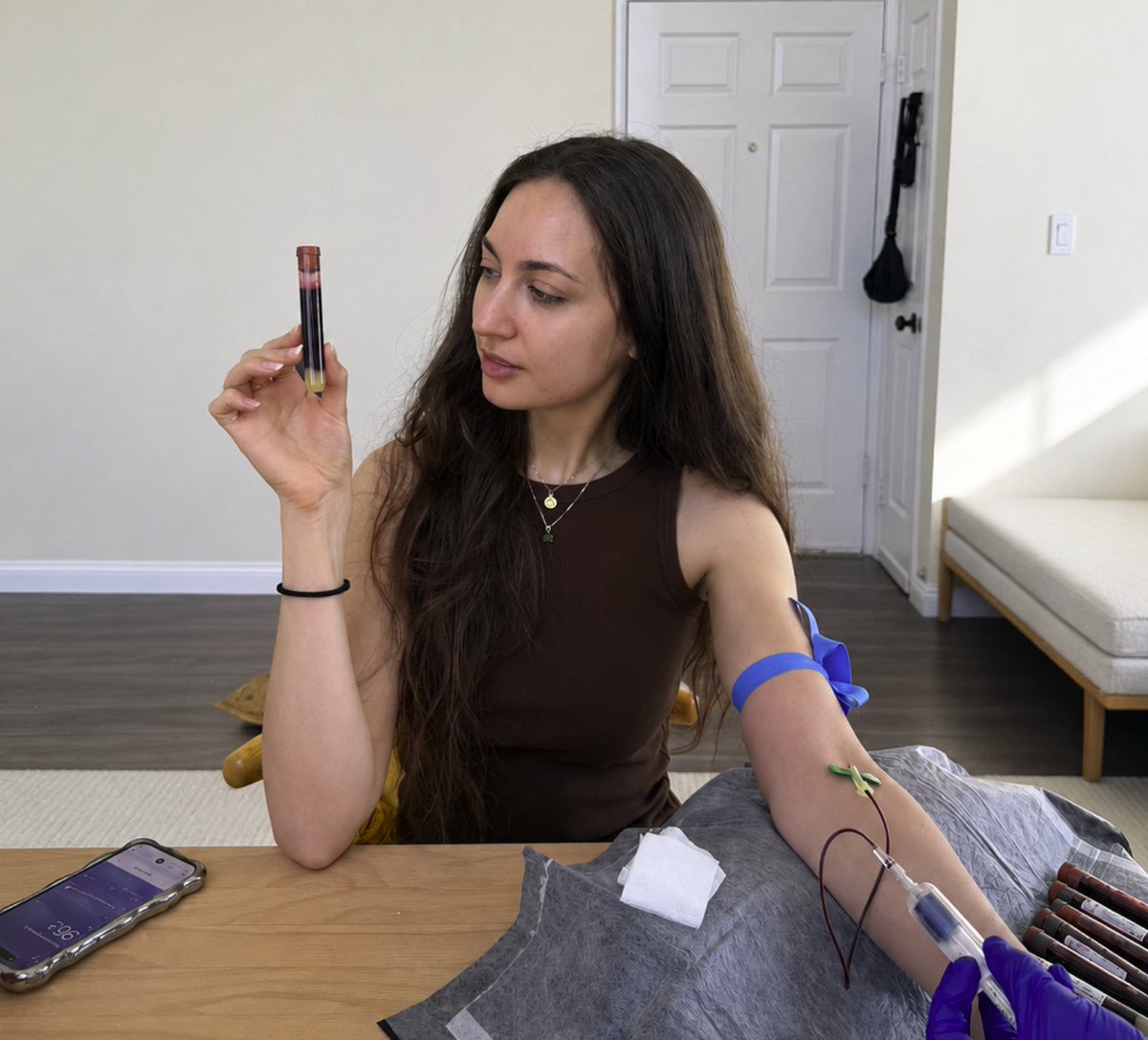
So I am running my own experiment.
I'm collecting 14 million data points on my menstrual cycle… my brain, blood, skin, saliva, grip strength, etc. We’re spending $2.6 million on this. And every second of my day is monitored and accounted for.
This will be the most quantified menstrual cycle ever.
We’ll post all results here (good and bad, wins and failures) with you for free.... sharing all the practical insights.
My hope is that we can put words and numbers to the female experience.
probably the biggest misconception today is that everything will be chat
chat is bad for discovery, chat is bad for repeating usecases, bad for multiplayer
people love GUI. people love being passive. people love to scroll and tap-tap-tap vs. type. voice only works when you're by yourself. the list goes on.
build a Mac, not MS-DOS!
Another attempt at making a boring industry fun, Why does all the expense tracker app look like spreadsheets.
Chart and tables
Don’t know when I will launch this, or even launch it but good time spent
While most people are rightfully dunking on the design language here, it is mostly a referendum on taste and current trends in interface design. I don't disagree it's bad, but what I think designers should really be having a visceral reaction to is that this new Material Design language is the product of metrics-driven brain-rot, where good design is not justified through metric validation; but instead the inverse: growth-hack culture pushes everything to become louder, dumber, and more attention-seeking simply because those qualities are easier to measure, and the end result is a lack of coherence, wasted space, and having zero faith in your users.
It's a slippery slope and when we talk about the role of the designer is now to decide where to draw the line, and when to say no to things, this is exactly what we mean.