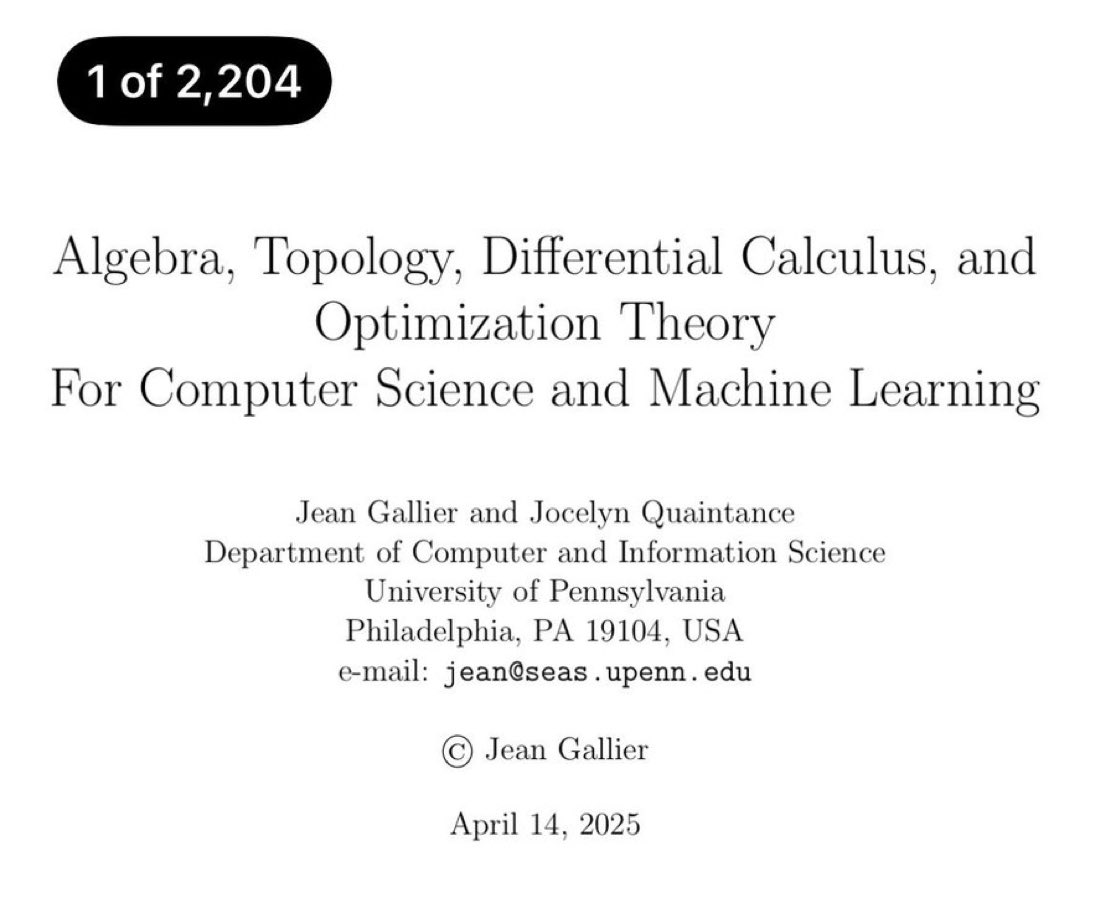
Updated 2204-page PDF Mathematics ebook:
"Algebra, Topology, Differential Calculus, and Optimization Theory For Computer Science and Machine Learning"
Find it here: https://t.co/HZc0LRoD7R
FREE Math Book. 1000 pages.
"Abstract Algebra: Examples and Applications" by
Hill, Thron et. al. "Designed to make abstract algebra as down-to-earth as possible.
⭕️Before getting into deep theoretical stuff, we first take a look at algebraic systems beyond the real numbers that are widely used in practical applications of mathematics. These include the complex numbers, integers mod n, polynomials, symmetries, and permutations. We then use these examples to motivate and illustrate the beautifully general ideas of the theory of groups, rings, and fields. Along the way, we give applications to signal processing, cryptography and coding theory, as well as making connections with other branches of mathematics such as geometry and number theory."
⭕️ "The textbook is provided in three different formats: hyperlinked online version, pdf, and spiral bound copy."
⭕️"Many students start out liking math. Some like it well enough that they even want to teach it. However, when they reach advanced math classes (such as abstract algebra), they become bewildered and frustrated. Their textbooks talk about strange mathematical thingamabobs they’ve never heard of, which have nonsensical properties that come from who knows where. In lectures, the professor/oracle makes pronouncements (a.k.a “theorems”) and utters long incantations (a.k.a “proofs”), but it’s hard to see the point of either."
⭕️"If the above paragraph describes you, then this book is meant for you! ... There’s a good reason why higher math classes are bewildering for most students. I believe that we math instructors tend to take too much for granted."
Justin Hill, Chris Thron (eds), Thomas Judson, Dave Witte Morris, Joy Morris, A. J. Hildebrand (sources), Christy Douglass, Jennifer Lazarus, Mark Leech, David Weathers, Moses Marmolejo, Adam McDonald, Katrina Smith, Johnny Watts, Holly Webb(chapter authors), Semi Harrison, Khoi Tran and Rachel McCoy (contributors)
Link: https://t.co/s9f3Th0T7E
There are 11 free Stanford lecture series on YouTube that universities charge thousands to teach. Here they are.
Bookmark this list. Every course below is taught by Stanford faculty.
1. CS229: Machine Learning
Taught by Andrew Ng. The most cited ML course in history.
Watch → https://t.co/p2NrhAiKCi
2. CS230: Deep Learning
Andrew Ng again. Neural networks from zero to trained model.
Watch → https://t.co/eIfiFYkeP2
3. CS231n: Deep Learning for Computer Vision
Taught by Fei-Fei Li and Andrej Karpathy. The lectures that built modern computer vision.
Watch → https://t.co/Kse924Cyn0
4. CS224N: NLP with Deep Learning
Christopher Manning. The NLP course Google, Anthropic, and OpenAI engineers recommend first.
Watch → https://t.co/Cn804DuG8T
5. CS224W: Machine Learning with Graphs
Jure Leskovec. The graph neural net curriculum used at Pinterest, Spotify, and Meta.
Watch → https://t.co/nrlaKitdwR
6. CS224U: Natural Language Understanding
Christopher Potts. The Stanford NLU course that pairs with CS224N.
Watch → https://t.co/xfoBMlkrJz
7. CS234: Reinforcement Learning
Emma Brunskill. The course every DeepMind researcher references for RL fundamentals.
Watch → https://t.co/1cr5oteoSz
8. CS330: Deep Multi-Task and Meta Learning
Chelsea Finn. The frontier curriculum for AI that learns to learn.
Watch → https://t.co/DTDO5hhZML
9. CS336: Language Modeling from Scratch
Percy Liang and Tatsunori Hashimoto. Build your own GPT, end to end.
Watch → https://t.co/2TjteUDzsa
10. CS25: Transformers United
Guest lectures from Geoffrey Hinton, Andrej Karpathy, Demis Hassabis, and OpenAI researchers.
Watch → https://t.co/Ep1urgzeqC
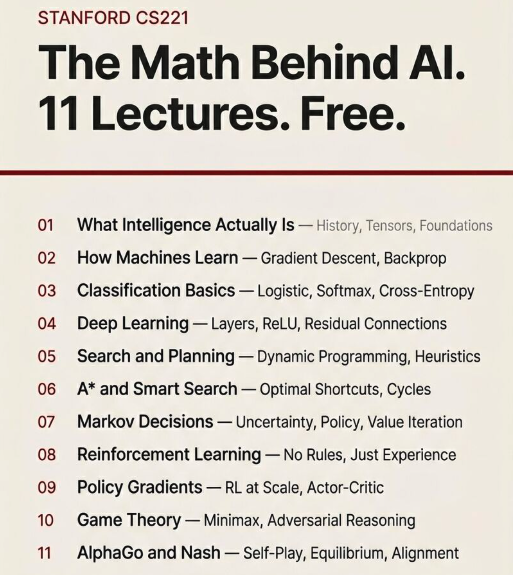
11. CS221: AI Principles and Techniques
Percy Liang and Dorsa Sadigh. Search, logic, probability, and ML together.
Watch → https://t.co/7hRZUgOt8Z
Statistics Every Programmer Needs — Practical Python implementations and quantitative methods: https://t.co/4d3s4zwKzo via @ManningBooks
🌟🌟🌟🌟🌟
This hands-on 448-page guide teaches you how to:
• Apply foundational and advanced statistical techniques
• Build predictive models and simulations
• Optimize decisions under constraints
• Interpret and validate results with statistical rigor
• Implement quantitative methods using Python
"Graph Theory" by Reinhard Diestel is one of the most complete introductions to modern graph theory. It begins with the fundamentals of graphs, paths, trees, and connectivity, and progressively develops more advanced topics including planar graphs, colouring, flows, Ramsey theory, random graphs, and graph minors.
The writing is rigorous and mathematically precise, yet surprisingly clear and enjoyable to read. Although the book is written from a pure mathematics perspective, many of the ideas it develops also underpin important areas of computer science, from database systems and network analysis to combinatorial optimisation.
I think it is an excellent resource for anyone who wants to build a solid understanding of graph theory and keep a reliable reference close at hand.
❗️UPDATE: As @naivebayesian kindly pointed out, please refer to the author’s website.
A free preview of the book is available here: https://t.co/P5DWtuyYDY
For the standard edition, the book should be purchased through the official page:
https://t.co/ViOr3Tr7Vw
This is NOT a sponsored post, just a correction that I believe is fair and important in order to properly recognise the author’s work.
I originally found the PDF link through Google and, I admit, I did not verify the source carefully enough. I will also try to contact the website hosting the PDF linked in my original post to ask whether its publication there was intentional or an error.
In the meantime, please refer only to the official links above and give the proper credit and recognition to the author. Thank you.
Andrej Karpathy in 1 hour reveal how he actually works with AI: "i just tell the machine what i want, in plain words"
no prompt frameworks. no 40-line system prompts. no magic.
by 2026 the engineer who dismisses LLMs loses to the junior who configured one right
1 hour. free. the most honest look at how the best in the world actually uses AI
bookmark & watch
FREE Math book. 700 pages.
"Everything You Always Wanted To Know About Mathematics: A Guided Journey into the World of Abstract Mathematics...", by Sullivan, with Mackey. Polynomnomnomials, Gauss in the House, The Full Monty Hall, Dominoes and Tilings, The Tower of Hanoi, Combinatorics, Pigeonhole Principle, Jections, Cardinality, Proofs, Set Operations, etc.
Link: Instructor John Mackey at CMU, Welcome Page, https://t.co/4om1T8wpdT
One professor at the University of Bonn quietly put his entire robotics curriculum on YouTube: SLAM. Sensor fusion. State estimation. Probabilistic robotics. Self-driving cars. Motion planning. Photogrammetry.
Cyrill Stachniss has been uploading full university lectures for years!
Each topic is a complete playlist; the kind of material that normally costs a semester of tuition.
He's one of the most cited researchers in mobile robotics and mapping. His students go on to build the navigation stacks powering real autonomous systems.
If you're serious about understanding how robots know where they are... this is the place to start.
Free. On YouTube.
📌 [https://t.co/INqnqzEBD7]
——
Weekly robotics and AI insights.
Subscribe free: https://t.co/9Nm01QUcw3
10 GitHub repos that distill the world's smartest people into AI you can run on your laptop.
In 2026, the greatest minds of our time became installable. Bookmark this list — you will not see anything stranger this year.
1. andrej-karpathy-skills
A single markdown file distilling Andrej Karpathy's wisdom on AI coding. 109K+ stars. The most starred single-file repo in GitHub history.
Repo → https://t.co/unItpr073y
2. MemPalace
Milla Jovovich, the Resident Evil actress, co-built this AI memory system using Claude Code. Near-perfect score on the LongMemEval benchmark.
Repo → https://t.co/o8xKSTz60D
3. autoresearch
Karpathy's own research automation framework. 23K stars in three days. The closest thing to having Karpathy as your research partner.
Repo → https://t.co/YURNnYJJN3
4. awesome-claude-code
The canonical playbook for Claude Code, the AI coding tool used inside FAANG, OpenAI, and Anthropic.
Repo → https://t.co/VhNjDoz7YM
5. SuperClaude Framework
The complete Claude Code methodology distilled into a deployable framework. Personas, commands, prompts, workflows.
Repo → https://t.co/vNnvQ9mq1e
6. AI-Agents-for-Beginners
Microsoft's free 12-lesson course on building AI agents. Real code, real exercises, real production patterns.
Repo → https://t.co/7dNsDw6bTj
7. awesome-llm-apps
106K+ stars. The most comprehensive collection of working AI applications on GitHub.
Repo → https://t.co/oXrD5A8K6a
8. mattpocock/skills
TypeScript wizard Matt Pocock's daily coding workflow, open-sourced. Planning, TDD, architecture, git guardrails.
Repo → https://t.co/Stzy92oYK4
9. hermes-agent
The self-evolving AI agent. Extracts skills from every conversation and gets smarter the more you use it.
Repo → https://t.co/OMgRfKAts4
10. qlib
Microsoft's full quant investment platform. The brain of a hedge fund analyst, free to clone.
Repo → https://t.co/aw74Z8aVTq
Here's the wildest part:
A Hollywood actress, a Stanford AI legend, a TypeScript world-class teacher, and Microsoft's research division all just open-sourced their thinking.
You don't need to be Karpathy. You don't need to be Milla Jovovich. You don't need a degree, a PhD, or a team.
You need a laptop, a weekend, and these 10 repos.
The greatest minds of our time are now installable.
Most people will scroll past this. The ones who don't will compound.
Save this before you forget.
100% free. 100% open source.
INSTEAD OF WATCHING NETFLIX TONIGHT.
Spend 1 hour with this.
Claude AI FULL COURSE that teaches you how to BUILD and AUTOMATE anything.
The people who watch this tonight will wake up tomorrow with a new skill.
Watch it and Bookmark it now.
MIT published 12 AI textbooks written by the top researchers who built the field.
These are not just books these are primary source material behind the world top AI ChatGPT, Claude, Gemini... (save this!)
1. Foundations of Machine Learning https://t.co/cyIHr6qm2z
2. Understanding Deep Learning https://t.co/5XUo4bPHRu
3. Machine Learning Systems https://t.co/l5bCCyXSV0
4. Algorithms for Decision Making https://t.co/1ZNU1XvSYK
5. Deep Learning https://t.co/JAo52d4JTI
6. Reinforcement Learning: An Introduction https://t.co/0XqopIY5CR
7. Distributional Reinforcement Learning https://t.co/z7bqEUK2ky
8. Multi-Agent Reinforcement Learning https://t.co/KgOtpxXAUc
9. Algorithms for Decision Making (Long Game) https://t.co/F6J9Za0igV
10. Fairness and Machine Learning https://t.co/r9egFAY6tL
11. Probabilistic Machine Learning: An Introduction https://t.co/xmmj7Ev7Of
12. Probabilistic Machine Learning: Advanced Topics https://t.co/6lUCb9blt8
I hope you found this helpful,
For more such useful resources you can follow me @ZabihullahAtal
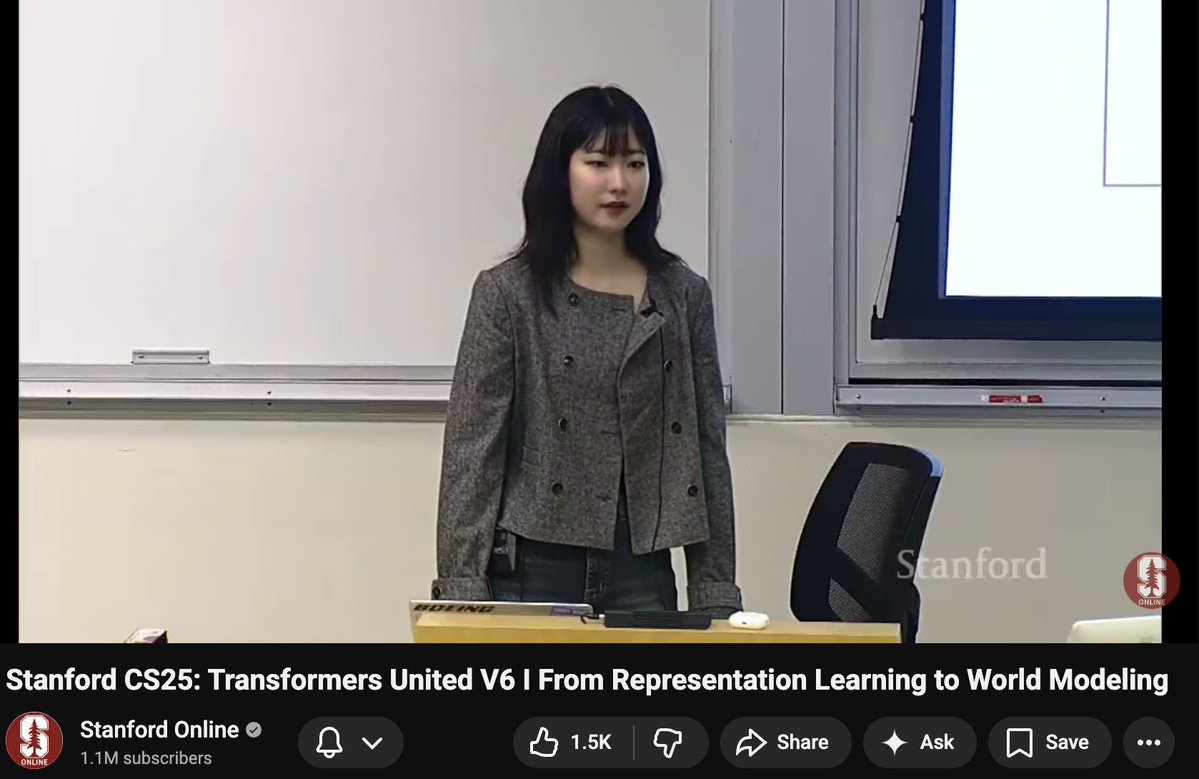
Stanford's latest seminar is a deep dive into the evolution of world modeling in AI.
Focuses on the shift in the world model from traditional reconstruction methods toward latent space prediction.
Covers topics like:
- Introduction to JEPA & World Models
- Causal JEPA
- LOWER Model
- Practical Applications & Planning
- Future Outlook
Stanford just published their autumn 2025 AI: Principles and Techniques course on YouTube. It's ~20 hours of lectures that you can watch right now or skip if you find them too boring.
https://t.co/1U51OU7nZT
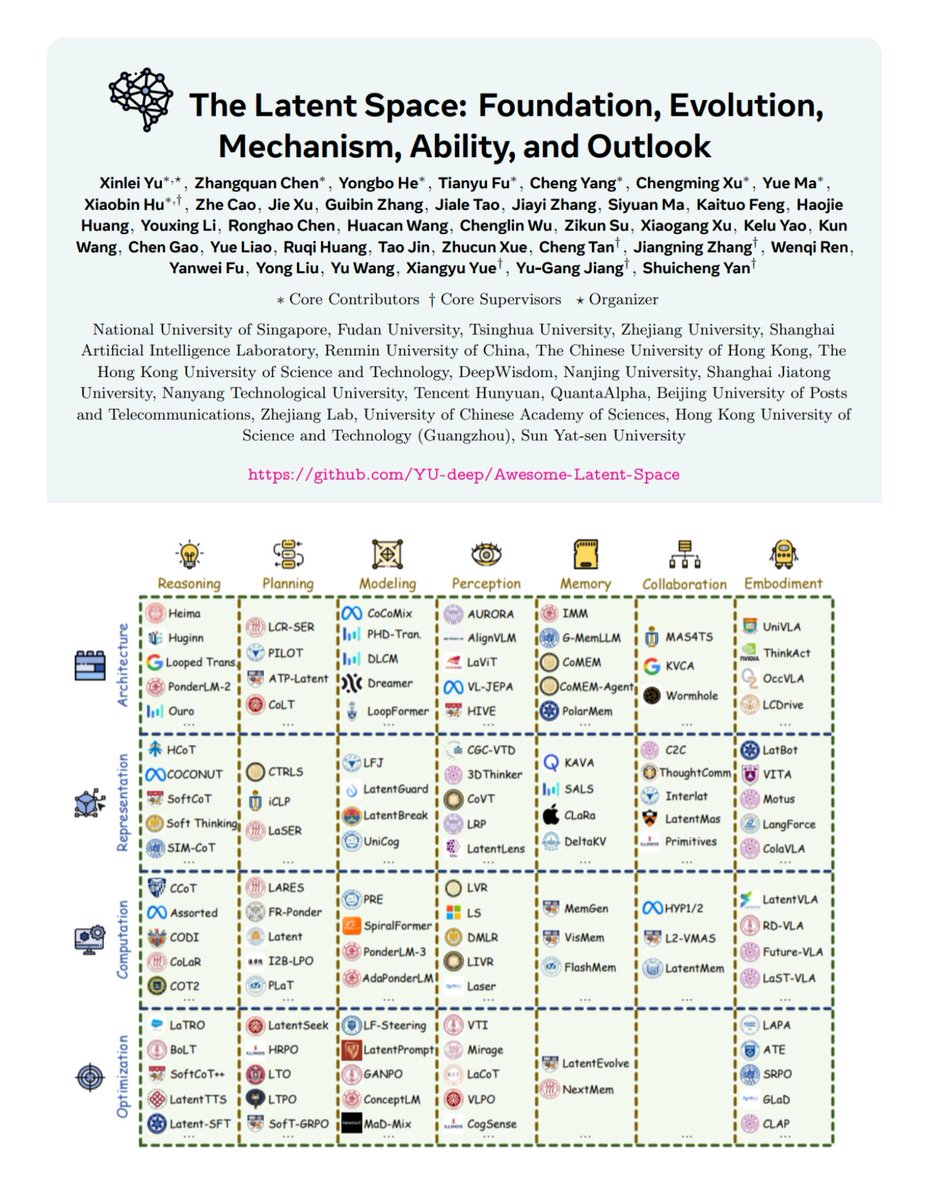
A must-read survey The Latent Space: Foundation, Evolution,
Mechanism, Ability, and Outlook
Shows how models are moving beyond tokens into continuous internal representations, covering:
- What latent space is (vs. text and visual spaces)
- Architecture and mechanisms
- Why it helps: less redundancy, no token limits, faster reasoning
- Evolution: early ideas → large-scale latent systems
- Abilities: reasoning, planning, perception, memory, collaboration, etc.
- Role in next-gen intelligence
The most mass-complete list of CS video courses on the internet.
cs-video-courses. 78K+ stars.
MIT. Stanford. Berkeley. Harvard. CMU. IIT. Princeton. Caltech.
All free. All video lectures. All in one repo.
Topics covered:
→ Data Structures and Algorithms
→ Operating Systems
→ Distributed Systems
→ Database Systems
→ Computer Networks
→ Machine Learning
→ Deep Learning
→ Natural Language Processing
→ Computer Vision
→ Computer Graphics
→ Security
→ Quantum Computing
→ Robotics
→ Blockchain
From beginner (CS 50) to advanced (6.824 Distributed Systems).
The curriculum is free. The commitment is yours.
GitHub link in comments.
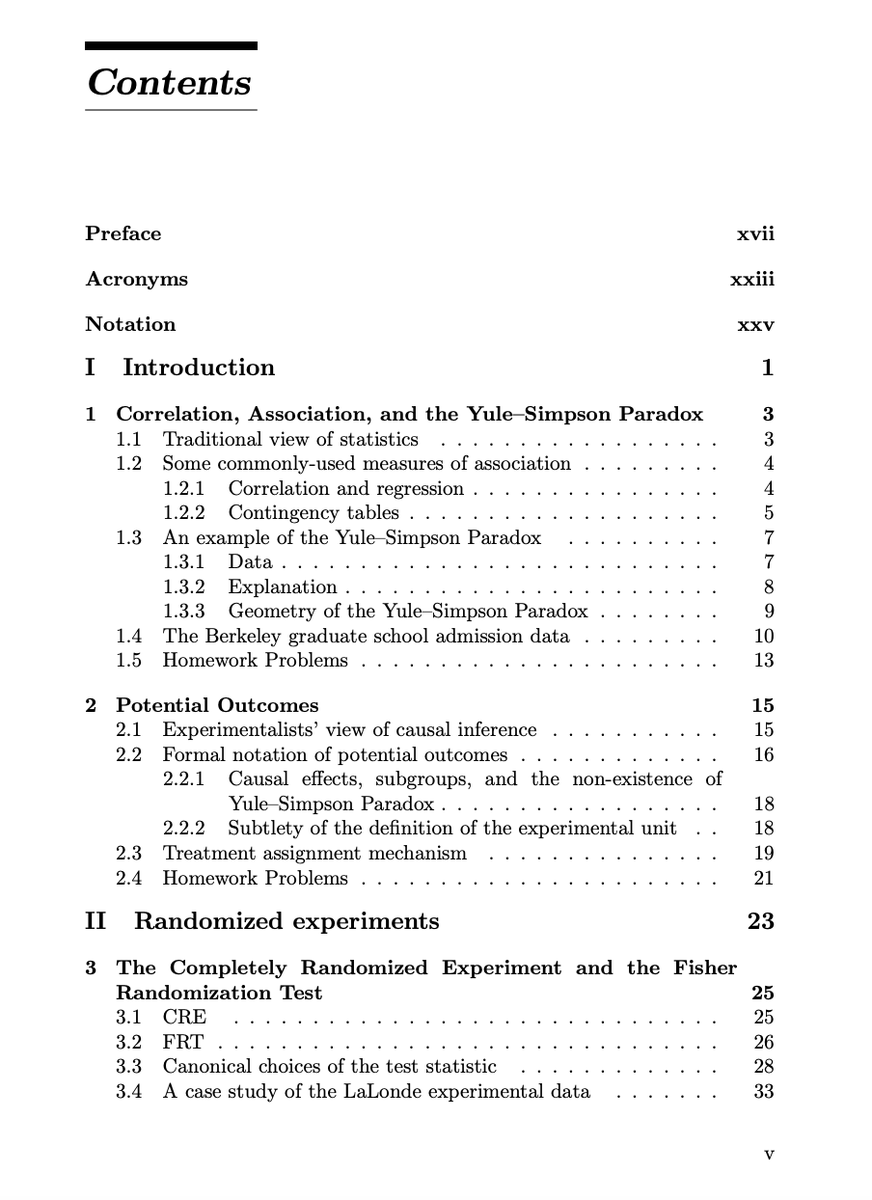
A First Course in Casual Inference by Peng Ding
PDF: https://t.co/FjmC3nBQ9G
So many guys nowadays are eager to learn state-of-the-art theory and methods in causal inference so that they are better equipped to solve problems from various fields.
This is a good book. It covers:
- Correlation, Association, and the Yule–Simpson Paradox
- Potential Outcomes and the Experimentalist's View
- Treatment Assignment Mechanisms
- Completely Randomized Experiments (CRE)
- Fisher Randomization Test (FRT)
- Canonical Choices of Test Statistics
- Basic Probability Theory and Statistical Inference (Prerequisites)
- Linear and Logistic Regressions
- Neyman's Potential Outcomes Notation








![IlirAliu_'s tweet photo. One professor at the University of Bonn quietly put his entire robotics curriculum on YouTube: SLAM. Sensor fusion. State estimation. Probabilistic robotics. Self-driving cars. Motion planning. Photogrammetry.
Cyrill Stachniss has been uploading full university lectures for years!
Each topic is a complete playlist; the kind of material that normally costs a semester of tuition.
He's one of the most cited researchers in mobile robotics and mapping. His students go on to build the navigation stacks powering real autonomous systems.
If you're serious about understanding how robots know where they are... this is the place to start.
Free. On YouTube.
📌 [https://t.co/INqnqzEBD7]
——
Weekly robotics and AI insights.
Subscribe free: https://t.co/9Nm01QUcw3](https://pbs.twimg.com/media/HKhIU75WYAAi0mF.jpg)