Believer. ED of Consumers Defense. Holds record for most Taylor Swift lyrics used in US Senate testimony. Rabid defender of pineapple-free pizza. Job 16:3
By continuing on the path of targeted digital regulations, Europe is ignoring the US-EU trade framework put in place by President Trump.
European tech firms are benefitting mightily from the ability to compete freely and fairly in US markets, while (at the exact same time) EU leaders/regulators are attacking American tech firms operating in their markets.
Shopping for my health insurance for my family for next year.
Cheapest PPO: $4,439/month. $16,000 deductible. 50% coinsurance after that.
That’s $53,000 a year in premiums for a bronze plan with a $16,000 deductible.
Thanks, Obamacare.
Permitting reform has officially passed the Senate and now heads to the House — a major win for American energy!
While not perfect, it's a step in the right direction for energy development and, as @SecretaryBurgum explains, “will actually lower the cost of energy in America.”
China isn’t just competing with American manufacturing. It has rigged the game. A new Select Committee bipartisan report examines how the CCP systematically built its manufacturing dominance at America's expense.
Looking at four industries —biomanufacturing, aerospace, semiconductors, and machine tools—the report exposes three key findings.
America must reindustrialize, rebuild its manufacturing capacity, and ensure we never depend on the CCP for the products and technologies critical to our economic and national security.
https://t.co/VNo0U8zU6E
Strong state financial officers are the frontline defense for your tax dollars.
In 2025 they protected ~$26 BILLION.
Minnesota’s experience shows what happens without them. SFOF CEO @OJOleka breaks it down with @SteveLanceNTD.
Excellent news from Florida!
@AGJamesUthmeier is taking action against @FirstStreet over its climate risk scoring scam that threatens American home values.
The final 2026 US budget is out…
One of the great political moves by the left in recent years has been convincing a large portion of America that we don’t already spend the vast majority of our money on healthcare and entitlement programs.
On my way to the office this morning, I passed a group of young people protesting, a Palestinian flag draped over their shoulders.
And I asked myself a question I can't shake: why does this generation always fall into the same trap? No matter the history. No matter the context. Even the ones from wealthy families, who went to the best schools, who were dealt every good card. Always the same trap.
I don't think it's stupidity. I think it's a mechanism. And a mechanism can be taken apart, piece by piece.
A. The observation: everything the state touches becomes unaffordable.
Look at economist Mark Perry's famous chart, the one people call "the chart of the century." It tracks US prices since 2000.
At the top, what explodes: hospital services, college tuition, textbooks, childcare, housing. Increases of +100%, +150%, up to +250%, far above general inflation.
At the bottom, what collapses: TVs, software, phones, toys, clothing. A TV today costs a fraction of what it did in 2000, for an infinitely better product.
Look at what separates the two groups. It isn't technology. It isn't complexity. It's one variable: how much the state is involved.
At the top, sectors that are subsidized, regulated, shielded from competition, where the state funds demand and blocks supply. At the bottom, sectors where companies fight every single morning to serve you better and cheaper.
B. The mechanism: why it's systematic.
When the state subsidizes demand without freeing supply, prices rise. Every time. Guaranteed student loans, and universities raise tuition. Housing aid plus blocked building permits, and rents skyrocket. Administered healthcare, and bureaucracy eats the budget before it ever reaches the patient.
In France it's even more vicious, because the price doesn't disappear: it hides. You never see the hospital bill, you pay it through payroll contributions. You never see the cost of school, you pay it through taxes. Public spending at 57% of GDP, one of the heaviest tax burdens in the world, more than €3.4 trillion in debt. And the result? Overflowing ERs, falling PISA scores, young people who can't afford to live in the city where they work.
The market didn't fail in these sectors. It was never allowed in.
C. Suffering demands a culprit.
A 22-year-old lives all of this in their bones. They can't find a place to live. Their degree either buries them in debt or opens no doors. The future feels blocked. That suffering is real, and I don't deny it for a second.
But human beings can't stand suffering without a culprit. They need a face. A scapegoat.
And this is where everything is decided: who taught them how to read the world?
D. Whoever tells the story picks the villain.
Schools are public. Universities are public. Culture runs on grants. Film goes through funding committees. Public broadcasting shapes the narratives. The people handing down the interpretive framework are, overwhelmingly, paid by the very system that creates the problem.
Do you really think that system is going to name itself as the culprit?
No. It names the capitalist. The boss. The landlord. "The rich." The multinational. The commercial West. Same role, same casting, every time.
E. One lens, a thousand causes.
And this brings me back to that flag. A generation taught to read every situation through a single lens, oppressor on one side, rich, Western, capitalist, oppressed on the other, will apply that lens everywhere. To housing. To climate. To conflicts on the other side of the world. The cause changes, the lens stays. That's why the trap is always the same: it's not the cause that draws them in, it's the way of thinking that was installed in them.
F. The perfect inversion.
Here's the irony. Capitalism is the force that drove down the price of almost everything it touched. The state is the force that blew up the price of almost everything it captured. And young people blame the first for the crimes of the second.
It's like blaming the firefighter for the fire because you saw him at the scene.
G. The ballot box confirms it.
In the US, a few weeks out from the midterms, a large share of urban young voters is getting ready to vote Democrat for more state, more spending, more regulation. New York elected a self-described socialist mayor, carried by young voters, on promises of rent freezes and city-run grocery stores. Rent freezes, the policy that has made housing scarcer everywhere it's been tried. The cure that worsens the disease.
In France, it's the same play in two acts. Part of the youth votes for the radical left, which promises more state. Another part votes for the center, which promises to "manage" the state well, and has dug the debt deeper than ever. Two different ballots, one shared assumption: the problem is the market, the solution is the state.
H. The way out.
These young people aren't stupid. They're right to be angry. They're just aiming at the wrong target.
The day they understand that their rent, their tuition and their hospital are expensive precisely because the state runs them, their anger will change direction. They'll stop protesting against those who create. They'll start protesting against those who capture.
That day, the greatest intellectual scam of our time will be over.
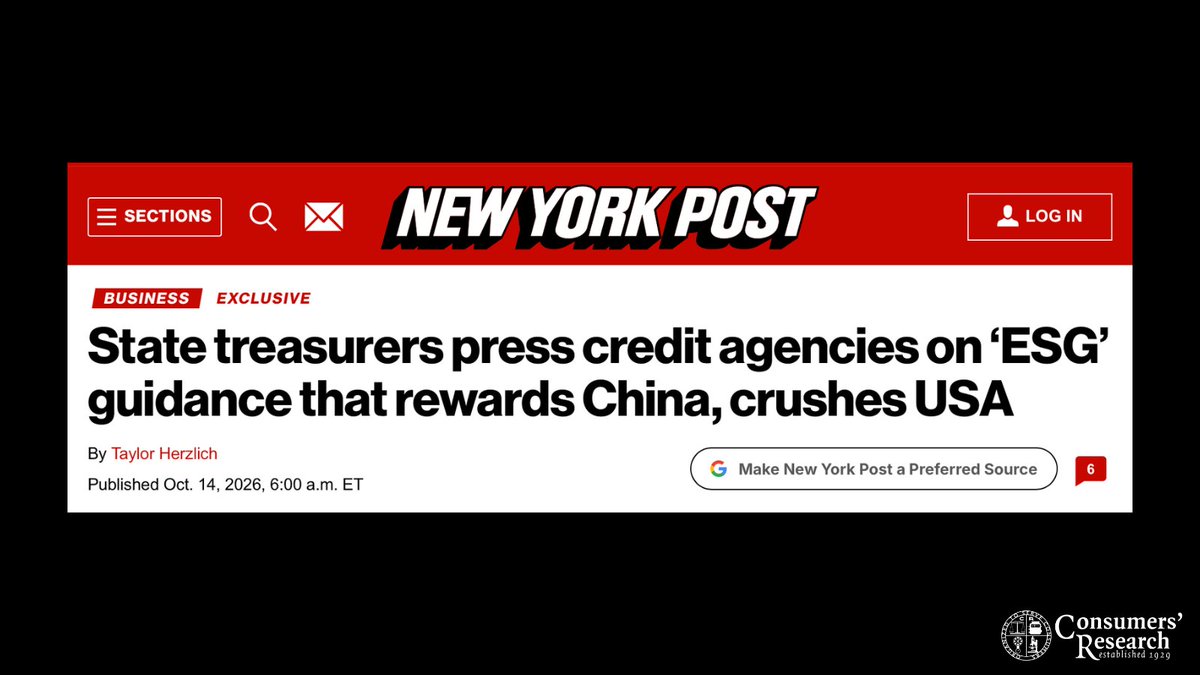
Credit rating agencies are still using ESG standards and discredited climate studies to assess and punish companies.
One example? US energy companies face downgrades while state-owned firms in China, the world’s largest polluter, keep higher ratings.
It’s ridiculous.
REPORT: 22 state financial officers are demanding answers from top credit rating agencies — including @MoodysRatings, @FitchRatings, and @SPGlobalRatings — on their continued use of discredited, woke ESG policies 👇
The state financial officers want to know specifically how rating agencies' continued use of these thoroughly discredited policies has influenced individual states' credit ratings, warning that continued use of these policies harms state financial interests, taxpayers and investors.
In their letter, the state financial officers highlight how these ESG policies rely on assumptions that have been repeatedly proven false. From assuming fossil fuel demand would rapidly decline to predicting that governments would universally impose tougher climate policies, the assumptions underlying discredited ESG policies have not materialized.
The state financial officers also highlight how use of these discredited policies in ratings has (and still is), in many cases, bizarrely led to higher ratings for Chinese businesses while simultaneously causing US companies to be downgraded.
The very fact that so-called 'ESG risk' resulted in some American companies getting downgraded while Chinese state-owned companies received high ratings should be enough to discredit this absurd metric permanently.
No credit rating agency should base scores on ESG, period.
@ConsumersFirst commends these state financial officers for being proactive in calling out these agencies for outrageous ESG practices.
BP CEO: “We have not been careful stewards of shareholder capital.”
BP's shareholders just got robbed of $4.5B. When the layoffs come, will it be the actuaries and management that justified the scam? It should be the board and executives that bought into #NetZero that should be FIRED!
@nashbacher@dandarling Obama got 70% of the vote against Allen Keys. Monday morning quarterbacking this 22 years later, but I say Ditka beats him heads up in 2004.