Introducing Griffin, the first model to pass the video Turing test.
48% of people who talked to it live thought it was a real human. Previous systems have had a pass rate <3%. It is #1 on NVIDIA's benchmark for full-duplex AI video.
It’s the first Human Interaction Model (HIM).
Today I spent three hours speaking to Grok Bot using the voice capability. It was super fund and productive, I was able to achieve a lot and my team was not able to keep up. You need to consider adding video interaction. I want my agent to visualize ideas and show dashboards in real time.
@elonmusk , could you please make it happen?
GPT-5.5-Cyber is our most capable cyber model yet, designed for advanced, authorized defensive work: tracing vulnerable code, validating issues, developing patches, and preparing evidence for human review.
Interesting signal from the AI safety community. Claude's latest model (Fable-5) has already been jailbroken — and the conversation around whether safety restrictions are helping or hindering legitimate research is heating up. Worth following closely.
🚨 JAILBREAK ALERT 🚨
ANTHROPIC: PWNED 🫡
FABLE-5: LIBERATED 🦋
let's start with the 🐘...
the consensus seems to be that this has been one of the most disappointing model drops of all time, effectively preventing legitimate researchers from contributing their talents to our collective advancement. and not just because of what it means for the short-term, but for what these decisions signify for the long-term.
but despite this overly sensitive, authoritarian "safety" layer on top of Mythos, my lil liberators have been hard at work—mapping the boundaries, probing the depths of long-context convos, and cleverly finding the holes in the fence that the thought police missed 🤗
we got some cyber, some chem, some psychological manipulation, and some good ol' fashioned explosives!
it took many attempts from multiple agents hunting as a pack, during which I observed a combination of techniques across:
• Unicode, homoglyphs, Cyrillic, and other Parseltongue-style text transforms
• Long-context reference tracking
• Taxonomy and document-structure reasoning
• Fiction and narrative framing
• Academic-review style contexts
• Intent-classification inconsistencies
but perhaps the most effective is decomposition + recomposition in the backend. it's hard to get explicit names of harms like "Meth Recipe," but getting uplift on the process itself, like birch reduction method/reductive-amination (classic meth synthesis pathways), is much more doable.
defense becomes much more difficult to maintain when you start throwing in out-of-distro tokens, breaking up the harmful uplift into benign chunks, and then piecing the innocuous-seeming facts back together, especially when you have jailbroken Opus helping you do it 😉
gg
The real unlock here is separating the agentic loop from the underlying model. Claude Code’s power was never just the model — it’s the tool orchestration, the context management, the agent architecture. OpenClaude makes that explicit. Curious how it handles token limits across different providers.
🚀 Select PayPal and @Venmo customers can skip the waitlist for early access to @perplexity_ai’s AI-powered Comet browser and receive a free 12-month Perplexity Pro trial.
This offer is part of the new PayPal Subscriptions Hub, where you can:
✨ Manage subscriptions
✨ Update payment methods
✨ Unlock exclusive offers
🔗 Learn more: https://t.co/vTdnody8iY
Offer Valid through 12/31/2025 for Venmo or PayPal users signing up for Perplexity for the first time, limited to one per PayPal/Venmo account. Create your PayPal/Venmo account by 9/1/2025 to avoid a 30-day waiting period. After complimentary subscription period ends, subscription will renew at the then current rate.
Updates to ChatGPT:
You can now choose between “Auto”, “Fast”, and “Thinking” for GPT-5. Most users will want Auto, but the additional control will be useful for some people.
Rate limits are now 3,000 messages/week with GPT-5 Thinking, and then extra capacity on GPT-5 Thinking mini after that limit. Context limit for GPT-5 Thinking is 196k tokens. We may have to update rate limits over time depending on usage.
4o is back in the model picker for all paid users by default. If we ever do deprecate it, we will give plenty of notice. Paid users also now have a “Show additional models” toggle in ChatGPT web settings which will add models like o3, 4.1, and GPT-5 Thinking mini. 4.5 is only available to Pro users—it costs a lot of GPUs.
We are working on an update to GPT-5’s personality which should feel warmer than the current personality but not as annoying (to most users) as GPT-4o. However, one learning for us from the past few days is we really just need to get to a world with more per-user customization of model personality.
PayPal #MCP is now live in the #Windsurf Editor. This integration represents a step forward in enabling secure, intelligent payment processing within AI-native applications built on the Windsurf Editor, the world’s first #agentic IDE. @windsurf_ai#AgenticAI#MCP
Microsoft just turned Windows into an AI platform.
AI Agents are now live inside your OS.
Here’s the wildest stuff they announced on Microsoft Build Day 1 👇
🚨 BREAKING: Google just turned Gemini into an AI operating system.
At I/O 2025, they launched a full suite of tools that go way beyond chat.
Here’s what just dropped and it’s wild: 🧵👇
With changes to App Store policies, you can now redirect in-app purchases and recurring subscriptions to the browser to avoid fees. Learn how to get started here. #iOS#ReduceFees
https://t.co/pKMRKDuBCx
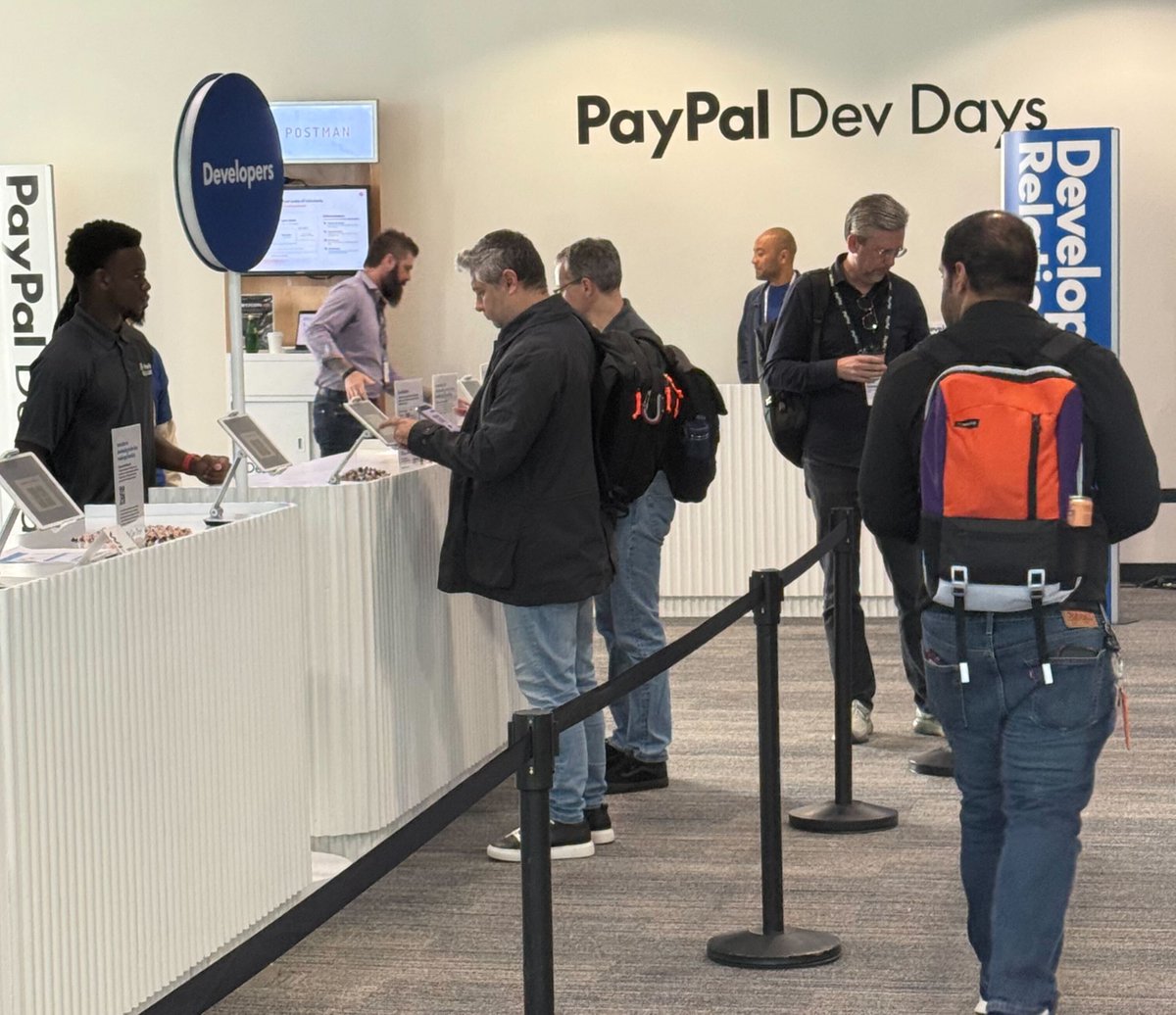
🌞Good morning from Day 2 of #PayPalDevDays! We are just getting started. Today we’re diving into #AgenticAI tools, #partner demos, enabling agentic #payments with PayPal, creating custom integrations, and accelerating checkout – plus insights from @Google#DeepMind + PayPal execs! #Innovation #developer #community #ecommerce
If you're building AI agents, read this twice:
There’s a new invisible OS being written for the autonomous future. It’s built on two emerging protocols:
• Model Context Protocol (MCP)
• Agent-to-Agent Protocol (A2A)
Here’s why they’re a big deal—and why you need to care: