Some people borrow your money
and don’t return it on time. No message. No update, unless you ask, and they feel no bad about it.
And then there are people who feel awkward even asking for their own money back.
Strange contrast! One feels no discomfort owing money. The other feels guilt demanding what’s theirs. Psychology is funny like that: shamelessness comes from low conscience, while hesitation comes from too much of it.
Excessively conscientious people are genuinely good people. They have strong inner morality, empathy, and a deep sense of responsibility. They don’t need supervision to do the right thing. In a high-trust society, such people become the backbone of social order.
But in a low-trust society like ours, the same traits turn into vulnerabilities. When others operate with entitlement, weak accountability, and opportunism, morality becomes asymmetrical: one side carries guilt, the other carries none. As a result, goodness gets exploited.
Moral: Being kind with the kind is important, but being shameless with the shameless is even more important. Empathy without boundaries is an open invitation to exploitation.
A quantity called the Hausdorff dimension describes how concentrated sets of points are, even when they aren’t easily described as shapes. This curve is in a sense “bigger” than a line, but smaller than a 2D object. Its Hausdorff dimension is about 1.26. https://t.co/lTM5OFFqfy
In this thread, I'll introduce the revolutionary work of Dr. Pierre-Marie Robitaille.
This will be an ongoing thread to repost his content from his YouTube channel (SkyScholar)
His work is dedicated to new ideas about the nature of the sun, metallic hydrogen, thermodynamics, and the microwave background.
He discusses astronomy, physics, chemistry, and topics relating to imaging.
We hope that the combination of searchable facts and visuals will aid in learning even the toughest concepts in astronomy.
(And even challenge some well established models while offering brand new alternatives.)
Pierre-Marie Robitaille, Ph.D., is a Professor of Radiology at The Ohio State University. He also holds an appointment in the Chemical Physics Program.
In 1998, he led the design and assembly of the world’s first Ultra High Field MRI System. This brought on the need to question fundamental aspects of thermal physics, including ideas related to Kirchhoff’s Law of thermal emission... and more.
This video is from April 28, 2017.
Links to articles cited in this presentation: Robitaille P.-M. A Thermodynamic History of the Solar Constitution — I: The Journey to a Gaseous Sun. Progr. Phys., 2011, 7(3), 3-25. https://t.co/RznZcQNPjG
Robitaille P.-M. A Thermodynamic History of the Solar Constitution — II: The Theory of a Gaseous Sun and Jeans' Failed Liquid Alternative. Progr. Phys., 2011, 7(3), 41-59. https://t.co/QwAc7fiU17
Over 60 Papers by Dr. Pierre Robitaille:
https://t.co/nCDUjMK1lE
Incredible optical illusion demonstrates that when objects are removed from peripheral vision, the brain perceives a slower pace of motion
📹 Akiyoshi Kitaoka
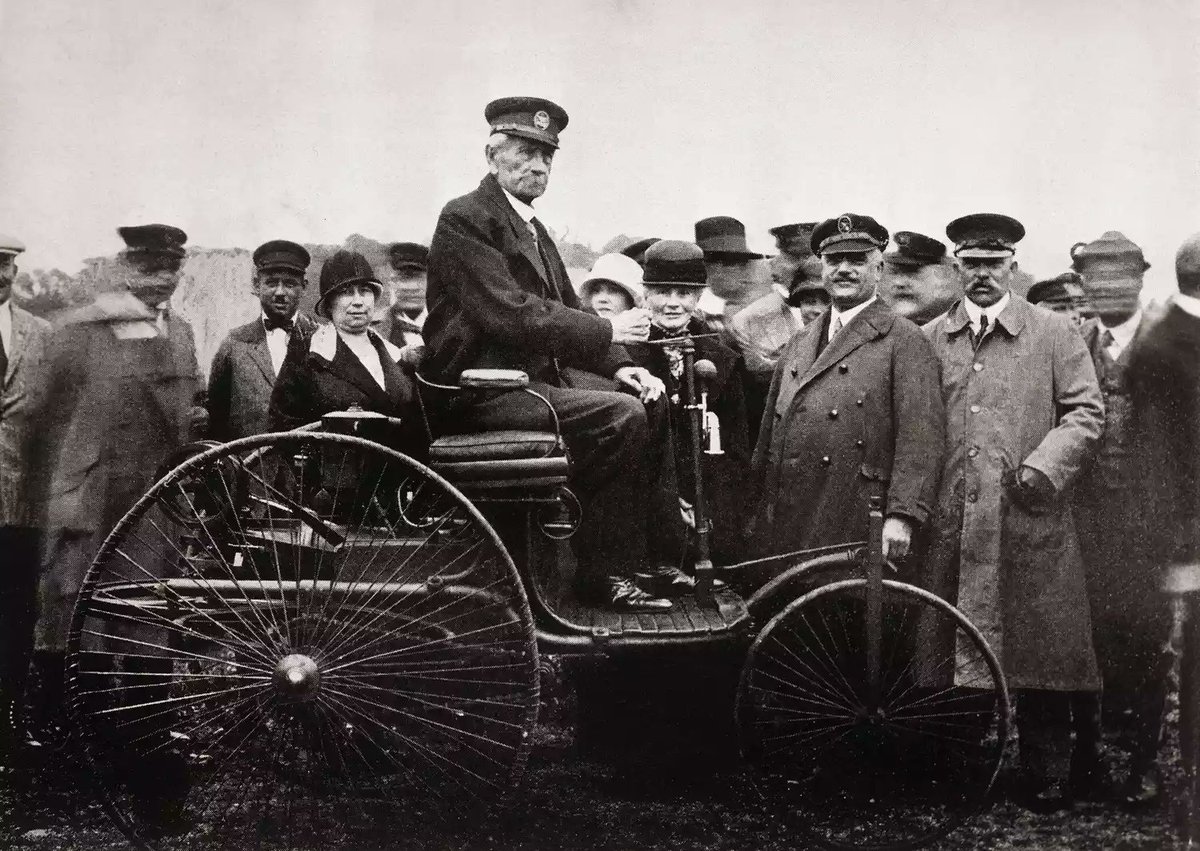
The world's first automobile created and driven by Karl Benz was the Benz Patent-Motorwagen, a three-wheeled vehicle powered by a four-stroke gasoline engine. Benz designed and built the engine and the chassis for the car, which he patented in 1886. He also invented many parts of the car, such as the spark plug, the carburetor, the clutch, the radiator, and the gear shift. The car had a top speed of about 8 miles per hour and could seat one driver and two passengers.
Benz first tested his car in public on July 3, 1886, in Mannheim, Germany. He started selling his car to the public in the same year, making it the first commercially available automobile in history. One of his first customers was Emile Roger, a bicycle maker from Paris, who became his agent in France. Benz also received the first driver's license in the world from the Grand Duke of Baden in 1888. The most famous trip made by the Benz Patent-Motorwagen was by Benz's wife, Bertha, who drove it from Mannheim to Pforzheim, a distance of about 66 miles, in August 1888. She did this without her husband's knowledge, to prove that the car was reliable and practical for long-distance travel. She also had to overcome some challenges along the way, such as refueling at pharmacies, repairing a broken chain with a hairpin, and using a shoemaker's leather to fix a brake. Her trip attracted public attention and helped promote Benz's car as a useful invention.
Benz continued to improve his car and produced several models with different features and designs. He also built some racing cars that competed in various events. In 1893, he made his first four-wheeled car, which had a more powerful engine and a steering wheel instead of a tiller. In 1900, Benz & Company became the world's largest manufacturer of automobiles, producing about 600 cars per year.
In 1926, Benz merged his company with Daimler-Motoren-Gesellschaft, which was founded by another German engineer, Gottlieb Daimler. The new company was called Daimler-Benz and produced cars under the brand name Mercedes-Benz. Benz retired from the company in 1906 and started another one with his sons, called C. Benz Söhne (C. Benz Sons). He died in 1929 at the age of 84.
The Benz Patent-Motorwagen is widely regarded as the world's first practical modern automobile and a milestone in the history of transportation. It is now preserved in several museums around the world, such as the Deutsches Museum in Munich and the Science Museum in London.
📷Bettmann Archive/Getty Images
These flamingos are feeding their chick a type of milk called crop milk
both parents have special cells to produce milk in their crop (part of their throat)
red, because it’s densely packed with dietary carotenoids
The Psychology of Tyranny and banality of evil.
“…individuals lose their capacity for intellectual and moral judgment in groups….there is an inevitable impetus for people to act tyrannically once they are put in groups and given power”. https://t.co/Ig3rR0AGrg